


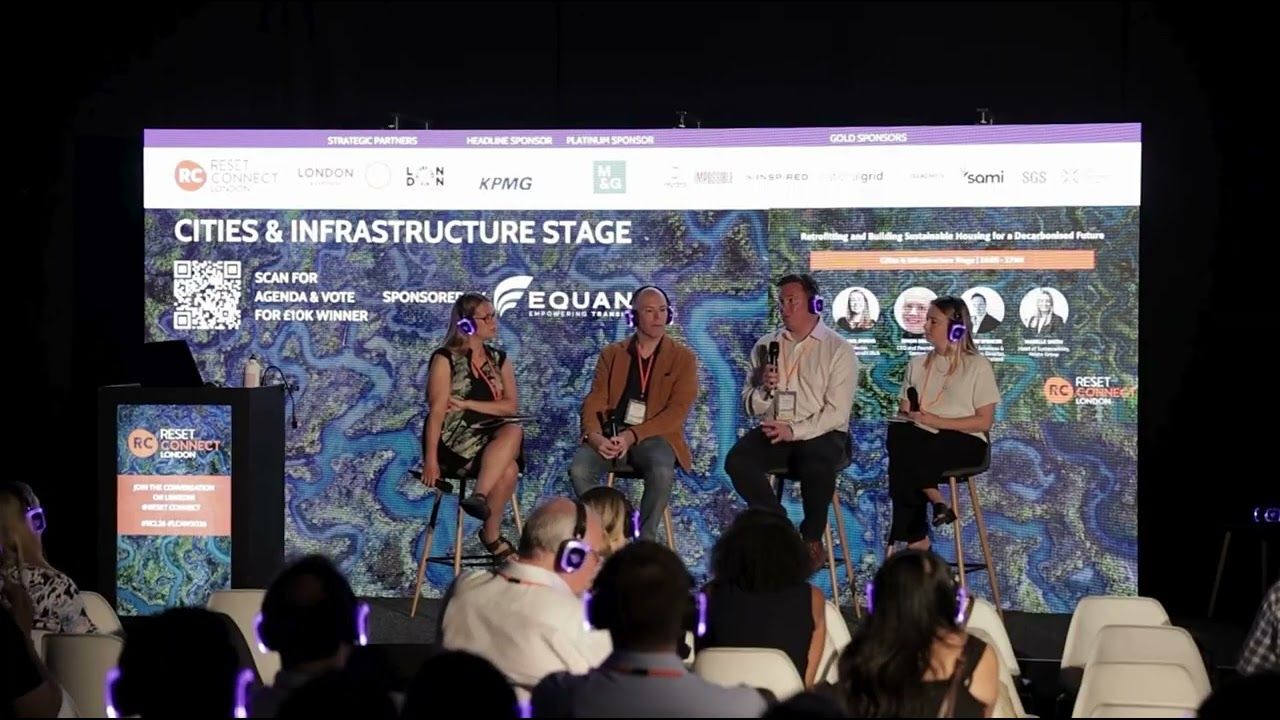
Retrofitting and Building Sustainable Housing for a Decarbonised Future
“It's a systems issue.”
Andrew Spencer, Strategic Solutions & Partnerships Director, Equans UK & Ireland
Home | Blog | Retrofitting and Building Sustainable Housing for a Decarbonised Future
Event: Reset Connect London 2026
Date: Tuesday 23 June 2026
Time: 16:00–17:00
Stage: Cities & Infrastructure Stage
Moderator: Rachael Owens, Co-Director, National Retrofit Hub
Speakers: Simon Bones, CEO and Founder, Genous; Andrew Spencer, Strategic Solutions & Partnerships Director, Equans UK & Ireland; Isabelle Smith, Head of Sustainability, Atrato Group
Estimated read time: 9 minutes
Quick Read Summary
A successful retrofit pilot does not automatically become a programme. Someone still has to approve the next budget, organise a dependable pipeline of work and persuade residents that the disruption will be worthwhile. At Reset Connect London 2026, Rachael Owens of the National Retrofit Hub brought those delivery questions to a panel working across household retrofit, contracting and property investment.
Simon Bones of Genous discussed the advice and borrowing options that homeowners need before they can act. Andrew Spencer of Equans argued for portfolio and neighbourhood approaches that connect finance with delivery capacity. Isabelle Smith of Atrato explained how an EPC upgrade pilot secured board support and became a funded programme for specialised supported housing.
The discussion connected the business case with the experience of living in a home. Lower bills, comfort, health and protection from future climate risks all mattered. So did the practical choices that determine whether an upgrade performs well and earns the confidence of the next resident considering it.
The Gap Between a Policy Ambition and a Deliverable Programme
Spencer framed retrofit as a coordination problem. “It's a systems issue.” Equipment is only part of the task: finance, a reliable workload and the organisations responsible for delivery have to fit together. A succession of separate funding rounds can leave contractors uncertain about what comes next, making investment in people and capacity harder to justify.
He argued for moving beyond individual projects towards portfolios of work. Energy-as-a-service and heat-as-a-service models were among the routes he identified for bringing private capital into schemes. He did not suggest that a commercial model alone would solve the problem. Without demand, a delivery structure and cooperation between organisations, the programme would still struggle to scale.
Smith described the same need for certainty from an investor's perspective. Long-term property commitments require plans that can survive changes in funding assumptions. Her account of Atrato's EPC upgrade programme showed why the route from policy to delivery runs through an organisation's investment decisions and budget process.
For housing owners and delivery partners, the implication is to plan the next phase alongside the first. A pilot needs a credible route to a wider programme, with responsibilities, funding and delivery capacity considered before the initial work ends.
A Pilot Needs a Budget and People Who Can Authorise the Next Step
Smith offered a concrete account of how that transition happened. An initial EPC upgrade pilot was followed by board support and a formal allocation of more than £2 million. The programme sat within a wider sustainable homes strategy and was intended to improve comfort for residents as well as contribute to emissions reduction.
The proposal grew through collaboration with investment and asset management teams. Staff inspecting properties and working with registered providers and care providers helped establish what needed to change. A sustainability and impact committee provided a route into board governance. This gave the proposal a connection to the people managing the assets and the people approving expenditure.
Smith said that 38 properties improved their EPC ratings in 2025 and described a target to complete the programme's upgrades by 2028. These were her reported results and plans, rather than an independent evaluation of the programme. She also stressed the value of being able to show progress to investors, the board and the organisations involved in residents' care.
The lesson for an organisation trying to move beyond a pilot is practical: evidence from the first properties must reach the teams who control the next decision. A technically successful installation cannot secure a programme budget on its own.
An Attractive Saving Still Needs an Affordable Route to Payment
Bones focused on homeowners arranging and paying for their own upgrades. They may be interested in reducing bills without knowing which measures suit their property, who can install them or how to borrow the money. Advice and finance are connected barriers: a resident cannot assess a loan sensibly without understanding what the proposed work is meant to achieve.
He used around £20,000 as an indicative cost for a package involving a heat pump, solar and a battery, while acknowledging that costs vary. It was an illustration of the upfront hurdle, rather than a price for every home. A household may see a case for the investment and still lack the cash to proceed.
Bones argued that mortgage lenders could play a larger role. His comparison between lower-cost mortgage borrowing and a more expensive personal loan illustrated how the cost of finance can change the decision, even when the proposed upgrade stays the same. The discussion did not establish a universal return or recommend a particular borrowing product.
He also argued for advice that can reach more people through digital tools, with further support where needed. The challenge for providers is to make the decision understandable at the point when a homeowner is considering it. Project cost, borrowing cost, expected savings and the assumptions behind those savings need to be visible together.
The Business Case Depends on the Property and the Installation
Bones cautioned against treating retrofit as a standard shopping list. The appropriate combination of measures depends on the property, the owner and what they want to achieve. He described the importance of solar panel numbers, battery size, heat pump sizing and operating temperatures in determining whether an installation makes financial sense.
That detail mattered to the discussion of public confidence. Near the end of the session, he acknowledged that poor installations can produce the negative experiences people hear about. Specifying and installing a system well is therefore part of earning trust, alongside explaining its benefits.
Spencer widened the business case beyond the individual property. He argued that neighbourhood programmes can connect home improvements with local employment, health and energy security. Those benefits may involve different organisations and budgets, so recognising them requires a wider view of who pays and who gains.
A credible proposal should distinguish the benefits expected from a particular installation from wider benefits that need separate evidence. For commissioning teams, the task is to make the assumptions checkable and keep responsibility for performance clear. A compelling sales story cannot compensate for a system that fails to work well in the home.
Residents Need a Reason to Participate and a Voice in the Work
Spencer's example from Dudley showed how engagement can change a programme. He described using a show home so people could experience the proposed improvements, rather than relying only on a technical explanation. Local voices helped make the conversation familiar. Community interest in green space and active travel also influenced the scope of the scheme.
Owens connected that example with the National Retrofit Hub's work on place-based approaches. Understanding the local building stock is one part of a strategy; understanding the organisations and relationships already present is another. She also highlighted the pressure on local authority staff whose commitment may exceed the capacity available to them.
Smith described a different engagement challenge in specialised supported housing. Residents may have physical or mental care needs, so reducing disruption affects which properties are upgraded first and how work is organised. Working with registered providers and care providers can identify appropriate opportunities, including periods when a property is empty.
“We want our residents to have warm, comfortable homes for the long term,” she said. That objective requires more than obtaining access for an installation. The practical conditions of a person's life have to inform the sequence and delivery of the work. For programme teams, engagement needs time and resources in the plan, alongside the technical measures.
An EPC Upgrade Is One Part of a Home That Works for Its Residents
Smith placed EPC improvements within a broader strategy that also considers green space and climate risks. On a hot day at the event, she pointed out that residents might want a cool home rather than a warmer one. Her team was using technology to assess exposure to risks including extreme heat and flooding across the portfolio.
The distinction matters because an energy rating cannot describe every aspect of a home's suitability. A programme aimed at better winter performance still needs to consider how the property will function in other conditions. Smith's account connected the upgrade target with wider decisions about the long-term quality of the housing.
The audience discussion returned to the workforce needed to deliver that quality. Spencer linked investment in training with a dependable pipeline of work. Bones emphasised that people considering a career need confidence in the sector's future. Owens described opportunities to introduce children to building systems through work in schools.
The panel closed by returning to communication. Spencer called for better storytelling and more empathy towards people who are unconvinced. Good experiences can help people understand the benefits, but those experiences first have to be delivered. The commercial case for scale rests partly on that connection: dependable work creates evidence that the next household, investor or delivery partner can assess.
Practical Application
For housing owners, local authorities and retrofit providers, the discussion suggests a way to test whether an initiative is ready to grow.
Questions to ask
- Who can authorise the next phase, and what evidence will they need from the pilot?
- Can residents understand the work, its disruption and its expected benefits before deciding?
- How do upfront costs, borrowing costs and operating assumptions affect the proposal for this property?
Signals to watch
- A funded programme of work that gives delivery partners enough certainty to plan capacity
- Asset managers, investment teams and resident-facing organisations shaping the same proposal
- Measures of progress that extend from installations completed to performance and resident experience
Traps to avoid
- Assuming an EPC improvement answers every question about comfort, overheating or future climate risk
- Presenting a supplier's indicative savings or return as a guarantee for every household
- Treating engagement and quality assurance as tasks to add after the programme is designed
A useful next step is to take one proposed portfolio and map who makes each decision, how residents will be supported and which results must be demonstrated before further funding is committed.
Key Takeaways
- Retrofit needs finance, delivery capacity and demand to develop together.
- Atrato's example connected a pilot with board governance, asset management and a dedicated programme budget.
- A homeowner can understand the benefits and still lack an affordable way to pay for the work.
- Design and installation choices affect performance, costs and public confidence.
- Local relationships and residents' care needs should influence how work is delivered.
- Energy ratings belong within a wider assessment of comfortable, resilient homes.
Final Thoughts
The panel's most useful examples explained how an upgrade becomes a decision that someone can act on. For an investor, that may mean a proposal with board support and a clear place in an asset strategy. For a homeowner, it may mean advice and finance that make the costs understandable. For a resident receiving work, it may mean confidence that their needs and daily life will be respected.
Those decisions are linked. A pipeline depends on participation, participation depends partly on trust, and trust depends on installations that deliver a good experience. Scaling housing retrofit means building those connections into the programme from the outset and showing, through the next phase of work, that they hold.
Speakers
Rachael Owens, Co-Director, National Retrofit Hub (moderator). Rachael leads collaborative work to overcome barriers to retrofit at scale. In this session she connected delivery with residents' health, comfort and the organisations working in their communities.
Simon Bones, CEO and Founder, Genous. Simon founded Genous in 2022 after a career in strategy consulting. His background includes climate science research and practical experience of retrofitting homes. His work focuses on helping property owners understand and deliver appropriate upgrades.
Andrew Spencer, Strategic Solutions & Partnerships Director, Equans UK & Ireland. Andrew works across strategy, innovation and delivery in retrofit, heat, power and place-based decarbonisation. His session contribution focused on finance, collaboration and the conditions needed to create delivery capacity.
Isabelle Smith, Head of Sustainability, Atrato Group. Isabelle oversees sustainability strategy across Atrato and its managed funds. Her contribution described the EPC upgrade programme for specialised supported housing and its connection with investment decisions, resident needs and wider climate risks.
Watch Full Session