


Rethinking Regional Energy Building a Resilient UK
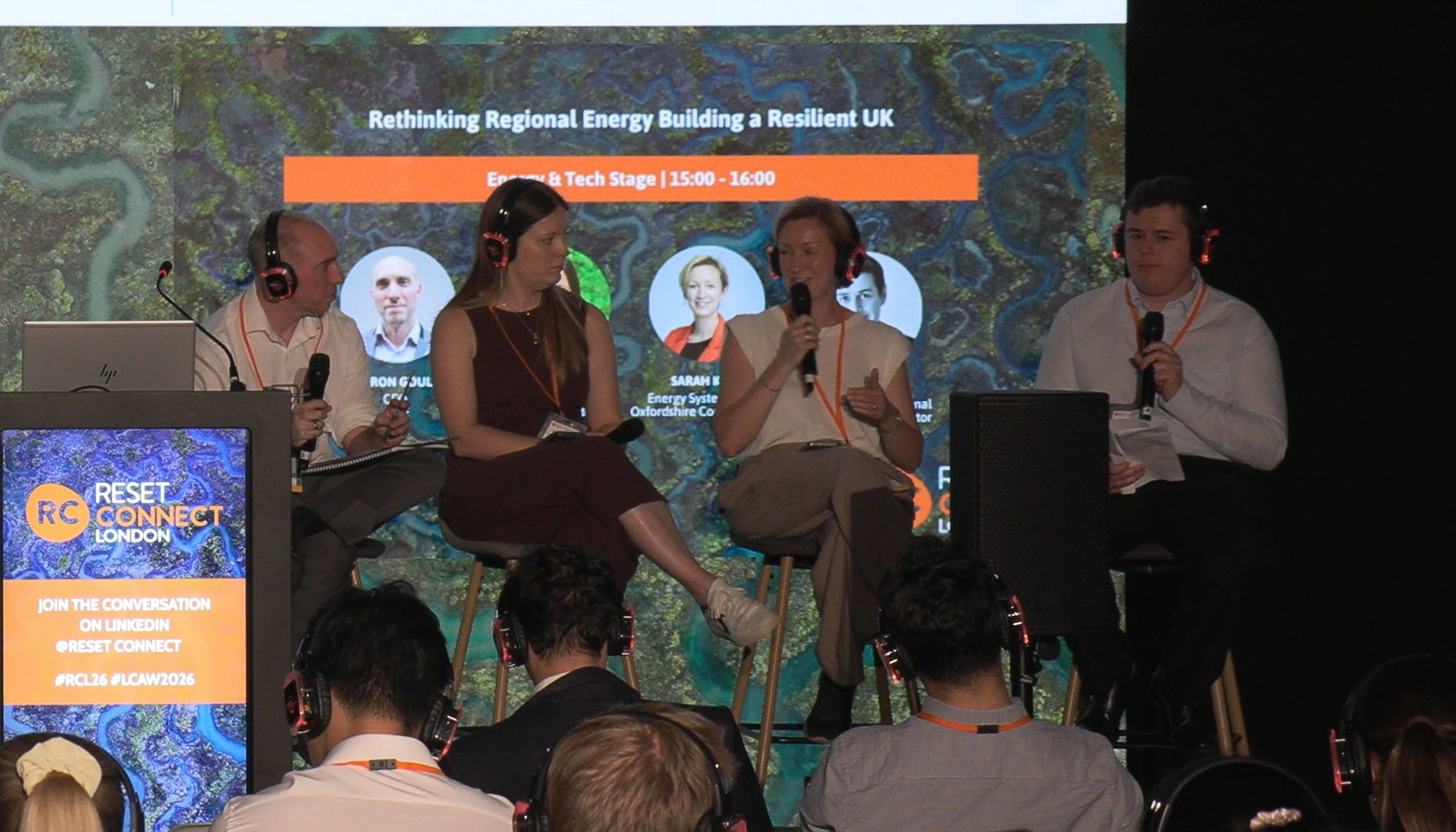
“The energy transition isn't about technology. It's about governance.”
Sarah Kerr, Energy Systems Lead, Oxfordshire County Council
Home | Blog | Rethinking Regional Energy Building a Resilient UK
Event: Reset Connect London 2026
Date: Tuesday 23 June 2026
Time: 15:00–16:00
Stage: Energy & Tech Stage
Moderator: Aaron Gould, Interim CEO, ADE
Speakers: Susie Leppard, Renewables and Energy Margins Director, OVO; Sarah Kerr, Energy Systems Lead, Oxfordshire County Council; Sam Tickle, Regional Energy Strategic Planning (RESP) Manager – Policy, Governance and Regulation, National Energy System Operator (NESO)
Estimated read time: 8 minutes
Quick Read Summary
A housing development needs electricity. The sewage treatment works serving it needs electricity too. If the two sit in the wrong order in the connections queue, a plan for new homes can stall before construction begins.
That example from Oxfordshire County Council's Sarah Kerr set the tone for a discussion about what regional energy planning has to achieve in practice. Moderated by Aaron Gould of ADE, the panel brought together Kerr, OVO's Susie Leppard and NESO's Sam Tickle to examine the relationship between national energy decisions and the places expected to deliver them.
The discussion connected three problems: coordination across organisations, the capacity of local authorities to participate, and commercial arrangements that make projects investable. The test running through each was whether a plan changes what can actually be built, funded and used.
Start with the Infrastructure a Place Needs
Kerr described how electricity constraints can reach beyond an individual connection application. Housing and the infrastructure supporting it depend on each other. Treating them as separate requests can obscure the order in which capacity is needed.
Her account of bringing developers, network operators and other stakeholders together made governance a practical issue. The task was to work through a shared dependency that no single organisation could resolve on its own. Her opening remark about technology and governance challenged the assumption that selecting equipment is enough to deliver a transition.
For councils and developers, the implication is to identify those dependencies early. A local growth plan needs to explain which services must be available, where they are required and how their delivery relates to the network. An energy plan becomes more useful when it helps those organisations make decisions together.
Tickle approached the same problem from NESO's perspective. He described regional planning as a way to bring local needs into a coordinated view of the energy system. That involves reconciling national objectives with regional ambitions, rather than assuming one automatically translates into the other.
Give Local Government the Capacity to Deliver
An invitation to contribute is not the same as the ability to participate. Kerr described the pressure on councils to engage with energy planning while working within constrained resources and competing priorities. Dedicated energy-system expertise, she said, was not available in every authority.
She wanted local government to be recognised as a delivery partner, with the support to perform that role. Councils bring knowledge of housing, transport, services and communities. Losing that knowledge from the process risks producing a technically coherent plan that does not respond well to the place it serves.
Tickle acknowledged the difference between creating a space for participation and removing the barriers to using it. He described local actor support as part of RESP's approach to helping organisations that are less familiar with energy planning engage with the process.
For programme teams, this raises a question before consultation starts: who has the time, information and authority to contribute? Attendance alone cannot establish that a region's needs are represented. Support for gathering evidence, understanding proposals and feeding decisions back into councils is part of making engagement work.
Build Governance That Survives Beyond One Plan
Oxfordshire's approach offered a concrete example. Kerr described a governance structure developed for local area energy planning that brought councils, network organisations and other partners into the same programme. Low Carbon Hub helped connect the work with the area's community energy sector.
The structure was being used for wider discussions about regional energy planning and heat networks. That mattered because the same local organisations were responding to several initiatives whose national responsibilities sat in different places. A shared forum gave them a way to examine the connections instead of managing each programme in isolation.
Kerr also emphasised involving planners and senior colleagues. Energy planning needed to become an organisational priority, rather than rely on one specialist joining every meeting and translating every request. The practical value lay in who could make decisions and carry them into the rest of the organisation.
Tickle saw opportunities for heat network zoning and RESP to learn from one another. He described cooperation between NESO and government as important to bringing those processes together. He did not present regional planning as a single solution to every delivery problem. Its contribution was to coordinate decisions within a wider set of responsibilities.
Make the Commercial Model Work for Smaller Projects
Leppard drew a distinction between the financing options available to larger renewable developments and the difficulties facing smaller, community-led projects. Long-term revenue arrangements can help a project secure investment, but smaller schemes may struggle to obtain an offer that meets their needs.
She identified two recurring requests from developers: greater certainty about future prices and a workable way to supply or share value with their local community. OVO's Extra Investment PPA was one commercial response she described. A power purchase agreement can provide a route to market; the details of the contract still determine how much certainty it offers.
Leppard pointed to North Ayrshire Council's solar projects on former landfill sites as an example of local authority generation linked to an OVO power purchase agreement. Her interest was in how models like this could become easier to repeat, rather than depend on exceptional persistence in each location.
She also warned against assuming local supply is automatically cheaper. The financial value of matching nearby generation and demand needs to be demonstrated, and the market arrangements must allow that value to be shared. Geographic proximity alone is not a business case.
Translate Network Investment into Local Outcomes
A plan written around network infrastructure can be difficult to use in a council meeting about a town centre, village or housing site. Kerr wanted a clearer translation between energy-system geography and the places where local decisions are made.
She described the difficulty of explaining what had changed after councils supplied data and engaged with network planning. A list of interventions around a grid supply point does not necessarily tell a local decision-maker what will happen in their community, or when.
Tickle argued that credible network planning remains essential. Investment needs a sufficiently clear direction for networks and the regulator to act with confidence. Regional planning therefore has to connect local priorities with the evidence used to justify infrastructure investment.
These are complementary tests. Network organisations need a case for reinforcement; councils need to understand what that reinforcement enables. A useful programme should make both visible, with a clear account of how local evidence affects decisions and how those decisions support delivery in specific places.
Treat the Evidence Base as the Start of Delivery
In the closing discussion, the panel considered whether regional planning reduced the need for local area energy plans. Gould argued that local plans remained valuable because they could provide detail, evidence and working relationships at a scale regional plans would not reproduce.
Kerr described Oxfordshire's evidence base as a starting point. The next step was to use it to develop a project pipeline and investment strategy, reducing the gap between completing a plan and delivering its priorities. Strategic direction also gave council decision-makers a basis for considering unfamiliar proposals and deciding where to focus.
Leppard returned to the people paying for the transition. Public support, in her view, depends on benefits that consumers can recognise while change is taking place. She connected the investment discussion with the need for stable policy and consistent signals between national arrangements and local markets.
Together, these contributions suggested a more demanding definition of success. A completed model or published plan is an output. Delivery requires decisions, viable projects, responsible organisations and a route to benefits that people can see. Those should be considered while the plan is being developed, rather than left for a later phase.
Practical Application, How to Turn Regional Energy Plans Into Delivery
For councils, networks, developers and community energy organisations, the discussion offers a way to test whether a planning exercise is ready to support delivery.
Questions to ask
- Which housing, transport, water or other infrastructure dependencies need a joint decision?
- Who has the capacity and authority to represent local needs, and what support is missing?
- How will the evidence base become a prioritised project pipeline and investment strategy?
Signals to watch
- Governance that includes the people who make planning, network and investment decisions
- A clear explanation of what network investment enables in named places
- Commercial terms that address a project's revenue needs and community benefit
Traps to avoid
- Treating publication of an evidence base as proof that delivery has happened
- Assuming every council can participate equally without dedicated support
- Promising lower bills simply because generation is geographically close to consumers
A practical next step is to take one priority project and trace its dependencies from local plan to connection, finance and delivery. Identify who owns each decision and where the existing process leaves a gap.
Key Takeaways
The panel judged energy planning by what it enables: coordinated infrastructure, investable projects and decisions that respond to local needs.
- Energy planning needs to connect infrastructure dependencies with local priorities.
- Local government participation requires capacity, expertise and organisational support.
- Shared governance can connect local plans, regional planning and heat network discussions.
- Smaller renewable projects need suitable commercial arrangements and revenue certainty.
- Network investment must be explained in terms local decision-makers can use.
- Evidence should lead into project development, investment decisions and delivery.
Quote of the Session
“The energy transition isn't about technology. It's about governance.”
Sarah Kerr, Energy Systems Lead, Oxfordshire County Council
Final Thoughts
The panel's examples made regional energy planning less abstract. A delayed connection can hold back housing and the services it relies on. A community project can have strong support and still struggle to secure the terms it needs. A council can contribute evidence without being able to explain what difference that contribution made.
Closing those gaps requires more than another plan. It requires organisations to agree how they will work together, give people the capacity to participate and turn evidence into decisions that support viable projects. That is the standard against which the panel wanted regional energy planning to be judged.
Speakers
Aaron Gould, Interim CEO, ADE (moderator). Gould introduced ADE's work on a demand-led energy system and framed the session around how national and local planning connect. He questioned the panel on delivery, investment and the continuing role of local area energy plans.
Susie Leppard, Renewables and Energy Margins Director, OVO. Leppard described her work with renewable generators and power purchase agreements. Her contribution focused on smaller projects, commercial certainty, local benefit and consumer support.
Sarah Kerr, Energy Systems Lead, Oxfordshire County Council. Kerr described her work on local area energy planning and engagement with regional energy planning. She brought examples of infrastructure coordination, council capacity and building governance around delivery.
Sam Tickle, Regional Energy Strategic Planning (RESP) Manager – Policy, Governance and Regulation, National Energy System Operator (NESO). Tickle discussed how regional planning can connect local evidence with system planning and investment, including participation, governance and the role of network infrastructure.
Watch Full Session