


Can Purpose Deliver Profit? The CFO’s Role in Driving Sustainable Growth
Home | Blog | Can Purpose Deliver Profit? The CFO’s Role in Driving Sustainable Growth
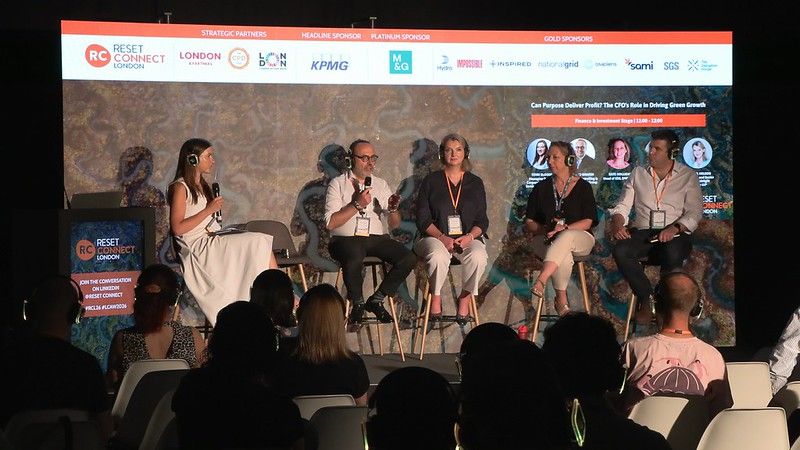
Reset Connect London 2026 | Wednesday 24 June 2026 | Finance & Investment Stage
Moderator: Terri Bloore, Managing Partner, Corporate & Financial Services, FINN Partners.
Speakers: Roberto Baiardi, VP, Global Controlling & Reporting, Chiesi Group. Robert Hayward, CEO & Chief Impact Officer, GoodFX. Annabel Nelson, Co-Founder and Senior Partner, Fairlight Partners LLP. Kate Holliday, Head of ESG, GES.
Estimated read time: 7 minutes
Quick Read Summary
A lower-emissions inhaler can take years to develop. The finance team has to commit resources long before a product reaches patients, and the development team has to preserve the safety and efficacy those patients depend on. Roberto Baiardi’s example from Chiesi gave the panel a concrete way into a question that can otherwise stay abstract. How does a CFO decide what sustainability is worth investing in today?
Terri Bloore put that question to a pharmaceutical finance leader, a financial services founder, a former insurance executive and an events sustainability lead. Their answers covered what to measure, how to bring a board along and where a demand for evidence can get in the way of the work itself.
Finance has more data. The next step is deciding what to do with it.
Robert Hayward described a familiar CFO job with a growing set of inputs. Finance still has to manage risk and allocate capital. It now also receives data on issues such as supply chains and climate exposure that might once have stayed with sustainability or other teams. Reporting creates a record. The opportunity Hayward saw was to use that record to change which projects the business funds and what risks it accepts.
Annabel Nelson drew a distinction between the evidence finance teams are trained to work with and the evidence they increasingly need. Financial accounts describe what has already happened. A sustainability decision often depends on qualitative evidence about what may happen to a business, its suppliers or its customers. A board still needs to decide what matters, why it matters and how much weight to give it. Nelson argued that a finance team should be able to explain that judgement when investors or regulators ask how it was reached.
Kate Holliday sees the same challenge from operations. As Head of ESG at GES, she works on the practical changes a finance decision can enable. A risk that sounds broad in a sustainability report becomes easier to discuss when the team can show where it affects an event, a supplier or a client relationship. That gives finance and operations a specific problem to solve together.
Chiesi’s inhaler decision started years before launch
Baiardi said Chiesi’s adoption of sustainability changed the scope of its finance work over time. As a benefit corporation, the group considers what it delivers for patients, communities and the environment alongside its obligations to shareholders. Those commitments have different measures and different time horizons. Finance has to bring them into the same planning process.
Baiardi used pressurised inhalers for asthma and chronic obstructive pulmonary disease to illustrate what that requires. Their propellant contributes to emissions. Reformulating the product around a lower-global-warming-potential propellant required years of development, and the group wanted patients to retain the safety and efficacy they were accustomed to. By the time a lower-emissions product is needed, much of the development spending and testing has to be behind it.
That makes the decision a product and capital allocation question as much as an emissions question. Finance has to judge what delay could cost, when to commit funding and how to assess progress before launch. The example also gives purpose a tangible meaning for a finance team whose day-to-day work can feel far removed from a patient’s experience.
Bring the board a decision it can make
Nelson recalled taking sustainability to the board of a large life company in 2017. The company provided long-term savings and insurance products and invested in assets to meet its obligations. From her seat on the credit risk committee, she could see that sustainability issues could affect those assets as well as the company’s operations. A forthcoming demerger made access to capital especially relevant. She framed the discussion around exposure the board could recognise and decisions it already owned.
Her advice was to start with the company’s strategy, identify the sustainability risks or opportunities most relevant to it and set measures that can track whether the response is working. That means making trade-offs visible. A board should be able to explain why it funded one action, why another is lower priority and what evidence might change that decision.
Holliday pointed out how long this can take in an established business. A board can agree on direction while the people who buy materials, work with suppliers or deliver projects still need time to change their routines. Baiardi described a similar difficulty at Chiesi. Finance knew how to collect the data. Agreeing credible targets for emissions, business travel and the vehicle fleet was harder, especially when those targets sat alongside financial goals and affected long-term incentives.
Make reporting serve the work
Holliday said GES has commercial reasons to track its performance. Clients increasingly ask suppliers for evidence, and some have reporting obligations of their own. Being able to show progress gives
clients something they can use and helps GES answer questions about its place in their supply chains. For that to work, the evidence has to come from the people who deliver the service.
Hayward described another side of the same problem. GoodFX distributes profits to charitable partners and needs to explain to clients what their business helped fund. A larger charity may already be able to report the trees it planted or other outputs. A smaller partner may have to divert staff time from delivery to meet a client’s preferred reporting format. Hayward argued for enough flexibility to capture useful evidence without making a project revolve around an indicator selected at the outset.
Baiardi’s starting point was materiality. For Chiesi, emissions, waste and electricity sourcing call for different measures from patient involvement in product development. The question is what the business needs to understand about each area, how often it needs that information and whether the measure helps it make a decision. A reporting framework can give those measures structure, but selecting and using them remains a management responsibility.
Long-term capital still needs a clear account of risk
An audience question about patient capital brought the time horizon into focus. Nelson noted that investors such as pension funds can have long-dated liabilities and a reason to look beyond quarterly performance. She saw a role for private capital in financing transition and adaptation. Investors still want to understand the assets, the risks they take on and the evidence behind the expected returns.
Hayward gave the view from the other side of the transaction. For a startup or scale-up, capital that can wait for returns can be difficult to find. Revenue-share arrangements can offer one route, but the businesses seeking patient capital and the investors able to provide it do not necessarily meet on terms that work for both.
That tension also applies inside a company. A board considering a multi-year investment has to weigh a return it cannot yet demonstrate against cash and resources it needs now. Hayward said boards already make that kind of decision on other subjects. A sustainability investment belongs in the same discussion, with evidence about the potential return and enough financial capacity to keep going through the transition.
Get finance and operations into the same conversation
In the final round, Holliday asked finance leaders to involve the people who will carry out their decisions while the options are still open. Operations teams can tell finance whether a proposed target is feasible, what it will take to implement and where a change might have consequences the spreadsheet misses. Baiardi brought the conversation back to whose outcomes the business measures, including patients whose experience of a product may be several steps removed from a finance decision.
Hayward asked the CFOs in the audience to raise their hands. The small response prompted a practical question for the people who spend their time at sustainability events. How do they get this conversation to finance leaders who are at their desks making decisions? His own example was to
begin with the CFO’s immediate concerns, including cost and whether a service works, before discussing the impact it can support.
Nelson’s closing point was that sustainability belongs in planning, decision-making and disclosure because it can affect the capacity to generate future profits. The panel’s examples put that in concrete terms. A product team needs time to reformulate an inhaler. A supplier needs evidence a client can use. A board needs to know what it is committing money to and when it can expect to see results.
Quote of the Session
“Sustainability is part of your job.”
Annabel Nelson, Co-Founder and Senior Partner, Fairlight Partners LLP
Watch Full Session