)
)
)
Driving Towards Net Zero: How Major Brands Are Leading the Charge and Building Resilience
🏠︎ | Blog | Driving towards net zero
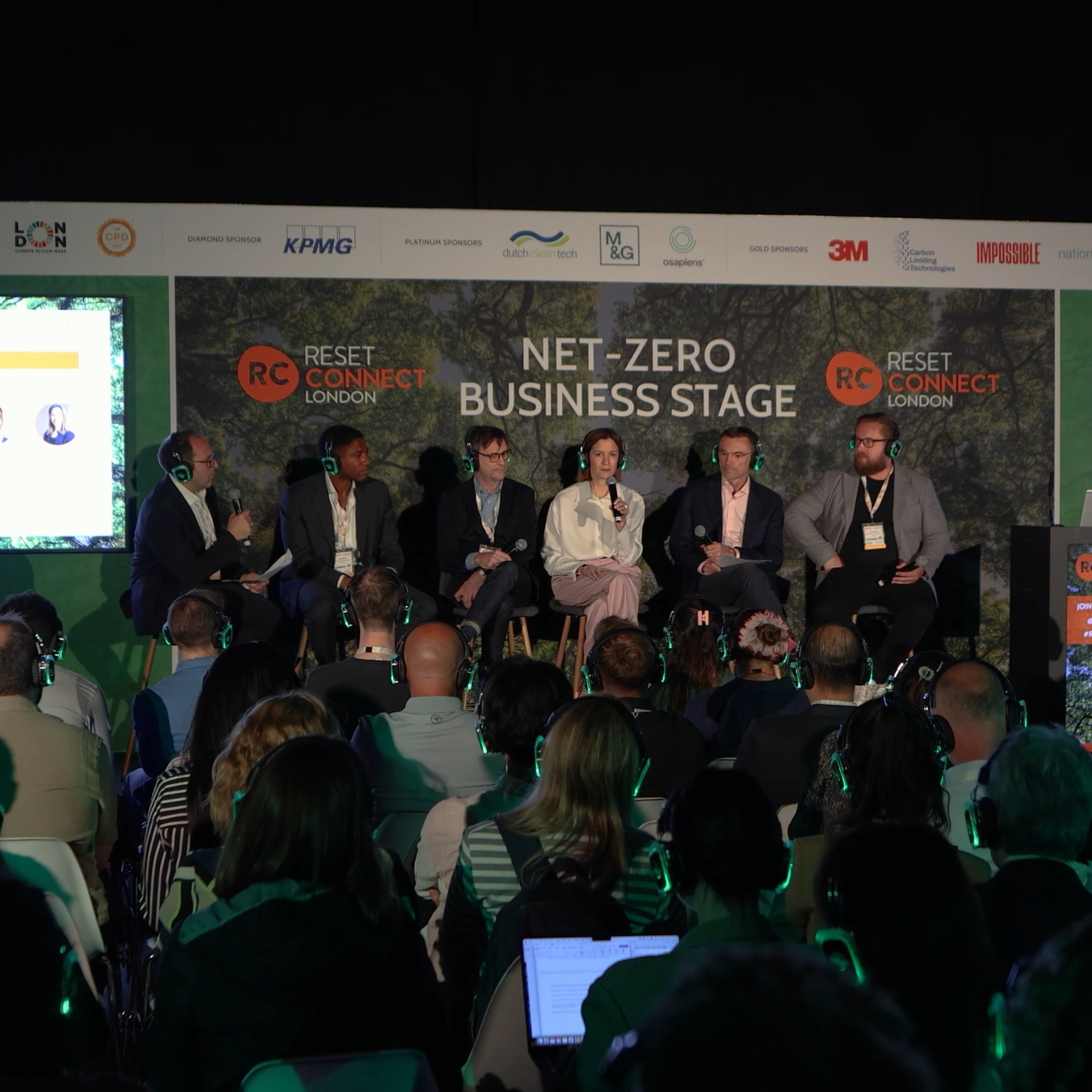
- Event: Reset Connect London 2025
- Date: 25 June 2025
- Speakers: Nick Hampton, CEO, Tate and Lyle, Tim Lambert, Regional Lead UK, Ireland and Nordics, Osapiens, Paul Gilligan, CEO, Magical Mushroom Company, Dara Olufon, Co Head of Global Climate Advisory, South Pole, Laura Mann, Global Head of Sustainability Corporate Affairs, Partnerships and Chair’s Office, AstraZeneca
- Estimated read time: 5 to 6 minutes
Quick read summary
This session explored what net zero looks like when it is treated as a business system, not a communications programme.
Speakers compared the current pushback on ESG language with the practical reality inside organisations, where regulation, supply chain disruption and investor scrutiny still demand action.
The discussion matters now because the easiest wins are no longer enough. Leaders are being asked to show decision grade data, credible returns and delivery plans that stand up under pressure.
You will gain a pragmatic view of how major brands are reframing net zero strategy around resilience and competitiveness, why scope 3 emissions create the hardest trade offs and what practical steps translate intent into execution.
Net zero is still moving, even when the language changes
A consistent theme was the gap between public debate and operational reality. The panel acknowledged a shift in sentiment around ESG, with some organisations stepping back or adjusting how they talk about sustainability. At the same time, speakers argued that the underlying drivers have not disappeared.
The practical point for commercially minded leaders is simple. Terminology can change quickly, but regulation, customer expectations and physical climate risk tend to move in one direction. Tim Lambert described this as a shift in language rather than a change in trajectory, with companies still investing in the systems needed to run sustainability programmes properly.
For sponsors, exhibitors and buyers, this matters because your partners will increasingly expect credible evidence, not broad statements. The work is becoming more operational and more visible.
Climate resilience is the framing that holds under scrutiny
Several speakers returned to resilience as the most durable way to explain why climate action belongs in core strategy. Laura Mann linked AstraZeneca’s approach to health outcomes and risk. She positioned investment as a resilience decision as well as a sustainability commitment.
Nick Hampton reinforced the resilience link through supply chain exposure, especially in agriculture. He described how extreme weather affects sourcing choices and continuity and how this pushes climate risk out of the abstract and into operational planning.
This is where net zero strategy becomes more than a target. It becomes a way to answer board level questions about continuity, cost exposure and long term competitiveness.
Competitiveness is how you scale delivery
Paul Gilligan set out a clear operating logic. He described leading with safety, shareholder value and price parity, with sustainability positioned as the additional benefit rather than the opening pitch. His argument was that procurement behaviour is often driven by cost and risk, regardless of what a report says, so solutions only scale when they fit commercial constraints.
Nick Hampton made a similar point through investment. He spoke about spending on green energy because it delivers a return. He also noted that access to supply is becoming a constraint, which creates first mover advantage for organisations that move early.
The takeaway is not that sustainability comes last. It is that delivery accelerates when it is tied to how the business wins. If you cannot explain an initiative in terms of cost reduction, risk reduction, revenue protection or the ability to keep serving customers, it will struggle when budgets tighten.
Scope 3 emissions are the real test, partnership is the practical route
Scope 3 emissions came through as the most challenging area, because it sits outside the four walls of the organisation. Laura Mann described scope 3 as the majority share of AstraZeneca’s footprint and spoke about setting clear expectations for suppliers, including science based targets, with the possibility of ending relationships if suppliers do not move.
Nick Hampton focused on partnership, especially in agricultural supply chains. He described long running regenerative agriculture programmes built with partners, using data to change farming practices, improve yields and reduce climate impact. The emphasis was on aligning incentives so suppliers can afford to change and so progress is measurable.
For buyers and exhibitors, the implication is practical. You cannot manage what you cannot see and you cannot shift a value chain through pressure alone. Scope 3 emissions work needs shared capability, data infrastructure and a plan that makes participation commercially viable.
Data and compliance are becoming the operating layer for action
The session also highlighted how delivery is moving into systems, not slide decks. Tim Lambert described the role of technology in compliance automation, traceability and transparency and noted that regulatory pressure is forcing companies to understand their value chains in more detail.
Dara Olufon gave an example of physical climate risk analysis being done at a granular level, then translated into specific mitigations and monitoring. His broader point was that digital tools have lowered the cost of this work, which makes decision grade data more achievable and makes prioritisation easier.
This is where operational discipline matters. Without credible data, organisations struggle to prove progress, to justify investment and to maintain trust when scrutiny rises.
The biggest risks are wasted effort and credibility gaps
As the work becomes more operational, two risks stand out.
First, the reporting burden. Nick Hampton argued that fragmented reporting standards consume resource that could be used for action and called for a more consistent approach that focuses on reporting the right things and demonstrating delivery.
Second, credibility gaps. Paul Gilligan described leadership that publishes strong claims while operational reality tells a different story and argued for stronger accountability, including independent auditing of sustainability reporting.
For commercial leaders, this is not abstract. Weak credibility creates regulatory risk, customer risk and talent risk and it can slow down partnerships that depend on trust.
Practical application, how to turn intent into execution
Below is a practical translation of what the panel described, framed for leaders who need delivery, not slogans. The first move is to treat net zero strategy as an operating model decision. That means being explicit about what you control, what sits in the value chain and where resilience and commercial outcomes overlap. In practice, the most useful conversations tend to start with a small set of board level questions, then move quickly into what evidence and capability you need to answer them.
Questions leaders should be asking
- Which parts of our net zero strategy are also resilience priorities, where disruption would hit revenue, continuity or cost base
- What do we control directly and what depends on partners, suppliers or policy
- What evidence would a sceptical board member accept as proof of progress and can we produce it quickly
Once those questions are on the table, watch for signals that the organisation is moving from intent to delivery. The panel’s examples point to a shift in what teams ask for day to day, less about ambition statements, more about traceability, compliance readiness and decision grade data.
Signals to watch in the organisation or market
- Procurement pushing back on sustainability language but still demanding traceability, compliance evidence and lower risk supply
- A sharper focus on value chain visibility, including deeper tier supplier analysis
- A widening gap between suppliers who are ready to move and those who will need support, time or incentives
The risk, as several speakers implied, is spending energy in the wrong place. Over reporting can crowd out action and over confident commitments without data can create a credibility problem that is hard to recover from. The pitfalls are usually not about intent, they are about governance, prioritisation and the design of incentives across scope 3 emissions.
Common pitfalls to avoid
- Treating scope 3 emissions as supplier policing, rather than a partnership and incentives problem
- Over investing in reporting across multiple frameworks, while under investing in delivery capability
- Announcing commitments without decision grade data behind them, which increases greenwashing risk
So what does good look like, in the terms the panel used. It is a delivery approach that proves value early, then scales into harder areas, especially in the supply chain. It uses technology to reduce friction and increase transparency, but it does not pretend systems alone will deliver outcomes. Most importantly, it makes participation commercially workable for partners, which is the only way scope 3 emissions improvements become repeatable.
What good looks like in practice
- A prioritised plan that starts with high confidence wins, then expands as delivery credibility is built
- Partnership programmes that share data and capability and make change economically sustainable for suppliers
- A grounded communication approach that focuses on what is in your control and proves progress through operational evidence
Key takeaways
- Net zero strategy holds up best where it is framed as resilience, competitiveness and delivery, not messaging
- Language may shift, but regulation, customer expectations and physical climate risk continue to push action forward
- Scope 3 emissions are the hardest problem, progress depends on partnerships, incentives and better data
- Technology helps when it turns complexity into decision grade data, but it is not a substitute for action
- Credibility is a commercial risk, stronger evidence and accountability protect trust
Quote of the session: “Look at the data.” Nick Hampton, CEO, Tate and Lyle
Final thoughts
This session made a clear argument. Net zero is becoming more commercial, not less relevant. Programmes that survive scrutiny are the ones built like strategy, anchored in climate resilience, supported by data and delivered through partnerships that make change possible across the value chain.
For Reset Connect audiences, the opportunity is to focus on operating models and decision making, not slogans. Control what you control, prove value early and build the capability to tackle the harder problems with partners over time.
Speakers
Nick Hampton, CEO, Tate and Lyle. Nick became CEO of Tate and Lyle PLC in April 2018 after serving as Chief Financial Officer. He previously joined from PepsiCo in 2014, bringing over 30 years of food and beverage industry experience. He has focused on embedding the company’s purpose and strengthening its sustainability focus.
Tim Lambert, Regional Lead UK, Ireland and Nordics, Osapiens. Tim leads growth for Osapiens across Northern Europe via the Osapiens Hub platform. He has experience building businesses across Europe, the Middle East and the Americas. He has focused on helping organisations grow with sustainability.
Paul Gilligan, CEO, Magical Mushroom Company. Paul leads the vision and strategy of the Magical Mushroom Company. He has international management experience across multiple industries, including senior roles at Sainsbury’s. He founded MMC Holdings International Ltd in 2020 to drive the group’s growth and scale sustainable packaging alternatives.
Dara Olufon, Co Head of Global Climate Advisory, South Pole. Dara is a sustainability and decarbonisation executive with over 15 years of experience in large scale transformation. Before joining South Pole, he was a Partner at McKinsey and Company in the UK, working on energy transition strategies, climate related investments and low carbon technologies.
Laura Mann, Global Head of Sustainability Corporate Affairs, Partnerships and Chair’s Office, AstraZeneca. Laura joined AstraZeneca in 2019 and has held roles across government affairs, sustainability, partnerships and strategic communications, including establishing the company’s COVAX partnership during the Covid 19 pandemic. She now leads sustainability corporate affairs and strategic partnerships and supports the group Chair and is Secretariat lead for the Sustainable Markets Initiative Health Systems Task Force.
Watch full session