


Making and Shaping Places with Nature-Based Solutions: The Ox-Cam Growth Corridor Opportunity
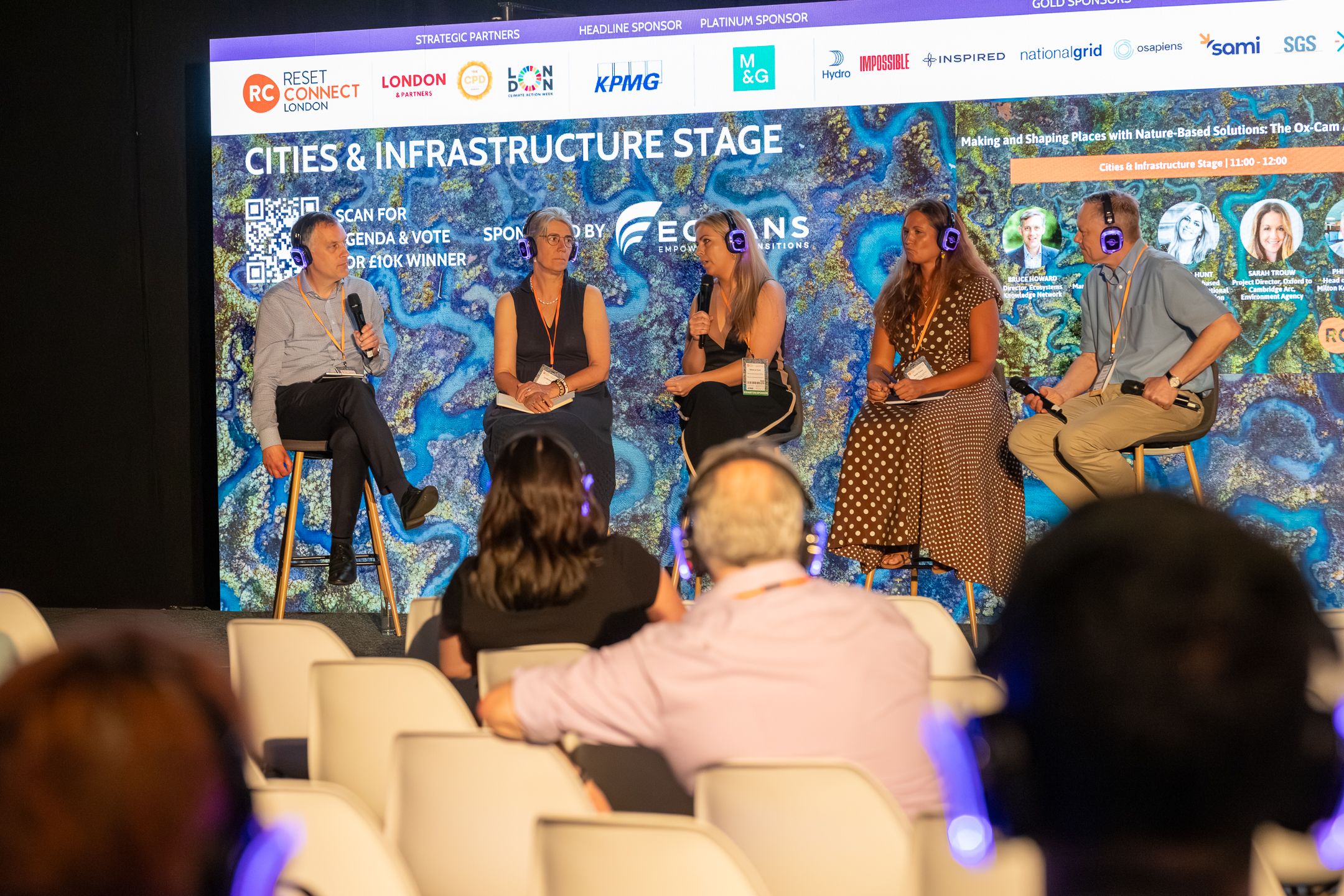
“There's no template for any of this work that we do.”
Rebecca Hunt, Nature-based Solutions Officer, National Landscapes Association
Home | Blog | Making and Shaping Places with Nature-Based Solutions: The Ox-Cam Growth Corridor Opportunity
Event: Reset Connect London 2026
Date: Wednesday 24 June 2026
Time: 11:00–12:00
Stage: Cities & Infrastructure Stage
Moderator: Bruce Howard, Director, Ecosystems Knowledge Network
Speakers: Rebecca Hunt, Nature-based Solutions Officer, National Landscapes Association; Sarah Trouw, Project Director, Oxford to Cambridge Arc, Environment Agency; Phil Bowsher, Head of Environment, Milton Keynes Parks Trust; Liz Nicholson, MD, Forest Canopy Foundation
Estimated read time: 9 minutes
Quick Read Summary
A green route to school, shade outside a restaurant and a river with enough clean water are practical conditions for a place to work. At Reset Connect London 2026, Bruce Howard of the Ecosystems Knowledge Network asked a panel working across the Oxford–Cambridge corridor how nature-based solutions could become part of its growth, rather than something considered after development decisions have been made.
Rebecca Hunt of the National Landscapes Association stressed that solutions must fit the places and communities they serve. Sarah Trouw of the Environment Agency connected natural assets with water, climate resilience and the ambitions of business clusters. Phil Bowsher of Milton Keynes Parks Trust explained the importance of connected green infrastructure and lasting stewardship. Liz Nicholson of the Forest Canopy Foundation examined what businesses and investors need to understand before they can put money into nature.
The discussion moved from the everyday experience of green space to a harder delivery question: who will organise and finance a network that extends beyond any one development? The opportunity was clear, but the panel did not present an already funded regional solution. It described the decisions, partnerships and investment arrangements needed to make one possible.
Nature Has to Work Where the Pressures Are
Howard began with a deliberately provocative question: could other parts of England provide the space for nature that the growth corridor needs? Trouw's answer was grounded in the services local landscapes provide. Trees offer cooling and shade; rivers and streams support water supply and quality; agricultural land contributes to food production. Those functions cannot simply be moved to another region while development proceeds without them.
“Water quality can't be offset somewhere else,” she said. Her point was about the relationship between a problem and the place where it has to be addressed. A distant investment does not automatically resolve pressure on a particular river or the conditions facing a community nearby.
Hunt extended that argument to the design of nature-based solutions. Working across different National Landscapes had shown her that communities and environmental needs differ. “There's no template for any of this work that we do.” Understanding the local context, including effects downstream, has to shape the intervention.
For a business or developer, that changes the starting point. The useful question is which environmental conditions the operation depends on and what the proposed investment can change in that location. A general commitment to nature is a poor substitute for understanding the specific risk.
A Green Corridor Should Connect Places People Actually Use
Asked what a nature-based solution would look like on the walk to school, Bowsher offered a direct example: a green corridor connecting homes with the school gate. Making walking an attractive option requires a route that reaches somewhere useful, alongside appropriate care and a sense of safety. His description of the Parks Trust's work included the staff who look after those spaces.
This brought the conversation beyond the amount of green space shown on a plan. A route has to connect, remain usable and be maintained. Those are decisions about design and management as well as land allocation.
Trouw made a related point about businesses occupying clusters of development. Cooperation could create corridors for nature across multiple sites, instead of leaving each business to invest within its own boundary. She used cooling, shade and attractive surroundings to explain how nature can affect the experience of a workplace or hospitality venue.
Hunt also asked the audience to consider what life might look like without effective responses to climate pressures. Her example of travel in extreme heat connected resilience with the ability to carry out an ordinary journey. For development teams, the implication is to test green infrastructure against how people will use the place, including under more difficult conditions.
The Business Case Reaches Beyond the Site Boundary
Nicholson challenged businesses to look beyond the red line around their property. Buildings, laboratories and parking spaces may define a development brief, but the quality of the surrounding place also matters. She described a partnership between Morgan Sindall Group and Blenheim involving woodland creation, using it to discuss water, carbon and the connection employees can feel with a landscape.
She also identified a limitation: the woodland was geographically separate from employees' workplaces. Her ambition was for a framework that could connect workplace and nature more closely. The example illustrated a possible relationship between a business and a landscape; it did not establish that the same arrangement would suit every development in the corridor.
Trouw described the opportunity to engage groups of businesses early in their planning. If a cluster recognises shared dependencies, it can consider investments together. She discussed rainwater harvesting as one way businesses might examine their own water resilience, particularly where buildings offer suitable roof space.
The practical question is whether the proposal addresses a dependency that the business understands. Water availability, comfortable outdoor space and the attractiveness of a workplace can be reasons to participate, but the benefits need to be specified. The panel's examples make a case for investigating those relationships, rather than assuming every green intervention delivers the same commercial result.
Investors Need to Understand What Their Money Will Deliver
Nicholson brought the finance discussion back to a basic question: “What are we asking people to invest in?” Interest in natural capital is not the same as a clearly described opportunity. Investors need to understand what is being offered and how its value and delivery will be assessed.
She referred to carbon units and biodiversity net gain units as examples of ways to define an offer. Later, she argued for clearer definition of a nature unit. That was a proposal for further work, not evidence that a single accepted product already covers the different benefits discussed by the panel.
Hunt described the effort required for conservation organisations to make their case to businesses. The organisations may have ecological expertise while needing to learn financial language and work within short funding cycles. She argued that regulation and compliance would have an important role, alongside the work of demonstrating why businesses should invest.
Trouw supported bringing opportunities together at a scale investors can consider. But the audience challenged how easily public and private finance could be combined, and whether private money would arrive in the amounts required. The answers expressed confidence in partnerships and demonstrator projects without presenting a completed financing structure. For anyone preparing an investment proposition, the distinction matters: demand for larger opportunities does not remove the need to explain the underlying activities, evidence and responsibilities.
Creating a Landscape Also Means Paying to Look After It
Bowsher described the Parks Trust's responsibility for looking after a substantial network of land in Milton Keynes. Some areas carry a maintenance cost without generating income. Others can contribute revenue, including productive landscape uses and recreational activity. He gave cricket bat willows as an example of deriving economic value from managed land.
His argument was to consider those possibilities when landscapes are designed. Green infrastructure can have several functions, but those functions need an organisation capable of managing them. A space that is attractive on completion still requires care over the years that follow.
He also saw a gap in the support available to developers. Planning requirements may be experienced as constraints, while opportunities to extend parks or green corridors lack an active partner helping to bring them about. The Parks Trust tries to fill that role locally by working with developers and bringing new spaces into long-term care.
For landowners and commissioning teams, this means considering stewardship alongside capital expenditure. Who will own or manage the land, which activities can support it and how will ongoing costs be met? Those questions determine whether an environmental asset remains useful after the construction phase has ended.
A Regional Map Needs a Delivery Mechanism Behind It
Asked for one bold change within two years, Nicholson proposed a map that brings environmental opportunities together. She referred to the 100 Miles Wilder initiative and a forest layer identifying suitable places for trees. Her emphasis was on considering competing land uses and avoiding decisions that solve one problem while creating another.
Trouw followed with the need to build nature and climate resilience into the planning and investment arrangements of new growth. Her ambition was a mechanism that could bring a pipeline of opportunities together and make investment accessible. She connected this with the longer time horizons that some investors can accept.
Bowsher made the delivery challenge specific. Sustainable drainage within individual developments does not automatically create strategic wetlands or restore a river corridor. Those larger outcomes need coordination across boundaries and an organisation with the remit to make them happen.
The audience's questions about water kept the discussion grounded. Trouw acknowledged the scale of the challenge while pointing to continuing partnerships and work with water companies and developers. The practical test for a regional strategy is what happens after opportunities are mapped: who can assemble the project, secure the land and funding, and remain responsible for delivery? The panel's confidence rested on the possibility of organising that work, rather than a claim that it had already been completed.
Practical Application
For developers, businesses and local partnerships, the discussion offers a way to test whether a nature-based proposal can move from aspiration to delivery.
Questions to ask
- Which local dependency or pressure is the investment intended to address?
- Does the proposed green infrastructure connect with the surrounding landscape and the places people use?
- Who will coordinate delivery across site boundaries and pay for long-term care?
Signals to watch
- Businesses and environmental organisations planning around shared water and land needs
- An investment offer with clearly described activities, evidence and responsibilities
- A named steward and a realistic plan for maintenance beyond construction
Traps to avoid
- Assuming a nature investment elsewhere resolves a local environmental problem
- Treating investor interest or a regional map as evidence of committed funding
- Planning individual sites without considering connections, cumulative pressures and ongoing management
A useful first step is to bring one development proposal together with the organisations managing the adjoining landscape. Identify the shared problem, the boundary that prevents progress and the party able to organise the next decision.
Key Takeaways
- Nature-based solutions need to fit local conditions and community needs.
- Connected green infrastructure can support ordinary journeys as well as ecological networks.
- A business case starts with specific dependencies and benefits that can be examined.
- Private investment needs a clear proposition, not only a broad statement about natural capital.
- Long-term stewardship belongs in the plan from the outset.
- Regional ambitions need a delivery mechanism that works across individual development boundaries.
Final Thoughts
The strongest thread through this discussion was the need to connect decisions that are often made separately. A business considers its site, a developer works within a boundary and an environmental organisation looks after a landscape. Water, wildlife and the people using a place move between those boundaries.
The Ox-Cam opportunity is to organise growth with those connections in view. That requires local knowledge, a clear account of what investment will deliver and someone responsible for caring for the result. The panel showed why nature belongs in early planning. Its harder challenge was turning that agreement into projects that can be financed and maintained.
Speakers
Bruce Howard, Director, Ecosystems Knowledge Network (moderator). Bruce works to connect environmental knowledge with decisions about health, economic development and other societal priorities. His background spans public, private, academic and non-profit organisations, and he originally trained as a landscape architect.
Rebecca Hunt, Nature-based Solutions Officer, National Landscapes Association. Rebecca works on nature-based solutions and regional green finance. Her contribution drew on experience across National Landscapes and the need to make projects appropriate to the communities and environments they serve.
Sarah Trouw, Project Director, Oxford to Cambridge Arc, Environment Agency. Sarah described leading the agency's work on the corridor since around 2018, testing approaches to environmental planning and climate resilience and working with partners on the region's growth ambitions.
Phil Bowsher, Head of Environment, Milton Keynes Parks Trust. Phil works with the planning and development of Milton Keynes and the long-term stewardship of its green infrastructure. His work also covers biodiversity and the environmental services provided by the Trust's land.
Liz Nicholson, MD, Forest Canopy Foundation. Liz's session contribution drew on her work across development, environmental services and not-for-profit partnerships, including the Forest Canopy Foundation and the Elemental tool. She focused on connecting environmental planning with practical business decisions.
Watch Full Session