


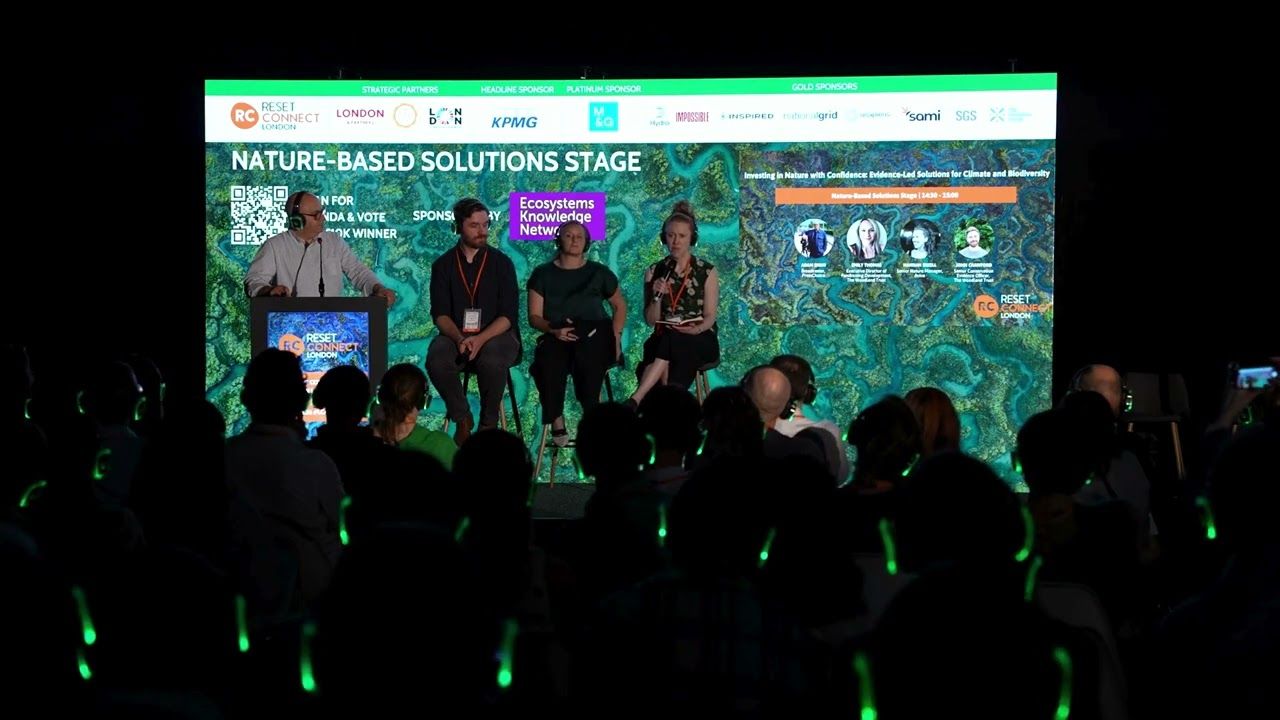
Investing in Nature with Confidence: Evidence-Led Solutions for Climate and Biodiversity
Home | Blog | Investing in Nature with Confidence: Evidence-Led Solutions for Climate and Biodiversity
Event: Reset Connect London 2026
Date and stage: 23 June 2026, 14:30–15:00, Nature-Based Solutions Stage
Moderator: Adam Shaw, Broadcaster, PressChoice
Speakers: Emily Thomas, Woodland Trust. Hannah Eskell, Aviva. John Crawford, Woodland Trust.
Estimated read time: 5 minutes
Quick Read Summary
- At Snaizeholme in the Yorkshire Dales, woodland creation, peatland restoration and work on watercourses are part of one catchment-wide project.
- The Woodland Trust is working with the universities of Leeds and York to track how water moves through the valley and understand how restoration could affect downstream flood risk.
- Aviva’s involvement illustrates how a corporate partnership can connect a company’s nature strategy with practical restoration and long-term monitoring.
What can one Yorkshire valley tell us about investing in nature?
A company can report how many trees it has helped plant long before it can say what the woodland has changed. At Reset Connect London, the Woodland Trust and Aviva explored how to deal with that gap. Their example was Snaizeholme, a steep-sided valley in Wensleydale where work on woodland, peat and watercourses gives researchers a chance to study what happens across a whole catchment.
Moderator Adam Shaw opened by questioning the familiar picture of a business giving money and a charity spending it. At Snaizeholme, each partner brings a different reason to stay involved. The Woodland Trust can restore habitats and study the results over time. Aviva can learn more about how recovering ecosystems might help address risks that matter to an insurer, including flooding.
Restore the catchment as a whole
Emily Thomas introduced Snaizeholme as an opportunity to work at landscape scale. The Woodland Trust’s film showed how the project combines woodland creation on the valley slopes with peatland restoration and work to return watercourses to a more natural condition. Each intervention has a different role. Together they allow the Trust to look at how water moves from the slopes into the streams and out of the valley.
The valley also helped make sense of Thomas’s closing point about smaller projects. A business or landowner may have far less land to work with. A hedge or a connection between habitats can still help build a more connected landscape, particularly when neighbours and farmers are involved. The question is what the work adds to the wider landscape around it.
Build monitoring into the work
John Crawford described the valley as a living laboratory. He explained that the team could account for about 92% of the water entering it and monitor how water moves through streams and soils before leaving the catchment. Working with the universities of Leeds and York gives the Trust a way to study those flows in near real time.
That 92% figure describes the water the team can account for. A separate question is how much the restoration changes the timing or volume of water leaving the valley, particularly during heavy rain. The panel discussed the monitoring as a way to investigate that question and build evidence about downstream flood risk.
Crawford also explained how the work feeds back into the restoration itself. Field data can inform woodland design, and the findings can help policymakers and funders refine their models. For a corporate partner, that gives early reporting a practical purpose. The first reports can explain what the team has learned, what it has changed and which effects still need time to measure.
Give the partnership a place in business strategy
Hannah Eskell linked Aviva’s involvement to a wider question for financial services. Where does the business depend on healthy ecosystems, and where could their decline increase its exposure to risk? For an insurer, flooding gives that question a concrete starting point. A project like Snaizeholme gives the business a chance to learn about the mechanisms that shape flood risk while helping the Trust deliver restoration.
The panel also discussed the pressure to report results quickly. The credible story will change as the evidence improves. Early updates can describe what has been funded and what is being measured. Later updates can show what changed and what researchers can reasonably attribute to the project. Being specific at each stage gives people a clearer view of progress and gives the partnership room to adapt.
Putting it into practice
Start with a business dependency or exposure that can be described plainly, such as flood risk in a particular area. Ask a delivery partner what the site needs, what evidence already exists and what the project would need to monitor. Agree who will collect and interpret the data, when the partners will review it and how they will report uncertainty. Build funding for that work into the partnership from the outset.
Key takeaways
- Fund monitoring alongside habitat work so the findings can guide delivery.
- Report activities, observed outcomes and longer-term expectations separately.
- Choose a partnership that fits both the needs of the landscape and a clear business priority.
Quote of the Session
“Nature really should be treated with the same kind of seriousness as every other risk on the balance sheet.”
Hannah Eskell, Aviva
Final thoughts
The value of Snaizeholme is that the same project can restore habitats and improve understanding of how a valley works. For businesses considering a similar partnership, the starting point is to ask what the landscape needs, what the company can help deliver and how both sides will know whether the work is having the intended effect.
Speakers and moderator
Adam Shaw — Broadcaster, PressChoice. A freelance journalist and Woodland Trust volunteer, Shaw moderated the discussion, pressing the panel on what makes a partnership useful to both sides and how it can show progress.
Emily Thomas — Executive Director of Fundraising Development, Woodland Trust. Thomas works with funders and supporters to advance nature recovery. She introduced Snaizeholme and discussed what businesses and charities can achieve through long-term partnerships.
Hannah Eskell — Senior Nature Manager, Aviva. Eskell works in Aviva’s Group Nature Team, integrating nature considerations into the business. She explained why landscape restoration matters to Aviva and how it connects to business risk.
John Crawford — Senior Conservation Evidence Officer, Woodland Trust. Crawford works on research that informs conservation practice. He explained how catchment monitoring and academic collaboration help the Trust refine its work and assess its effects.
Watch Full Session