


A Green Patient is a Healthy Patient: Investing in Health through Sustainability
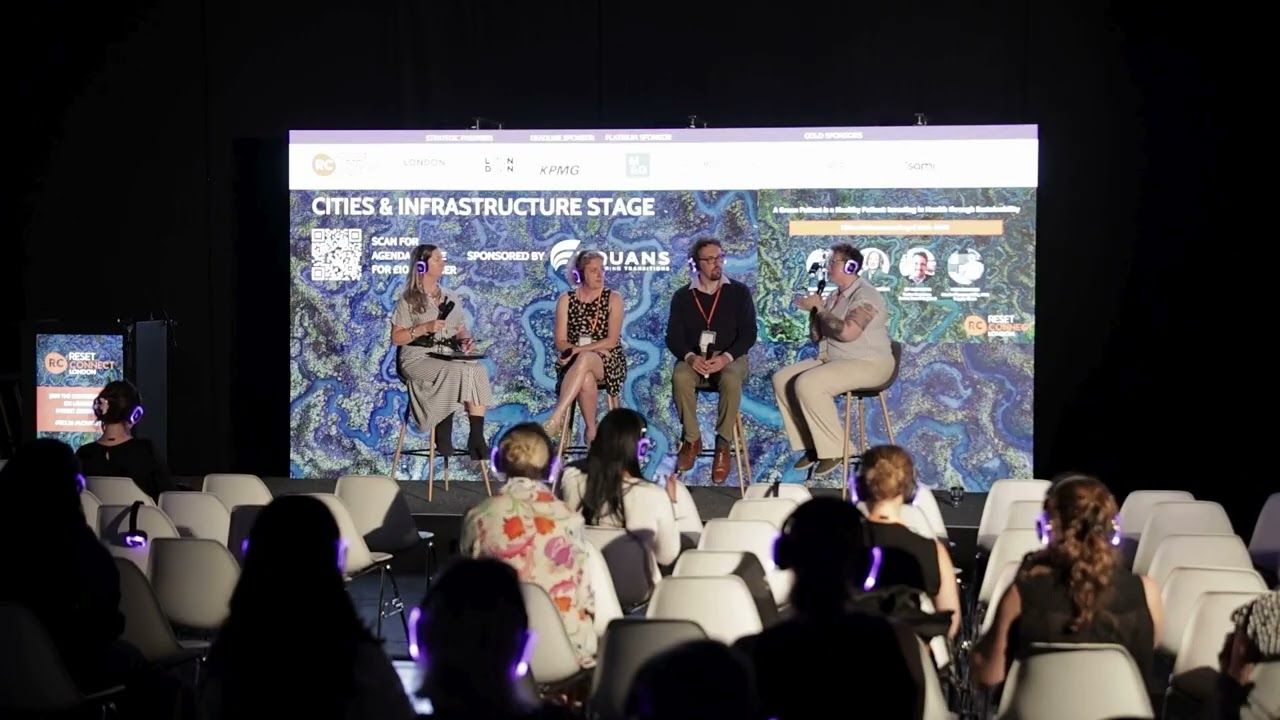
“Our job is to make sure we can treat you when you come to us.”
Heidi Barnard, Head of Sustainability, NHS Supply Chain
Home | Blog | A Green Patient is a Healthy Patient: Investing in Health through Sustainability
Event: Reset Connect London 2026
Date: Wednesday 24 June 2026
Time: 14:00–15:00
Stage: Cities & Infrastructure Stage
Moderator: Illana Adamson, Founder & CEO, Be Better Sustainability
Speakers: Dr Susanna Petche, Founder, Trauma-Sense; Kit Allwinter, Senior Inspector, Active Travel England; Heidi Barnard, Head of Sustainability, NHS Supply Chain
Estimated read time: 9 minutes
Quick Read Summary
A reusable medical device needs a service that can clean it. A cycle route needs to feel safe enough to use. A community asked to change needs to recognise its own concerns in the proposal. These practical conditions connected a wide-ranging discussion of health and sustainability at Reset Connect London 2026.
Moderated by Illana Adamson of Be Better Sustainability, the panel brought together Heidi Barnard of NHS Supply Chain, Kit Allwinter of Active Travel England and Dr Susanna Petche of Trauma-Sense. Their work sits in different parts of the system, but each described decisions whose consequences reach beyond one product, budget or organisation.
Barnard explained how procurement can reduce waste while protecting continuity of care. Allwinter examined how everyday journeys can make physical activity easier and why transport engagement often misses the problems residents want solved. Petche argued for more attention to distress, safety and connection when asking people to participate in change. The discussion's practical challenge was to bring those perspectives into decisions without losing the responsibilities of each service.
A Sustainable Product Must Still Be Available When the Patient Needs It
Barnard put the purpose of procurement first. “Our job is to make sure we can treat you when you come to us.” A supplier's ability to deliver tomorrow is only part of that responsibility. NHS Supply Chain also has to consider whether products will remain available over the years covered by its procurement arrangements.
She described international dependencies in raw materials and manufacturing, and the potential for flooding, wildfires and other climate pressures to disrupt them. For her team, environmental performance and resilience therefore belong in the same conversation. A lower-impact product is useful only if the system can continue to obtain and use it when needed.
Barnard set out three areas of work: reducing inefficient consumption, improving the products healthcare will continue to need and supporting innovations that change how care is delivered. The first included products bought but left on shelves until they expire. That is a problem of ordering and use as well as manufacturing.
For suppliers and procurement teams, the implication is to look beyond a single product claim. The proposal needs to explain how it reduces avoidable waste, what changes in its production and how reliable supply will be maintained. Barnard's account connected those questions to the service being provided to patients.
A Reusable Device Needs More Than a Purchasing Decision
The discussion of circularity made that relationship concrete. Barnard described some single-use products that could be replaced by reusable devices, alongside others where single use remained appropriate. Different products and care pathways require different approaches.
Reuse depends on the capacity to decontaminate, sterilise or launder the item as required. Barnard said that capacity was not available at the scale needed for an immediate wholesale switch. Buying a reusable device without the supporting service would leave a gap between the procurement decision and practical delivery.
Her answer was a staged transition. Purchasers can work with public and private partners to signal future demand and develop the capacity needed to meet it. Where single-use products remain necessary, she discussed recovering valuable materials and improving the product's environmental performance.
Later, she challenged a blanket move away from plastic. Material properties can perform an important clinical function, and changes to regulated devices need an appropriate approval process. For commissioning teams, the practical task is to define the function that must be preserved, identify a suitable alternative and plan the services and approvals needed to use it. A purchasing target cannot do that work on its own.
Make Movement Part of a Journey People Already Need to Make
Allwinter approached prevention through everyday travel. Walking, wheeling and cycling can form part of trips to work, shops, school or public transport, rather than requiring a separate appointment for exercise. He described the attraction of making activity fit within time people are already spending on a journey.
His example of a child travelling independently to school extended the argument beyond the child. If appropriate routes allow that journey, a parent may spend less time driving between activities and have more freedom to take part in their own interests. He connected those possibilities with the social relationships that develop when people can use their neighbourhood more easily.
The barriers he described were tangible. Busy roads can make cycling feel unsafe. A poorly drained crossing can make walking unpleasant. A bus caught in traffic offers little advantage to the people on it. Encouraging a different choice is difficult if the physical conditions continue to favour the existing one.
For local authorities, developers and employers, this means looking at the actual journey before promoting a behaviour. A route has to be practical and accessible for the people expected to use it. The panel's argument was about making healthier activity easier to fit into daily life, rather than assuming that a message alone will change how people travel.
Start Community Engagement with the Problem People Want Solved
Allwinter also challenged how transport proposals are presented. A council may announce a cycle or bus route and ask residents whether they support it. That can turn engagement into a contest over an already chosen design, with the discussion focused on parking, inconvenience and resistance to change.
He proposed starting with local concerns instead. Can children get to activities independently? Do people feel able to walk to the shops or park? Do neighbours have opportunities to meet? Those questions can reveal shared priorities before a particular intervention is put forward.
The next step is to explain how the proposed scheme addresses those priorities. Without that connection, an authority can complete a consultation process and still fail to engage meaningfully with what the community has said. Allwinter recognised this as an area where the transport sector needed to improve.
The distinction is useful beyond transport. When an organisation wants people to accept a change, it needs to show how that change relates to something they value and remain open to what their experience reveals. Engagement should inform the problem being addressed and the response, as well as communicate the decision.
Distress and Disconnection Belong in the Conversation About Change
Petche brought a GP's perspective to the question of participation. She argued that fear, distress and a sense of being unsafe can affect how people engage with information and decisions. Her concern was that initiatives can assume people are ready and able to act, while overlooking the pressures they are already managing.
She connected that discussion with unequal access to safe outdoor environments and with anxiety about climate change. She also described social connection as important to her approach. “Community is everything,” she said, advocating support that helps people feel less isolated and more able to participate.
The practical organisational question is how to create the conditions for engagement. An invitation to change may be received differently by someone who feels supported and someone who feels overwhelmed. Listening, accessible communication and opportunities for connection were themes running through her contribution.
That does not mean every disagreement is a trauma response or that one approach will work for everyone. Petche's contribution offered a perspective on barriers that technical programmes may overlook. For employers and public services, it suggests asking what support people need to take part, alongside explaining the action being requested.
The Benefits and Costs Do Not All Sit in the Same Budget
Barnard described the healthcare value chain as a community of organisations. She argued for collaboration around a shared outcome, rather than approaching suppliers primarily through blame. Moving towards different products or services requires understanding how each organisation can change and what makes that transition viable.
She also discussed the consequences of withdrawing a large contract. A decision taken by a purchaser can affect a supplier's ability to operate and the people who work there. Her point was to work through the reasons for the product and the route to improvement, rather than make a sudden change in response to a general trend.
In the closing discussion, Allwinter highlighted another difficulty: an intervention can create benefits for a different service without those benefits being adequately recognised in the original decision. Transport and healthcare organisations may each assess their own part while missing the reasons to act together.
The panel did not quantify a combined return for its proposals. It argued for a broader assessment that keeps the individual responsibilities visible. For decision-makers, that means identifying who bears the cost, who receives the benefit and what evidence would allow the organisations involved to make a joint case. Collaboration becomes more useful when it changes how a decision is assessed and delivered.
Practical Application
For procurement, transport and sustainability teams, the discussion offers a way to examine a proposed change before committing to it.
Questions to ask
- What patient or community need must the proposal continue to meet?
- Which services, infrastructure or approvals are required before the new approach can work?
- Are benefits falling outside the budget or organisation making the decision?
Signals to watch
- Procurement proposals that address waste, product performance and continuity of supply together
- Community engagement that begins with lived problems and shows how a scheme responds
- A transition plan developed with the organisations responsible for implementation
Traps to avoid
- Buying a reusable product without a workable cleaning or servicing arrangement
- Assuming information alone removes physical, practical or emotional barriers to participation
- Treating a clinical anecdote or an expected saving as a measured system-wide result
A useful next step is to map one proposed intervention across the whole pathway. Identify the people affected, the supporting services required and the evidence needed by each organisation before the change proceeds.
Key Takeaways
- Sustainable procurement needs to protect the continuity of patient care.
- Reducing over-ordering and expired stock is part of reducing environmental impact.
- Reuse requires supporting services and product-specific decisions.
- Everyday journeys can create opportunities for activity when suitable routes exist.
- Engagement works better when proposals address concerns communities recognise.
- A shared outcome needs a business case that accounts for effects across organisations.
Final Thoughts
This session brought sustainability close to the way services are used. A procurement decision affects whether a device can be cleaned and supplied. A street design affects whether a journey feels possible. The way a proposal is discussed affects whether people feel heard and able to participate.
The panel's strongest examples showed why those decisions need to be examined together. The next step is to make the connections operational: plan the supporting services, involve the people affected and agree how outcomes will be assessed. That is where a broad commitment to health and sustainability becomes a practical change in delivery.
Speakers
Illana Adamson, Founder & CEO, Be Better Sustainability (moderator). Illana works on sustainability and organisational change. In this session she drew on her experience of working with NHS boards to connect climate, health and decisions across different systems.
Dr Susanna Petche, Founder, Trauma-Sense. Susanna is a GP whose work also focuses on psychological trauma, health and well-being. Her contribution examined how distress, perceived safety and connection can affect participation in change.
Kit Allwinter, Senior Inspector, Active Travel England. Kit works on making walking, wheeling and cycling safer and more practical. His background spans public and private sector transport work, with an emphasis on how infrastructure and everyday travel affect communities.
Heidi Barnard, Head of Sustainability, NHS Supply Chain. Heidi's session contribution covered product procurement, supplier collaboration, circularity and resilience, with a focus on maintaining patient care while reducing environmental impact.
Watch Full Session