


The Corridor Program - Partnership Fostering Sustainable Development In The Brazilian Amazon
“For complex problems, you have to have complex solutions.”
André Guimarães, Executive Director, IPAM Amazônia (The Amazon Environmental Research Institute)
Home | Blog | The Corridor Program - Partnership Fostering Sustainable Development In The Brazilian Amazon
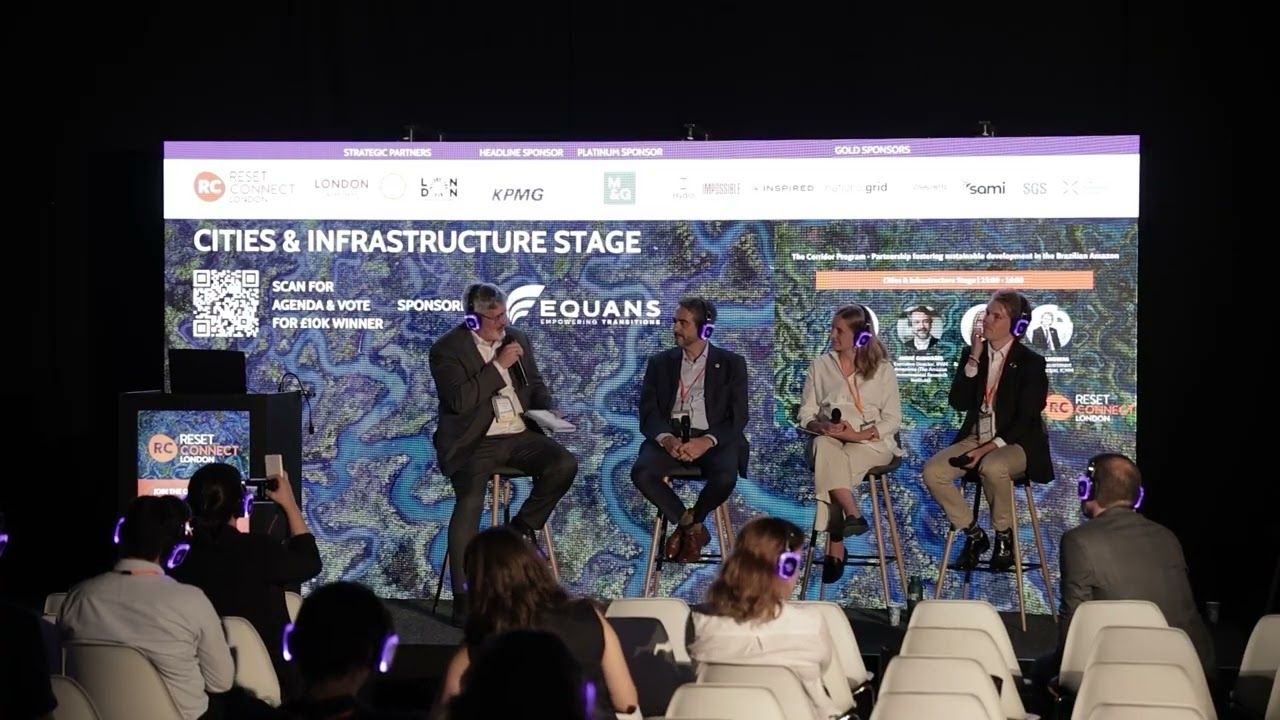
Event: Reset Connect London 2026
Date: Tuesday 23 June 2026
Stage: Cities & Infrastructure Stage
Speakers: Eduardo Figueiredo, Senior Vice President Sustainability - Norsk Hydro (moderator). André Guimarães, Executive Director - IPAM Amazônia (The Amazon Environmental Research Institute). Birgit Euba, Raw Materials Supply Chain Sustainability - Mercedes-Benz AG. John Lindberg, Policy & Government Affairs Principal - ICMM.
Estimated read time: 10 minutes
Quick Read Summary
Buying lower-carbon aluminium does not settle what happens to the forests and communities around the mine. This Reset Connect London 2026 panel followed a commercial relationship between Hydro and Mercedes-Benz into a more difficult question: how can the companies buying and producing a material support development where it originates?
The Corridor Program connects industrial investment with Amazon-based expertise and community priorities. The discussion moved from consultation and forest-based livelihoods to the purchasing requirements of an automotive manufacturer, then to the evidence needed to make claims about social progress credible.
You will come away with the reasoning behind a regional partnership, an account of how a major buyer works through its raw-material supply chains, and a practical distinction between funding projects and showing that people’s lives are improving. The commercial thread is trust: how it is built, how it can be lost and why it matters to the reliability of a supply chain.
A Pipeline Is an Industrial Asset. The Territory Around It Needs a Wider Plan
Eduardo Figueiredo, Senior Vice President Sustainability at Norsk Hydro, began with the company’s bauxite mine in Paragominas and the pipeline linking it to the refinery. He described a route of roughly 240 kilometres and around 30 traditional communities with which Hydro has a formal consultation process. The question was how to direct investment towards their priorities while addressing the wider conditions in which those communities live.
Hydro already puts money into mandatory and voluntary projects, Figueiredo said, but those investments alone cannot transform the region. Forest products can have economic potential without the infrastructure, capacity or market conditions needed to support a living. The programme grew from asking how company investment could connect with larger investments and specialist partners.
André Guimarães, Executive Director of IPAM Amazônia, rejected the search for a single solution. “For complex problems, you have to have complex solutions.” His example was road building: improved access may be valuable, but without protection for natural assets and consultation, a road can also increase deforestation and inequality. Social, economic, environmental and political decisions have to be considered together.
For a commercial reader, this matters because the risks around an operation do not stop at its boundary. A funded project can meet its own objectives while the conditions that make the wider business relationship unstable remain unresolved.
A Community Project Is Not a Success Just Because the Building Exists
Birgit Euba, who works on raw-material supply-chain sustainability at Mercedes-Benz, identified two conditions for the company’s involvement: local people must influence decisions, and the effects of investment must be measurable. She described seeing development projects elsewhere that produced schools without teachers. The building existed; the service did not.
Her first test was whether communities could identify their needs and participate in allocating funds. Her second was whether the partners could track changes in quality of life. Euba described the use of the Social Progress Index and surveys of local communities to understand needs, set indicators and assess progress over time.
Figueiredo acknowledged the difficulty of measuring changes across a territory rather than within one company’s operations. “Everything that we do needs a number behind this,” he said. The discussion described the programme’s approach to measurement; it did not present a completed impact evaluation demonstrating its overall effects.
For a commercial reader, this matters because money spent and facilities delivered are not interchangeable with social progress. A credible investment case needs a baseline, measures that reflect local priorities and an explanation of how the intervention contributed to the change being claimed.
The Carbon Conversation Opened the Door to Human Rights and Biodiversity
Euba traced the partnership back to a procurement objective: reducing the carbon associated with aluminium. Mercedes-Benz wanted electrification to reduce emissions across the vehicle’s life cycle, rather than simply move them from use into production. Working with Hydro then brought the conversation closer to the people and ecosystems connected with the material.
The scope widened from carbon to human rights, biodiversity and a just transition. “Our commitment goes beyond our factory gates,” Euba said. A manufacturer has to understand the conditions under which materials are extracted and processed as well as what happens at its own sites.
Figueiredo made the producer’s position explicit. Mining in the Amazon affects forests and people’s lives; those impacts do not disappear because a company funds development work. He argued for sustained investment and relationships built over time, alongside a business case for stronger environmental and social performance. Euba’s closing remarks similarly described a direction of travel, acknowledging that the company’s vision was not yet fully realised.
For a commercial reader, this matters because a lower-carbon specification answers one purchasing question. It does not answer every question about human rights, nature or local livelihoods. Those issues require their own assessment and action within the same sourcing relationship.
Purchasing Power Has to Reach Further Than the First Supplier
Euba described automotive supply chains in which the mine can sit 10 or 12 intermediate steps away from the vehicle manufacturer. Mercedes-Benz’s core business is making cars, but many of the risks attached to their materials arise at the extraction stage, far beyond the immediate supplier relationship.
She outlined a systematic response. Mercedes-Benz had identified 24 materials associated with risks and assessed the issues attached to them, including extraction methods, deforestation, human rights and child labour. The response then enters purchasing requirements that suppliers must accept before an award. Depending on the risk, those requirements can involve standards, certification, mine audits or carbon targets. She also described working with miners and standard-setting organisations from the other end of the chain.
Hydro’s vertically integrated operations made the chain easier to understand, Euba explained. Depending on the route, Hydro supplies Mercedes-Benz through another supplier or directly. She described visiting the mine, refinery and pipeline and seeing other stages of production in Norway. Those visits connected a materials decision with places and people that would otherwise remain distant from procurement.
For a commercial reader, this matters because a requirement passed to a first-tier supplier is only one route to addressing upstream risk. Better visibility can help a buyer identify where requirements are reaching, where evidence is missing and where direct cooperation would be more useful.
Private Investment Should Complement Government, Not Replace It
Figueiredo put a difficult question to Guimarães: when companies work on development across a region, where is the line between contributing and taking on the responsibilities of the public sector? Guimarães argued that businesses should complement public institutions, whose resources and capacity may be limited, rather than attempt to replace them.
He linked forest protection with the conditions that allow people to earn a living. His account of the programme brought businesses, public institutions, researchers and civil society together because each can address only part of the problem. Funding and delivery capacity are useful, but they sit alongside local knowledge, public responsibilities and an understanding of the territory as a whole.
He also described an immediate role for cooperation: communicating climate risks through local leadership, teachers, authorities and associations, so information reaches people who can act on it. The practical point was to work through existing relationships rather than assume that a company’s own message or project could reach everyone.
For a commercial reader, this matters because partnership governance has to be clear about who decides, who delivers and who remains accountable. An initiative that leaves those roles undefined risks promising more than its partners can legitimately or practically provide.
Credibility Is Built Through Repetition, Not a Partnership Announcement
John Lindberg, Policy & Government Affairs Principal at ICMM, described the mining sector’s trust problem in terms of the different realities surrounding an operation. “A mine is not just a mine.” It creates employment and revenue, but it is also a source of concern and change for people living nearby. Bringing those perspectives into the same process is part of building a direction that people can trust.
His argument for responsible practice was commercial as well as social. Consistent behaviour gives communities, investors and supply-chain partners evidence that a company keeps its word. Moving away from those practices in the rush to secure minerals, he warned, can introduce risks that undermine credibility and relationships. Community opposition and disruption are among the consequences he described.
Figueiredo saw a similar business case: stronger environmental and social performance could be recognised by customers or become a condition of continued operation. He also saw the reach of a brand such as Mercedes-Benz as a way to attract additional partners. Neither speaker supplied a quantified return for the Corridor Program.
For a commercial reader, this matters because the value of a responsible supply chain rests on behaviour that remains dependable over time. An announcement can introduce a partnership. It cannot substitute for evidence that the people affected are being heard and commitments are being met.
Practical Application, How to Connect Responsible Sourcing with Local Development
The discussion offered a way to connect two activities that companies often manage separately: purchasing a material responsibly and investing in the places affected by its production.
Questions to ask
- Which risks sit at the origin of our materials, and how many organisations stand between us and that origin?
- Can local communities influence the projects and funding decisions made in their name?
- Are we measuring money spent and facilities delivered, or changes in the services and opportunities people can use?
Signals to watch
- Purchasing requirements backed by evidence from the relevant stages of the supply chain
- Community priorities feeding into project selection and measures of progress
- Partners contributing different capabilities to a plan with clear responsibilities
Traps to avoid
- Treating lower carbon emissions as proof that human rights and biodiversity risks have been resolved
- Assuming a high-profile partner or a new building demonstrates successful development
- Letting private investment blur the responsibilities of public institutions
What good looks like here is specific and checkable: a material whose origin the buyer understands, priorities shaped with local people, a useful baseline and evidence that informs the next decision about funding.
Key Takeaways
The panel connected a raw-material purchasing relationship with the longer work of building trust and opportunity where the material originates. Its strongest examples concerned how decisions are made and measured.
- Hydro described consultation with around 30 traditional communities along its pipeline and a need to connect its investment with other partners’ capabilities
- Community participation needs to influence funding decisions, not only accompany a project’s announcement
- Mercedes-Benz’s account combined assessment of 24 risk materials with supplier requirements, standards and engagement further upstream
- A lower-carbon material still requires attention to human rights, biodiversity and livelihoods
- Social progress requires evidence about people’s lives; expenditure alone does not establish it
- Consistent responsible practices support the trust on which long-term business relationships depend
Final Thoughts
The most useful distinction in this discussion was between a successful transaction and a successful relationship with the place behind it. Mercedes-Benz can specify lower-carbon aluminium, and Hydro can invest in community projects. Neither decision alone establishes that the wider environmental and social challenges are being addressed.
The Corridor Program’s proposition is to connect them: use a commercial relationship to bring investment, local expertise and community priorities into the same process. The difficult part is demonstrating what that process changes. It requires evidence beyond expenditure, responsibilities that remain clear and participation that affects decisions.
That is also where the business case becomes concrete. A supplier whose commitments are visible and dependable can be a more reliable partner. The panel argued for earning that position through sustained work, rather than assuming the value follows automatically from joining a programme.
Speakers
Eduardo Figueiredo, Senior Vice President Sustainability - Norsk Hydro (moderator). Eduardo leads sustainability work for Hydro’s bauxite and alumina business, including nature and people strategies in Brazil. His background includes the steel industry and leadership of NGOs in Brazil, and he holds a biology degree from PUC Minas.
André Guimarães, Executive Director - IPAM Amazônia (The Amazon Environmental Research Institute). André trained as an agronomist at the University of Brasília and holds a master’s in agricultural economics from Cornell University. He has more than 30 years’ experience across non-profit leadership, the World Bank and finance, and leads IPAM’s work in the Amazon.
Birgit Euba, Raw Materials Supply Chain Sustainability - Mercedes-Benz AG. Birgit works in strategic purchasing on sustainability in raw-material supply chains, covering human rights, environmental issues and recycled content. Her work connects supplier requirements and risk assessment with cooperation across the materials value chain.
John Lindberg, Policy & Government Affairs Principal - ICMM. John joined ICMM in 2022 and leads its global policy agenda and multilateral engagement strategy. His work covers responsible mining, critical minerals, standards and traceability, following earlier experience in the global nuclear sector.
Watch Full Session