


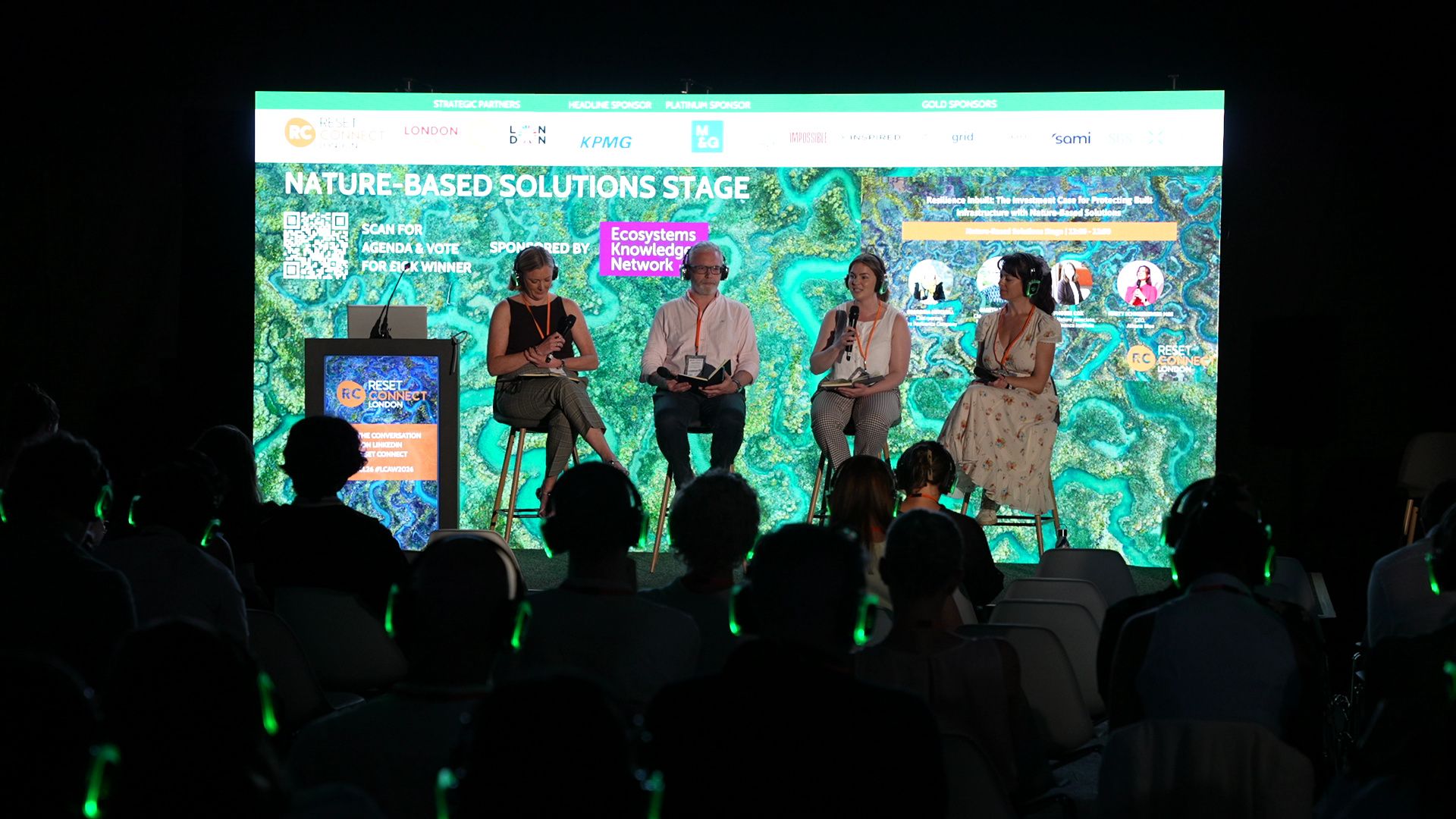
Resilience Inbuilt: The Investment Case for Protecting Built Infrastructure with Nature-Based Solutions
Home | Blog | Resilience Inbuilt: The Investment Case for Protecting Built Infrastructure with Nature-Based Solutions
Event: Reset Connect London 2026
Date and stage: 23 June 2026, Nature-Based Solutions Stage
Moderator: Georgina Mitchell, Chairperson, Aire Resilience Company
Speakers: Dr Gareth Thomas, National Biodiversity Network Trust. Phoebe Cox, Green Finance Institute. Kirsty Schneeberger MBE, Athena Blue.
Estimated read time: 6 minutes
Quick Read Summary
A business can have a flood plan for its premises and still lose power when the substation it relies on goes underwater. A road operator and a water company can both benefit from restoring the same stretch of upland. At Reset Connect London 2026, Georgina Mitchell asked how infrastructure operators can turn those shared dependencies into a case for investing in nature.
The panel identified two separate hurdles. A project has to demonstrate that it can reduce exposure to a specific risk. It also has to find customers willing to pay for that protection over the years the project needs to operate.
Look beyond the asset boundary
Phoebe Cox of the Green Finance Institute described how weather damage to roads, railways, substations and telecommunications hubs can interrupt businesses far from the damaged site. A port closure, for example, can delay suppliers and customers even when their own premises are unaffected. Water shortages can also hold up development or disrupt operations that depend on abstraction.
That wider exposure changes what an operator should assess. The cost of flooding includes the time a service is unavailable and the businesses that depend on it. It also changes where to intervene. An upstream project that slows water can help several assets downstream. An operator assessing only what it can build on its own land may miss the chance to share the cost of a larger intervention.
Start with the ecology of the site
Dr Gareth Thomas of the National Biodiversity Network Trust explained that wetlands, woodland and grassland can reduce exposure to hazards such as floods and heat. Their performance depends on the site and the condition of the habitat. An intervention also needs a plan for stewardship after the initial work is finished.
Thomas contrasted two examples. At Medmerry in West Sussex, moving the coastal defence line inland allowed intertidal habitat to develop and provided a buffer against storms. In the Flow Country, planting trees after draining deep peat damaged the habitat the intervention should have accounted for. The examples show why a species record, a map or a carbon estimate needs to be read alongside the ecology and hydrology of the place. A project that looks attractive on paper can create new risks if its baseline is poorly understood.
Find the customer before raising the capital
Kirsty Schneeberger of Athena Blue identified gaps in evidence, difficulty turning ecological benefits into an offer a buyer can purchase, and a mismatch between the size of individual projects and the sums institutional investors want to deploy. Monitoring coastal habitats can be particularly costly. Project developers need to show what they expect to deliver, then budget for measuring and reporting what happened after funding arrived.
Cox drew a distinction between the capital that gets a project started and the revenue that sustains it. Businesses she spoke to in East Anglia often recognised their exposure to flooding or water shortages. It was harder for them to estimate the cost of interrupted operations and how much a proposed intervention might reduce it. Until buyers can make that comparison, a technically credible project may struggle to secure a payment commitment.
Share the cost and the evidence
Cox pointed to the Moors for the Future Partnership as an example of the range of organisations that can benefit from upland peat restoration. Road operators have reasons to reduce flood disruption. Energy providers have a stake in wildfire risk, and water companies can benefit from better water quality and lower flood exposure at treatment sites.
Each organisation may assess the value of its own contribution separately, even though the benefits come from work across the same landscape. That can leave benefits out of a business case and require the project team to monitor different parcels on different schedules. Buyers who agree on a common baseline and reporting plan can assess the wider intervention while retaining evidence for their own investment decisions.
Schneeberger suggested that groups of buyers or advance commitments could give project developers more certainty about revenue. She also pointed to restoration across the Solent, where habitats including seagrass, oyster reefs and saltmarsh interact. The example illustrates why monitoring a whole coastal system can reveal benefits that would be missed if each habitat were assessed in isolation.
Practical Application
- Map the services your asset depends on, including power, transport, water and communications.
- Estimate the cost of disruption and identify who else faces losses from the same hazard.
- Assess ecological fit and compare the proposed intervention with other ways of protecting the asset.
- Agree who pays for delivery, maintenance and monitoring. Set a baseline that buyers and project developers can use together.
Key Takeaways
- The financial case for adaptation can extend beyond the asset owner to customers and operators that depend on the same network.
- Restoration needs a site-specific baseline and funding for stewardship.
- Upfront finance depends on a credible source of future revenue.
- Several beneficiaries can share project costs and agree a common approach to evidence.
Quote of the Session
“It’s a proper asset and it’s a proper piece of infrastructure that we rely on.”
Dr Gareth Thomas, Chief Executive Officer, National Biodiversity Network Trust
Final Thoughts
The investment case begins with a service that needs to keep running. Once operators identify who relies on it and what disruption costs them, they can compare interventions and decide who should contribute. The work then has to be planned and funded over the time it takes the habitat to deliver protection.
Speakers
Georgina Mitchell chairs Aire Resilience Company, a community interest company working with nature-based solutions to reduce flood risk to Leeds.
Dr Gareth Thomas is Chief Executive Officer of the National Biodiversity Network Trust, which hosts the NBN Atlas and works to make biodiversity data usable for decisions.
Phoebe Cox is a Senior Nature Associate at the Green Finance Institute. She works on financing resilience and bringing private investment into nature-based solutions.
Kirsty Schneeberger MBE is Founder and Chief Executive Officer of Athena Blue, which works with coastal and ocean projects and potential buyers to mobilise finance.
Watch Full Session