


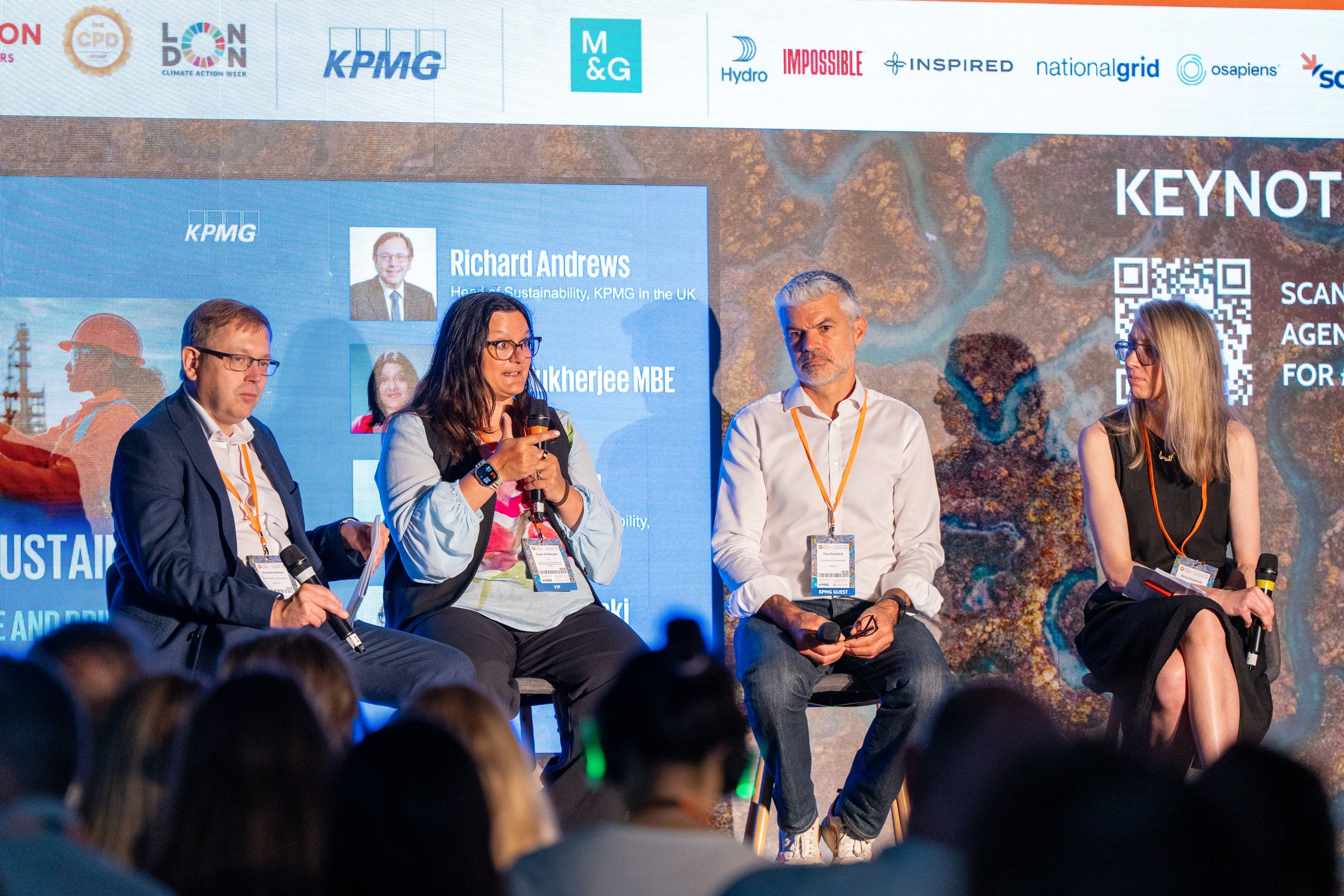
Keynote Panel - Reframing Sustainability: Building Resilience and Driving Growth.
Home | Blog | Keynote Panel - Reframing Sustainability: Building Resilience and Driving Growth.
Event: Reset Connect London 2026
Date: Tuesday 23 June 2026
Speakers: Richard Andrews, Head of Sustainability - KPMG (moderator). Sarah Mukherjee, CEO - Institute of Sustainability and Environmental Professionals. Tom Crawford, Global Head of Sustainability - Vodafone Group. Alicia Kedzierski, Head of Sustainable Finance Department - Financial Conduct Authority.
Estimated read time: 10 minutes
This session was hosted by KPMG, Headline Sponsor of Reset Connect London 2026, and moderated by KPMG’s Head of Sustainability.
Quick Read Summary
The argument running through this Reset Connect London 2026 keynote was that sustainability spent several years being defined by regulatory compliance, and that the useful framing now is resilience: whether a business can keep operating and growing through shocks it can no longer treat as exceptional.
The most concrete content came from the regulator. The Financial Conduct Authority has just published the findings of a transition finance pilot examining whether firms across the economy can actually raise the capital to transition, and the answer for smaller companies is complicated.
You will come away with what the pilot found, a working example of climate adaptation from a telecoms network, the commercial case for circularity as supply chain insurance, and an unusually blunt assessment of why the sustainability profession communicates badly.
Resilience Is the Frame That Survived the Regulatory Era
Richard Andrews of KPMG opened by explaining why the framing needed to change at all. An overemphasis on regulatory demands had, in his assessment, overshadowed the strategic and commercial advantages sustainability can deliver.
What has replaced it is resilience, and he broke it into categories: financial resilience, meaning the capital to weather a shock; operational resilience, maintaining products and services through disruption; commercial and strategic resilience against market shifts including AI and cyber; and an emerging category he called societal resilience, covering the role of private enterprise in supporting communities during periods of shock.
Tom Crawford of Vodafone described the same arc from inside a corporate function. There was a phase of enthusiastic target-setting without enough attention to delivery, then a swing towards heavy regulation which he considered necessary, and now a correction. What comes next is the interesting part: sustainability recognised as an environmental requirement and simultaneously as a resilience and growth driver. "It’s not woke, it’s not regulation, it’s just business language," he said, describing it as a return to the triple bottom line.
Alicia Kedzierski of the FCA offered the sharper version of the same point, noting that arguments resting on doing the right thing were commercially naive and did not account for the trade-offs involved.
Climate Adaptation Looks Like a Four-Step Operational Plan
Crawford gave the clearest worked example of adaptation in the batch, and it is built on the asset his company already owns.
He set the scale first, citing around 4,000 extreme weather events over the past decade, costing 2 trillion dollars and affecting 1.6 billion people. Telecoms is not immune: flooding in Germany in 2021 took out 13,000 of Vodafone’s fixed lines.
The response is a four-step framework of predict, prepare, respond and recover, underpinned by connectivity. Prediction uses data the network generates anyway, including ground temperature at base stations to identify wildfire risk and signal behaviour across data traffic to infer highly localised rainfall for flood forecasting. Preparation means early warning messages sent to handsets located inside an affected zone, as during cyclones in Mozambique. Response includes prioritising emergency services on 5G and deploying pop-up networks. Recovery covers both speed, with 80 per cent of those German lines restored within 24 hours, and redesigning for the next event.
His ask of government was pointed: lean into critical national infrastructure, prioritise it and invest in it, because these events are becoming routine.
The FCA Has Published What Actually Blocks Transition Finance
Kedzierski was explicit that the regulator’s interest is not in how many transition-labelled products exist, though if firms launch them they must be what they claim. The question the FCA has been asking is broader: can the transition be financed at all, and does market integrity allow firms across the economy to raise what they need.
The transition finance pilot, launched a year ago and published a few weeks before the event, examined whether barriers exist in practice, including within the FCA’s own rules. It found nothing in those rules requiring fundamental change, but it did surface frictions, and the underlying position is good: deep pools of capital and broad capability already exist in the UK.
The problem is smaller companies. A large corporate has a wide range of capital available. A smaller firm attempting something genuinely new runs into credit risk assessment that looks backwards at a track record it does not have. Public finance institutions exist to help, but Kedzierski found the landscape genuinely hard to navigate, recalling the moment she realised advice to "contact government" was meaningless: "there’s no hotline, how do you reach government?" Two responses are underway. The Treasury is considering what she described as a no wrong door approach, so a firm arriving at the wrong institution gets directed to the right one, and the Green Finance Institute has launched a transition finance lab supporting first-of-a-kind projects where both the asset and the financing structure are new.
Circularity Has Become a Supply Chain Insurance Policy
Crawford made the commercial case for circularity without reaching for environmental arguments at all.
Two pressures drive it. Raw material and component availability is volatile, worsened by AI data centre demand consuming memory chips and microprocessors and pushing prices up across the rest of the electronics industry, and by geopolitical and trade tension. At the other end, electronic waste is among the fastest growing waste streams: 44 million tonnes globally in 2014, 62 million tonnes in 2022 with only around 22 per cent officially recycled, and a projected 82 million tonnes by 2030.
The demand side has already moved. Research commissioned by Vodafone’s independent institute surveyed 5,000 customers across five European countries and found 40 per cent intending to buy a second-hand device next time. More tellingly, 81 per cent of those who already owned a second-hand device intended to buy another, which suggests the market is stable rather than experimental.
His most vivid example was the Royal Mint, which has diversified into electronic waste recycling and operates a chemical leaching process extracting gold from circuit boards in 10 to 20 seconds. "It’s no longer just an environmental option," he said. It is a resilience and competitive strategy.
The Sector’s Own Communication Is Part of the Problem
Sarah Mukherjee of ISEP was the most self-critical voice on the panel, and the most quotable.
Her first target was short-termism, describing the tendency of decision-makers to discount anything falling outside their own tenure, which she sees in policy, media and business alike. Her second was skills and training, which get squeezed first under cost pressure and which she argued is a strategic error: colleagues under 30 want to see what an organisation actually does rather than what it says, and "they will walk away if they think you’re not doing it".
Her sharpest criticism was aimed inward. "We have sometimes not been our own best friends," she said, describing a profession that talks in wonky nerd speak and alphabet soup without explaining to business leaders why any of it is relevant to their bottom line or their medium-term future.
Her proposed fix is almost embarrassingly simple. Saving money is what cuts through with organisations of every size, from multinationals to micro businesses. "Let’s just stop talking about carbon and saying you can save money," she said. Reduce consumption, free up budget for what the business actually wants, and the carbon saving follows anyway.
A Regulator Describes Its Most Useful Tool as Convening
Asked what regulation can do to support the transition, Kedzierski gave an answer that was not about rules.
Policy takes a long time to produce, so the FCA leans on something it has in abundance: almost every financial services firm has to talk to it. That convening power lets the regulator bring the market together, understand where the genuine challenges sit and let industry build its own tools. She pointed to the climate financial risk forum, co-convened with the Bank of England, which publishes practical material by industry for industry on adaptation and transition finance metrics.
She also announced on stage that the FCA has brought a firm working on climate scenario modelling into its regulatory sandbox, addressing a live question about whether the scenarios financial services currently uses capture second order impacts adequately.
Her closing thought was the most durable line of the session and applies well beyond finance: "what you do when you’re popular has to stand up when you’re unpopular." Her argument was that the sustainability field avoided hard conversations while conditions were favourable, and that having them openly now is what earns credibility as the politics shift.
Practical Application, How to Reframe Sustainability Internally
This panel was aimed at people who already believe the case and struggle to make it land with colleagues, which is a different problem from the one most conferences address.
Questions to ask
- Could we make this argument entirely in terms of cost saved and disruption avoided, without mentioning carbon?
- Do we have an operational plan for extreme weather, or only a risk register entry?
- If we are a smaller firm, have we mapped which public finance institutions and initiatives are actually open to us?
Signals to watch
- Treasury work on making public finance support easier for smaller firms to navigate
- Second-hand and refurbished purchase intent, which one large survey put at 40 per cent for mobile devices
- Changes to greenhouse gas accounting that would require hourly rather than annual renewable energy matching
Traps to avoid
- Cutting skills, training and communications first under cost pressure, which are the capabilities the rest depends on
- Making the values case to a commercial audience without the commercial one underneath it
- Treating circularity as waste management rather than as protection against price and supply volatility
What good looks like, on this panel’s account, is a sustainability case a finance director would recognise as a resilience investment, told in language nobody needs a glossary to follow.
Key Takeaways
A regulator, a global corporate and a professional institute agreed that the substance of sustainability work has not changed, and that almost everything about how it is framed has to.
- The FCA found no fundamental barriers in its own rules to transition finance, but identified frictions and a persistent funding challenge for smaller firms
- Backward-looking credit risk assessment is what blocks smaller companies attempting genuinely new things
- Vodafone runs climate adaptation as a four-step operational framework using network data to predict floods and wildfires
- Global electronic waste rose from 44 million tonnes in 2014 to 62 million in 2022, with only around a fifth officially recycled
- Cost saving is the argument that cuts through with businesses of every size, and carbon reduction follows it
Quote of the Session
"What you do when you’re popular has to stand up when you’re unpopular."
Alicia Kedzierski, Head of Sustainable Finance Department, Financial Conduct Authority
Final Thoughts
The most useful thing about this panel was its willingness to name the sector’s own failures.
Mukherjee on jargon and privileged voices dominating niche arguments, Kedzierski on values-led business cases being commercially naive, Crawford on enthusiastic targets set without delivery plans.
None of that is comfortable from a stage, and all of it explains more about the current backlash than any external factor.
What holds the reframing together is that none of the three arguments needs the others. Resilience stands on operational necessity, circularity on supply chain economics, transition finance on capital market plumbing. That independence is what makes the framing durable in a way that a single unifying argument would not be, and it is the reason this session was more convincing than the phrase reframing sustainability initially suggests.
Speakers
Richard Andrews, Head of Sustainability - KPMG (moderator). Richard is a partner and KPMG’s Head of UK ESG, leading the practice across all markets, with over 25 years of experience in regulation, controls and assurance and a previous appointment as a specialist advisor to the House of Commons Treasury Select Committee.
Sarah Mukherjee, CEO - Institute of Sustainability and Environmental Professionals. Sarah leads the professional institute for sustainability and environmental practitioners, having previously spent 20 years as an award-winning journalist reporting on environmental issues, with experience across the water industry, crop protection and environmental regulation.
Tom Crawford, Global Head of Sustainability - Vodafone Group. Tom is a design engineer by training with over 20 years in product development, manufacturing and commercial leadership, and established the sustainability function at Dyson before joining Vodafone. He is a named inventor on more than 70 patents.
Alicia Kedzierski, Head of Sustainable Finance Department - Financial Conduct Authority. Alicia sets the FCA’s regulatory ESG strategy and has led its sustainability disclosure requirements policy and its work on transition finance and transition planning, having previously worked at the Prudential Regulation Authority and the Bank of England.
Watch Full Session