


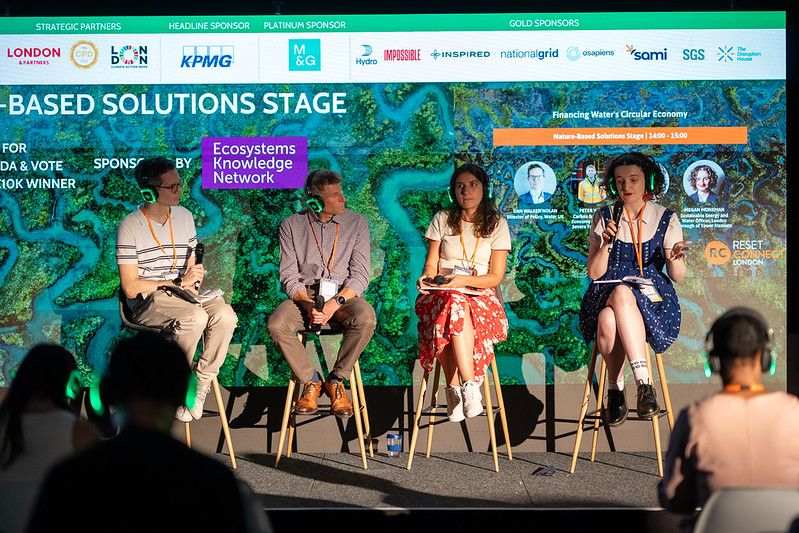
Financing Water’s Circular Economy
Home | Blog | Financing Water’s Circular Economy
Event: Reset Connect London 2026
Date and stage: Wednesday 24 June 2026, 14:00–15:00 (London time), Nature-Based Solutions Stage
Moderator: Dan Walker-Nolan, Water UK
Speakers: Peter Vale, Severn Trent. Antonia Doncila, Openreach. Megan Monkman, London Borough of Tower Hamlets.
Estimated reading time: 5 minutes
Quick Read Summary
- Openreach and Affinity Water tested whether spare fibre-optic cables could help identify water leaks early.
- The London Borough of Tower Hamlets discussed using planning and development funding to support water efficiency, reuse and sustainable drainage.
- Severn Trent is exploring how wastewater treatment works can recover useful materials, energy and water.
What are we already paying for?
A fibre-optic cable laid to carry broadband can also help find a leak in a nearby water pipe. A building designed with two sets of pipes could one day use reclaimed water to flush its toilets. And a treatment works can recover useful materials from sewage. At Reset Connect London, these examples raised a question that sits behind much of the debate about water supply. How much more could we get from the infrastructure we already pay to build and maintain?
Dan Walker-Nolan of Water UK moderated the discussion with Peter Vale of Severn Trent, Antonia Doncila of Openreach and Megan Monkman of the London Borough of Tower Hamlets. Their examples put the focus on where water and materials are lost, who can act and who benefits if the investment works.
Find the leak before it becomes a repair
Antonia Doncila described a trial with Affinity Water that used spare capacity in Openreach’s fibre-optic network. A device sends pulses of light along the fibre and measures changes in the signal caused by vibrations nearby. Where fibre runs close to a water pipe, those changes can give the water company a location to investigate.
The process depends on work in the field. Teams investigate alerts and use confirmed events to build a reference library of signals. That helps them distinguish a likely leak from other activity near the cable. The trial illustrates how a telecommunications network can support another utility without the water company having to install a separate sensing network along the same route.
The financial case depends on how a warning changes the response. Detecting a leak earlier can reduce the amount of treated water lost and give a utility a chance to intervene before a fault causes wider damage. Evaluating a trial therefore means looking at confirmed leaks, time to repair and avoided losses alongside the cost of the sensing system.
Design buildings for the water they need
Megan Monkman pointed to a decision that developers can make while a building is still on the drawing board. Separate pipes can keep drinking water apart from lower-grade water suitable for some uses, such as toilet flushing. Installing those pipes during construction could make future reuse easier where a safe and suitable supply becomes available.
The London Borough of Tower Hamlets example also connected water demand to flood risk. Megan Monkman described proposals for tighter water-efficiency and runoff requirements, alongside a possible payment where a developer can demonstrate that site constraints prevent compliance. The idea was to direct that money into measures such as sustainable drainage and water reuse across the borough.
The council’s town hall already provided a practical example through rainwater harvesting and greywater recycling. Extending that work across more buildings would depend on funding, site conditions and who will maintain the systems after installation. Those questions belong in the design and budget from the start.
Recover what arrives at the treatment works
Peter Vale described how Severn Trent is exploring ways to recover more from wastewater. Cellulose from sewage could become a feedstock for materials. Recovering ammonia could turn a substance that must be managed during treatment into a useful input. He also discussed whether highly treated water could serve uses such as irrigation, depending on the treatment required and the needs of the intended user.
Each example changes the investment question. The treatment works needs a reliable process, and the recovered material or water needs a use that can support the cost of producing and supplying it. A pilot can establish how well a process works and what else would have to be in place before it could operate at scale.
Put the costs and benefits in the same conversation
The panel’s examples cross organisational boundaries. Openreach owns the fibre, while a water company investigates and repairs a leak. A developer decides what plumbing goes into a building, while a future occupant pays to use and maintain it. A treatment works can recover a material, but another organisation may be the one that uses it.
Those boundaries help explain why a technically promising idea can be hard to fund. The organisations involved need to agree what each will pay for and how they will measure what changes. Bringing those decisions forward can make it easier to move from a trial to a service people can use.
Putting it into practice
Choose a defined problem, such as leaks along a stretch of pipe or demand for drinking water in a new building. Record the starting point, identify who would use the service or recovered resource, and agree who will pay for installation and ongoing operation. Use the trial to measure whether the project delivers enough value to justify extending it.
Key Takeaways
- Measure how earlier detection changes the time to repair and the amount of treated water lost.
- Consider water reuse when specifying plumbing and drainage for new buildings.
- Give recovered water and materials a clear end use before committing to wider deployment.
Quote of the Session
“It really is a platform for cross-sector collaboration.”
Antonia Doncila, Openreach, on using fibre-optic sensing across utilities
Final Thoughts
The most telling example was an existing cable finding a new use. It worked because the organisations involved could bring different assets and expertise to the same problem. Similar decisions arise in buildings and treatment works, where the case for investment becomes clearer once the people paying for the work and the people using its results are part of the same conversation.
Speakers and moderator
Dan Walker-Nolan | Director of Policy, Water UK. Dan Walker-Nolan moderated the discussion and framed water reuse and efficiency in the context of supply pressures.
Peter Vale | Carbon and Circular Economy Architect, Severn Trent. Peter Vale described the utility’s work to test new ways of recovering materials, energy and water from wastewater.
Antonia Doncila | Sustainability Manager for Climate and Nature, Openreach. Antonia Doncila explained how fibre-optic sensing can help water companies identify potential leaks earlier.
Megan Monkman | Sustainable Energy and Water Officer, London Borough of Tower Hamlets. Megan Monkman discussed planning, water reuse and sustainable drainage from a local authority perspective.
Watch Full Session