


Creating Resilient Cities Through Sustainable Transport and Travel
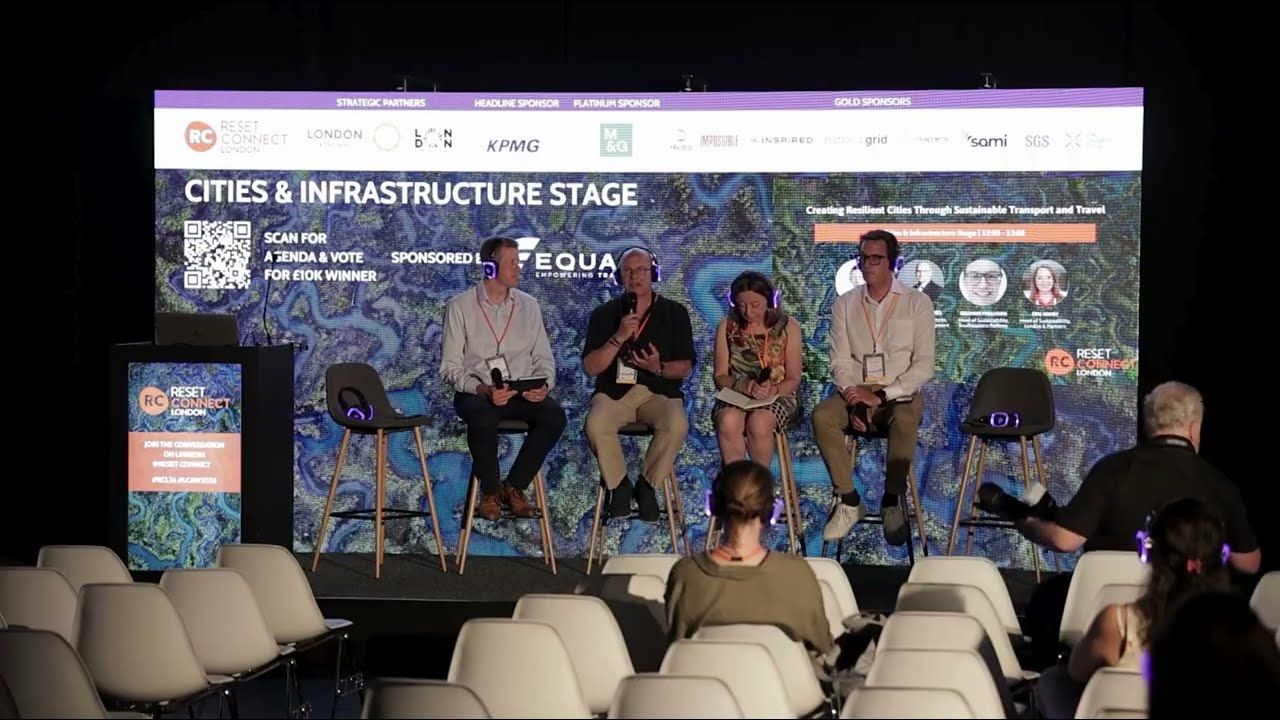
“So we have a brilliantly resilient railway system, but no one can use it.”
-Graham Mollison, Head of Sustainability, Southeastern Railway
🏠︎ | Blog | Creating Resilient Cities Through Sustainable Transport and Travel
Event: Reset Connect London 2026
Date: Tuesday 23 June 2026
Stage: Cities & Infrastructure Stage
Speakers: Ben Foulser, Partner, KPMG UK (moderator); Peter Runacres, Head of Urban Futures, The Earl’s Court Development Company; Graham Mollison, Head of Sustainability, Southeastern Railway; Pru Ashby, Head of Green Innovation, London & Partners.
Estimated read time: 8 minutes
Quick Read Summary
A station can remain above floodwater while every road leading to it is submerged. Graham Mollison used that example to expose a weakness in how transport resilience is assessed: protecting the asset does not necessarily protect the journey.
At Reset Connect London 2026, Southeastern Railway, The Earl’s Court Development Company and London & Partners explored how sustainable transport connects with climate adaptation, public space and economic opportunity. Moderated by KPMG UK’s Ben Foulser, the discussion moved between long-term infrastructure planning and the everyday reasons people choose a car over public transport.
The practical lesson was to examine the connections: between stations and surrounding streets, transport and energy systems, new technology and accessibility. Resilience depends on those relationships working together.
A Resilient Railway Is Only Useful If People Can Reach It
For Mollison, resilience starts with providing services people can rely on, including those who cannot work from home. He recalled running trains for essential workers during the pandemic and linked that responsibility to recovering quickly when weather disrupts the network.
His station example showed why recovery cannot be planned within the railway boundary alone. An elevated station might be protected from flooding, but flooded approach roads can still prevent passengers reaching it. A transport operator needs to understand what happens to the surrounding community as well as its own infrastructure.
Mollison described an interdependency workshop bringing together Network Rail, local authorities and other organisations whose services depend on one another. The purpose was to identify shared vulnerabilities and work out how those organisations could respond collectively.
That changes the scope of an investment decision. Protecting a station, road or railway embankment may solve one organisation’s problem while leaving the journey broken elsewhere. The useful question is whether people can still reach work, education and essential services when conditions deteriorate, and which partners must act to make that possible.
Long-Term Adaptation Needs Decisions That Can Change
The challenge is also one of timescales. Mollison described the difficulty of moving a business accustomed to relatively short planning windows towards decisions about climate conditions decades ahead. A fixed forecast offers little reassurance if sea levels, rainfall or temperatures develop differently from expectations.
He explained how adaptation pathways can provide a long-term direction with points at which the response changes. Working with Network Rail, the Environment Agency and local authorities means considering how infrastructure and flood defences interact, rather than treating each asset as an isolated engineering problem.
Peter Runacres, Head of Urban Futures at The Earl’s Court Development Company, extended that approach to urban development. He described plans to connect drainage, water reuse and planting so that public spaces can remain usable as the climate changes. The aim is to combine functions: a landscape can support movement, manage rainfall and provide shade.
Both accounts favour decisions that preserve options. Planning for resilience does not mean claiming to know exactly what conditions will be in 2050. It means identifying dependencies, choosing interventions that address them and knowing when a different response may be needed. Those review points belong within the strategy from the beginning.
Transport Choices Shape the Space Between Buildings
Earls Court’s existing transport connections give the development a strong starting point. Runacres described nearby Underground and rail services, then focused on a different challenge: how people move safely through the neighbourhood once they arrive.
He presented a largely car-free approach, with parking concentrated on accessible provision and an electric car pool. The intention is to reduce the space dominated by vehicles while retaining access for people who need it. That is a design choice about the kind of neighbourhood being created, not simply a target for reducing car use.
Less vehicle-dominated space creates opportunities for planting, play and other uses of the public realm. Runacres connected that space with climate resilience, explaining how transport planning can make room for greener routes and sustainable drainage. He also discussed the potential to connect the development’s energy storage with local mobility needs.
These were proposals and opportunities described at the session, rather than evidence that every benefit had already been delivered. Their value lies in considering the systems together at design stage. If roads, energy infrastructure, landscaping and water management are commissioned separately, the opportunity to make one investment serve several purposes can be missed.
Sustainable Travel Has to Work for the Person Making the Journey
An audience question brought the discussion down to the experience of travelling with children, navigating broken lifts and using crowded transport in hot weather. A journey can appear sustainable in a plan while remaining unattractive or impractical for the person expected to make it.
Mollison described Southeastern’s work on accessible toilets, station access and an accessibility panel that advises the business. He also highlighted assistance services that help passengers board and use trains. These measures address confidence as well as physical infrastructure: passengers need to know the journey is achievable before they set out.
Pru Ashby, Head of Green Innovation at London & Partners, pointed to passenger comfort in newer transport infrastructure and the potential of services that bring different modes together in one booking experience. Runacres discussed making information about a development’s transport options available for journey planning.
Foulser’s response identified where integration can still fail: a lift’s status missing from a journey planner, a train departing before a connecting bus arrives, or an uncomfortable vehicle discouraging repeat use. Better data and coordination have to resolve those practical problems. Adding another planning tool is not enough if the information does not reflect the journey people will actually encounter.
New Technology Needs a Clear Role in the Transport System
Autonomous vehicles prompted both enthusiasm and questions about their purpose. Ashby described London’s appeal to mobility innovators, while emphasising the need to consider safety and the effect on existing transport workers. She raised autonomous buses as a possible response to driver recruitment difficulties, rather than assuming every application should be a private car journey.
Runacres explored how shared autonomous vehicles could reduce the need for parked cars and release street space for other uses. Mollison considered a complementary role for rail: connecting rural communities and people with changing mobility needs to the beginning or end of a train journey.
The benefits were conditional. Foulser asked how rail would compete if a direct, single-occupancy journey became cheaper and avoided an interchange. Making a vehicle autonomous does not, by itself, establish that it will support public transport or a city’s wider objectives.
Ashby’s broader argument was to connect innovation with real city challenges, funding and opportunities to test solutions. For transport organisations, that means defining the problem before selecting the technology. A trial should show whether a service improves access, strengthens an existing network or changes how space is used, and examine what it might make worse elsewhere.
Practical Application: Test the Whole Journey Before Protecting One Asset
Start with a journey that matters to a community, workforce or development. Trace it from the front door to the destination, including every interchange and access route. Then test how it works during disruption.
Questions to ask
- Can passengers reach the station if nearby roads flood, and who is responsible for those roads?
- Does journey information include the accessibility and service conditions people need to make a decision?
- Could transport, drainage, planting and energy infrastructure share space or investment?
Signals to watch
- Dependencies that fall between organisations’ existing risk registers.
- Recurring failures at interchanges or on the first and last parts of a journey.
- Opportunities to trial innovation against a clearly defined service problem.
Traps to avoid
- Calling an asset resilient without checking whether the service remains usable.
- Reducing vehicle access without designing for people who still need it.
- Assuming a new technology will improve the whole system because it solves one problem.
Bring the relevant operators, infrastructure owners and local authorities into the same conversation. Agree who acts, what information they share and when the plan needs revisiting.
Key Takeaways
- Reliable transport depends on access routes and connecting services as well as the railway or road itself.
- Adaptation pathways provide a long-term direction while allowing decisions to change as conditions develop.
- Transport planning can release public space for planting, drainage and other neighbourhood uses.
- Accessibility, comfort and accurate information influence whether people can choose sustainable travel.
- Autonomous vehicles need to be assessed against their contribution to the wider network, rather than treated as inherently beneficial.
- Collaboration can uncover practical improvements that do not begin with buying new technology.
Final Thoughts
The panel’s most useful examples concerned the boundaries between responsibilities. A station survives a flood but passengers cannot reach it. A journey planner offers a route without the information needed to use it. A development gains transport connections but still has to make its internal streets welcoming and accessible.
Those gaps are difficult to solve through a single organisation’s investment programme. They require shared information, decisions about public space and relationships that continue beyond an individual project.
For businesses, developers and public authorities, the starting point is concrete: choose a journey, identify where it can fail and bring the organisations responsible for those connections together. That creates a more useful test of sustainable transport than considering each asset in isolation.
Speakers
Ben Foulser, Partner, KPMG UK (moderator). Ben works in KPMG’s transport practice. Introducing the session, he described around 20 years’ experience in the sector and responsibility for its work in sustainable and intelligent transport.
Peter Runacres, Head of Urban Futures, The Earl’s Court Development Company. Peter’s experience includes regeneration at King’s Cross and New Street Square in London and the Al Bahar Towers in Abu Dhabi. At Earls Court, he focuses on the long-term resilience of the masterplan and infrastructure, integrating design, technology and sustainability from concept to operation.
Graham Mollison, Head of Sustainability, Southeastern Railway. Graham leads Southeastern’s sustainability programme, covering decarbonisation and climate adaptation. His work includes the operator’s net zero roadmap, contributions to rail carbon accounting and collaboration on climate resilience across the transport system.
Pru Ashby, Head of Green Innovation, London & Partners. Pru leads work connecting green innovation with London’s economic development. Her experience spans supporting international companies expanding into London, work with Tech City UK and a posting in New York. She studied engineering and previously worked in utilities and events across several countries.
Watch Full Session