


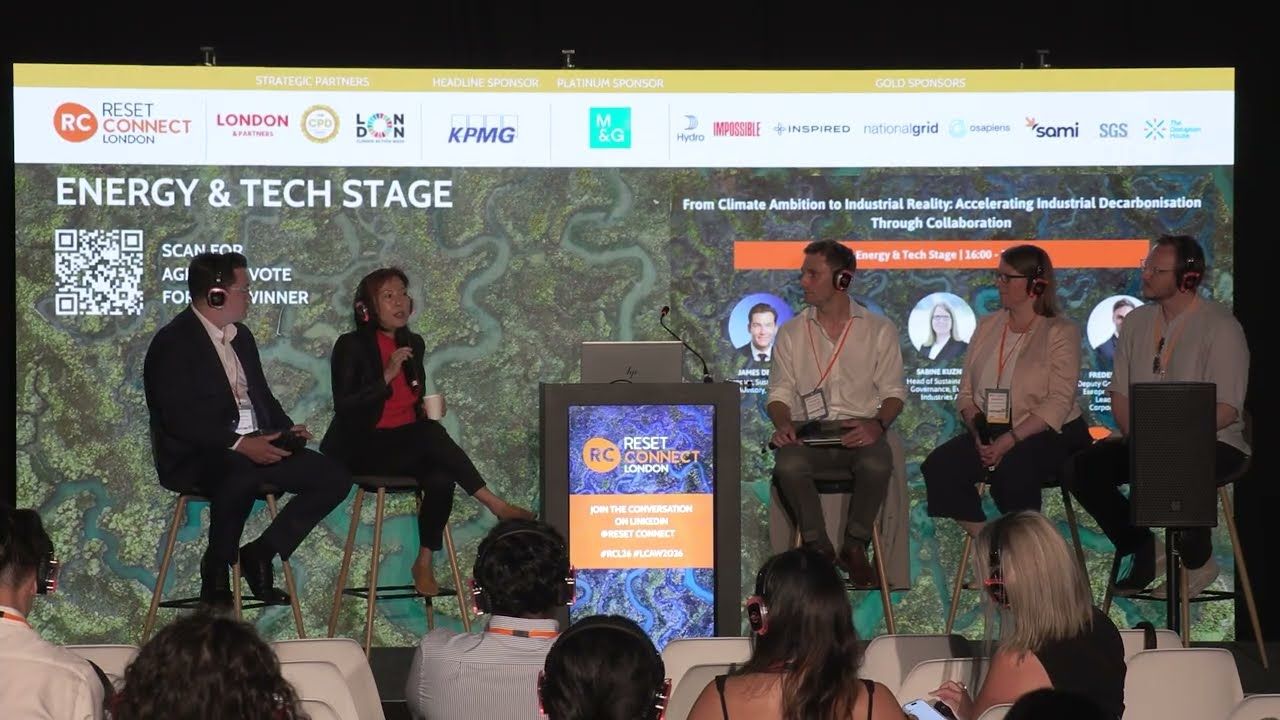
From Climate Ambition to Industrial Reality: Accelerating Industrial Decarbonisation Through Collaboration
Home | Blog | From Climate Ambition to Industrial Reality
Event Reset Connect London 2026
Date Tuesday 23 June 2026, 16:00–17:00
Stage Energy & Tech Stage
Moderator James Dennis, Director, Sustainability Advisory, KPMG
Speakers Michelle Tan, Senior Vice President & Head, Environmental Sustainability, Singapore Economic Development Board (EDB). Sabine Kuznik, Head of Sustainability Governance, Evonik Industries AG. Thomas Panton, Founding Associate, Endgame Capital. Frederick Barnes, Deputy General Manager & European Sustainability Lead, Sumitomo Corporation Europe.
Estimated read time 5 minutes
Quick Read Summary
A steelmaker needs to know where its cleaner energy will come from and who will buy the steel. An energy supplier needs enough demand to justify investment. A buyer may be willing to pay more for lower-emissions material, provided it can count on the supply and defend the price. Each decision depends on the others.
At Reset Connect London 2026, panellists from industry, economic development and climate investment explored how to get those decisions made together, from testing hydrogen in an existing blast furnace to finding customers willing to commit to future steel production.
1. Start with the plant you have
The choice of technology depends on what a plant makes, which equipment it can adapt and what infrastructure it can access. Electrification changes a site’s power requirements. A fuel switch depends on a reliable supply at a workable price. Carbon capture raises a separate question about what happens to the captured CO₂.
Hydrogen brought those differences into focus. A technology can work in a trial while its supply remains too expensive or uncertain for widespread use. The next decision is which changes can be made now and which depend on investment outside the plant gate.
2. Use trials to answer investment questions
Frederick Barnes described a Japanese steelmaking collaboration that tested hydrogen injection in a blast furnace. Testing a change on equipment already in use can show what needs adapting and what a larger deployment would require.
The panel also discussed a European project designed around hydrogen-based steel production from the outset. A new plant brings a different set of commitments. The steelworks, hydrogen supply and customers all need to come together on a timetable that makes sense for the investment.
3. Bring buyers in before production starts
Who pays the green premium? The panel used steel to make the question concrete. Through an offtake agreement, a buyer commits to taking some of a project’s future output. That gives the producer a clearer view of demand before it builds capacity.
Barnes pointed to automotive manufacturers willing to pay more for lower-emissions steel. The size and duration of that premium matter to both sides. A buyer needs to know what it is getting for the price, while the producer needs to know whether the orders cover enough output to justify investment.
4. Combine demand where projects share a constraint
Michelle Tan brought the perspective of Singapore’s Economic Development Board, which works with manufacturers and export-oriented industries. Where several businesses face similar costs or infrastructure constraints, combining demand can give suppliers a clearer view of the market and help public agencies identify bottlenecks affecting more than one project.
That logic also applies across borders. Cleaner fuel may be produced in one market, used to make a material in another and sold to customers elsewhere. Those partners need to know when the others can commit before setting their own investment dates.
5. Decide what the next stage of investment needs
A project moving from trial to commercial production has to answer questions about price, timing and volume. A successful trial may establish what a process can do under particular operating conditions. A purchase commitment can show that customers will take the output. Each piece of evidence answers a different question for the people deciding whether to back the project.
6. Look for usable heat next door
Sabine Kuznik described an Evonik site in Belgium near a waste-to-energy plant. She raised the possibility of bringing steam from that plant into production to reduce the site’s reliance on gas. The companies would need to work together on the supply, with public authorities involved where permits are required. She also pointed to data centres as a potential source of heat for nearby users.
Practical Application
Pick one process and identify the decision holding up investment. If the issue is the cost of cleaner energy, ask suppliers what purchase volumes would change the price. If it is demand, ask buyers what they could commit to and what evidence they need about emissions. If it is whether a technology can work on the site, design the trial around the operating data the manufacturer and its investors need.
Key Takeaways
- Test the technology against the constraints of the site where it will be used.
- Discuss offtake volumes and prices with buyers early enough to inform the investment decision.
- Where projects depend on the same infrastructure, compare requirements and timelines before each company plans in isolation.
Quote of the Session
“Clearly we’ve got a lot of technology available today and a lot of funding and enthusiasm in deploying those technologies, but we’re not achieving the scale of decarbonisation that we’re seeking to achieve in line with the Paris Agreement.”
James Dennis, Director, Sustainability Advisory, KPMG
Final Thoughts
The panel opened with the gap between climate ambition and the pace of industrial decarbonisation. The steel examples gave that gap a practical shape. Producers, energy suppliers and buyers each have a decision to make, and a project can stall when any one of them has to commit before it knows what the others can deliver.
Speakers
James Dennis, Director, Sustainability Advisory, KPMG, moderated the discussion.
Michelle Tan, Senior Vice President & Head, Environmental Sustainability, Singapore Economic Development Board (EDB), spoke from the perspective of an agency working with industrial companies.
Sabine Kuznik, Head of Sustainability Governance, Evonik Industries AG, brought the perspective of a chemicals manufacturer.
Thomas Panton, Founding Associate, Endgame Capital, brought an early-stage climate investment perspective.
Frederick Barnes, Deputy General Manager & European Sustainability Lead, Sumitomo Corporation Europe, shared steelmaking and supply chain examples.
Watch Full Session