


Banking on Sustainability: Turning Responsibility into Opportunity
Home | Blog | Banking on Sustainability: Turning Responsibility into Opportunity
Event, date, speakers and read time
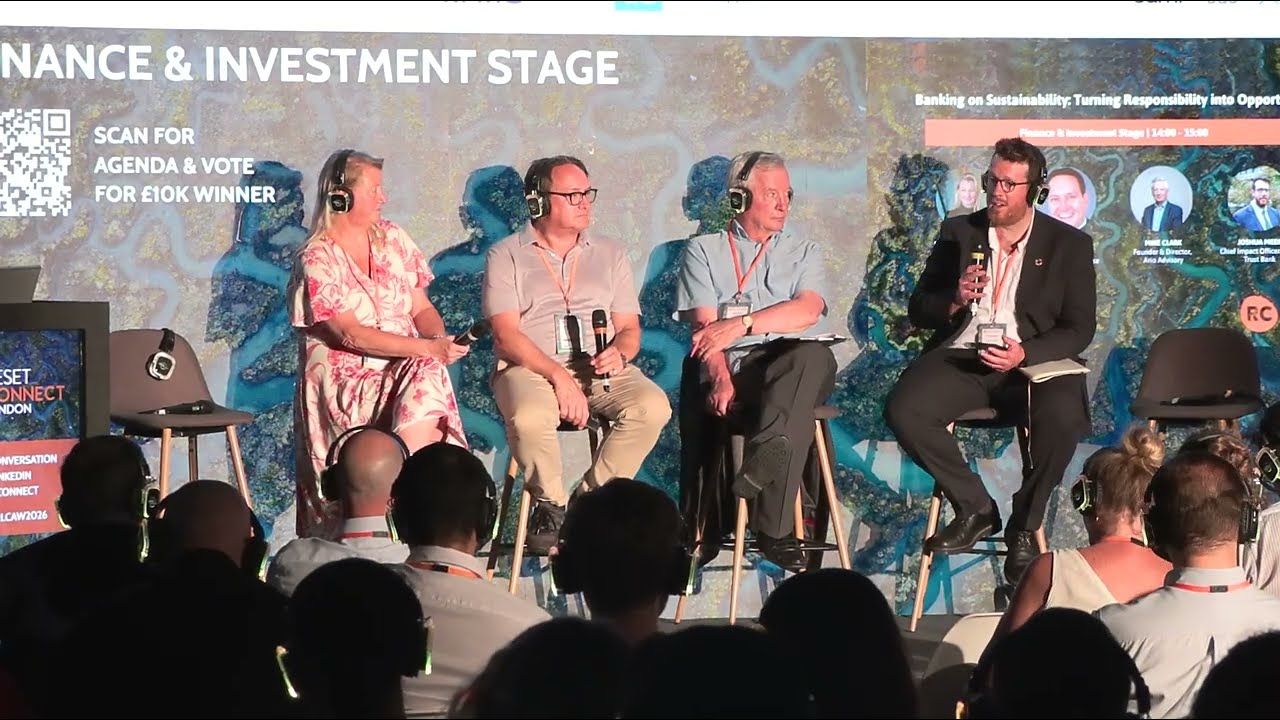
Reset Connect London 2026 | Tuesday 23 June 2026 | 14:00–15:00 | Finance & Investment Stage
Heather Buchanan, moderator, Bankers for Net Zero initiative and APPG on Sustainable Finance. Rupert Bull, CEO, The Disruption House. Mike Clark, Founder and Director, Ario Advisory. Joshua Meek, Chief Impact Officer, Unity Trust Bank.
Estimated read time: 8 minutes
Quick Read Summary
Why can a bank have money available for transition lending and still struggle to find projects it can finance? Heather Buchanan put that question to a panel spanning commercial lending, data and advisory work. The answers came down to what a lender can see about a borrower, what the borrower gains by taking part, and who can share the risk when a worthwhile project stalls.
The discussion moved from a small business’s energy bill to the design of rebates and first-loss facilities. It also raised a question for anyone writing a transition plan: how much can a national or portfolio-wide framework tell you about what a particular business or place actually needs?
Quote of the Session
“If you can’t see who needs a carrot, how do you know to offer them a carrot?”
Rupert Bull, CEO, The Disruption House
Why earmarked money can sit unused
Heather Buchanan began with the distance between building the machinery for sustainable finance and getting money into businesses. The sector has spent years developing commitments and ways to measure progress. Her question was who could change the conditions that still keep capital from moving: banks, governments or regulators.
Rupert Bull described a problem that arises even when funding is available. A lender has to find suitable borrowers and determine what the proceeds will pay for. If a loan is labelled as transition finance and the money goes to a different use, the lender may have to defend the environmental claim it made about the deal. The caution is understandable, but it can leave a lending programme with money to deploy and very few applications it can confidently approve.
An aggregate commitment tells you how much money an institution intends to make available. It tells you much less about the decisions a lender faces when a particular firm applies. What equipment will be replaced? What evidence supports the expected savings? Can the lender establish what happened after the money went out? Answering those questions takes staff time and reliable information. On smaller loans, the work involved can matter as much as the price of the capital.
Start with something the borrower wants to know
Bull described approaching businesses with a question about whether they could spend less on energy. An energy bill is something a business already has. If sharing it helps the firm find a better deal or understand why its costs have risen, the owner has an immediate reason to take part. The same information can give a lender or adviser a starting point for a conversation about energy use and potential investment.
That starting point is especially relevant for smaller businesses. An owner may be able to tell you exactly which machine is unreliable and when it will need replacing, yet have little time to assemble a broad sustainability return. If the lender asks for everything it might one day find useful, the customer may never get far enough to discuss the investment. If it asks for the information needed to assess a specific project, it can explain what each piece of evidence is for.
There are limits to what energy records can tell a lender. A bill can show what the business purchased and how much it paid. It can’t, on its own, show that a particular installation will deliver the expected savings. That requires an estimate, a project specification and some way to check what happened after installation. The merit of starting with the bill is that it gives the conversation somewhere concrete to go.
Follow what the bank is financing
Joshua Meek introduced Unity Trust Bank through its double bottom line. He described a bank founded by trade unions with a requirement to remain commercially sustainable while delivering positive social, economic and environmental impact. For Meek, that begins with knowing what the money is used for when the bank lends.
That perspective broadens the conversation beyond labelling a loan. A bank that starts with the purpose of the lending can ask what change the borrower expects to make and what evidence would tell the bank whether it happened. Those questions belong in the discussion about the loan itself. They are harder to answer once the project is underway and the borrower is being asked to reconstruct decisions from old invoices and estimates.
The commercial decision still matters. A project can have a clear purpose and a borrower can have a credible plan, yet the loan can remain difficult for the bank to approve. Knowing the use of proceeds helps establish what the investment is intended to achieve. The lender still has to decide whether the borrower can repay, whether the project can be delivered and whether the terms make sense for both sides.
Choose the incentive that changes the decision
Bull used a heat pump to illustrate why the form of support matters. A small discount on a loan may leave a business facing much the same upfront cost and payback period. A rebate that reduces the cost of installation could make the same project easier to justify. The point of the example was to ask which change would affect the owner’s decision.
A first-loss facility addresses a different decision. Under that kind of arrangement, another party agrees to absorb a defined initial portion of losses. The lender still makes a credit decision, but it makes it with a different exposure to the downside. The panel discussed this as a possible way for government or another institution to enable lending that banks might otherwise decline.
Those mechanisms can be assessed by looking at the project that would have stalled. If a borrower sees little benefit in going ahead, a guarantee for the lender might leave the central problem untouched. If the borrower is willing to proceed and a lender cannot bear the risk on the proposed terms, an installation rebate may solve only part of the problem. Where public money is involved, there is also a question about how to show that the support enabled an investment that would otherwise have been delayed or abandoned.
Account for the risks a lender cannot carry alone
Mike Clark drew a distinction between financial risk and societal risk. A community can be exposed to harm that a lender sees only indirectly, through the borrower’s ability to keep trading or the security behind a loan. Equally, an investment can make a place more resilient while delivering benefits that are shared among many organisations. The return available to one lender may reflect only a fraction of what the investment is worth to those affected.
The closing discussion brought that question down to the level of place. Physical climate risk depends on where a business operates and what it relies on. A portfolio can be organised around sectors and loan sizes while the practical exposure turns on the condition of a building, local infrastructure or whether an area is prone to flooding. The panel raised local authorities and local climate bonds in discussing how capital could reach investments shaped by those conditions.
For a lender, taking place seriously changes what counts as relevant evidence. A standard assessment can provide consistency across applications. Local information helps explain why two businesses that look similar on paper might need different investments or different terms. The opportunity is to use both when deciding which projects can proceed and who needs to be involved.
Practical application
Take one prospective investment, such as a small firm replacing expensive heating equipment. Ask the owner what they pay now, what will be installed, what savings they expect and how much they can afford upfront. Agree what evidence can show the money was used for the installation. Then identify the reason the project is likely to stall. If the payback is too long for the borrower, assess whether a rebate could change it. If the lender cannot carry the credit risk, establish whether a partner could share it under clear terms. If the uncertainty is about the projected savings, begin with better information about the building and its energy use.
Key takeaways
- Give borrowers an immediate reason to share data, such as understanding energy costs.
- Agree what the loan will pay for and how that will be checked.
- Distinguish the support a borrower needs from the risk a lender needs to share.
- Include local conditions when assessing physical risk and the proposed investment.
Final thoughts
The panel’s opening question about who is responsible becomes easier to answer when there is a project on the table. The borrower can explain what would make the investment worthwhile. The lender can say what it needs to assess the deal. A public or local partner can identify where the benefits extend beyond that transaction and whether it has a role in making the project happen.
Speaker bios
Heather Buchanan moderated the session. She co-founded the Bankers for Net Zero initiative and works with the APPG on Sustainable Finance.
Rupert Bull is CEO of The Disruption House. He discussed the firm’s work on sustainability data and transition lending, including using energy costs to open a conversation with smaller businesses.
Mike Clark is Founder and Director of Ario Advisory. He introduced himself as an actuary working across banking, insurance, pensions and regulation.
Joshua Meek is Chief Impact Officer at Unity Trust Bank. He explained how the bank considers the purpose of its commercial lending alongside its financial sustainability.
Watch Full Session