


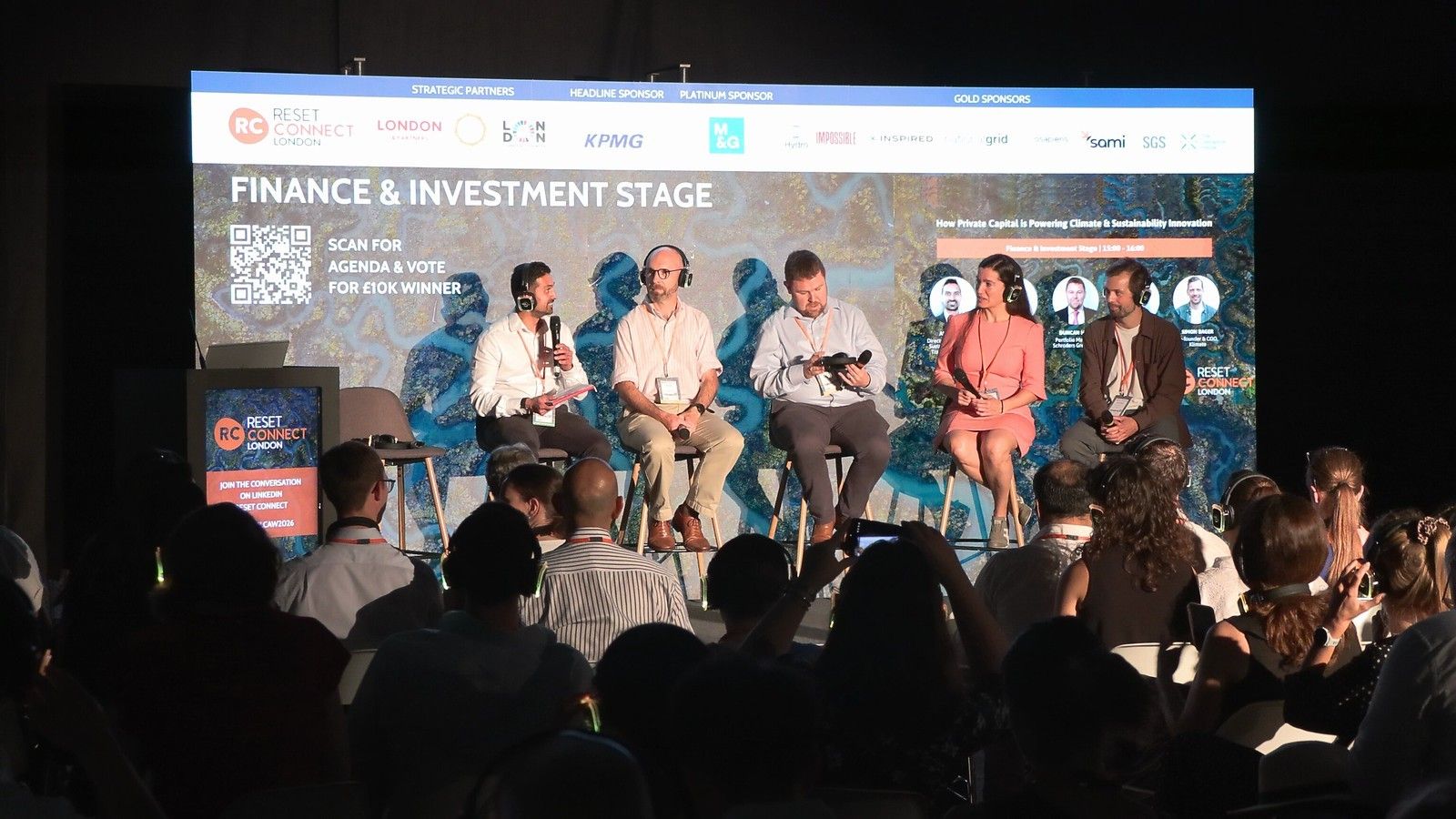
How Private Capital is Powering Climate & Sustainability Innovation
🏠 | Blog | How Private Capital is Powering Climate & Sustainability Innovation
Event: Reset Connect London 2026
Date: Tuesday 23 June 2026
Speakers: Akhil Shah, Director - Climate Tech | Sustainable Finance & Transition - HSBC UK (moderator). Cam Ross, CEO - Green Angel Ventures. Duncan Hale, Portfolio Manager - Schroders Greencoat. Stephanie Bilo, Chief Client & Investment Solutions Officer - responsAbility Investments AG. Simon Bager, Co-founder & COO - Klimate.
Estimated read time: 10 minutes
Quick Read Summary
Climate innovation does not get funded by one kind of money. It gets funded by a chain of very different investors with incompatible risk appetites, each handing a company on to the next. This Reset Connect London 2026 panel put four links of that chain on one stage and asked them to explain where they fit.
The most useful thing to come out of it was a financing model borrowed wholesale from renewables. Corporate offtake agreements, the mechanism that built the wind industry, are now being applied to carbon removal, allowing a facility to raise debt against a contracted buyer rather than a hope.
You will come away with what each stage of capital wants, how blended structures are actually assembled, and an honest account of why nature-based solutions are still struggling to attract commercial money.
Four Kinds of Capital, One Chain
Cam Ross, CEO of Green Angel Ventures, sits at the earliest end. His firm invests at pre-seed and seed, often into two people with an idea, no revenue and no clients but a technology with credible
climate potential over five to 10 years. Typically it comes in just after a friends and family round, putting perhaps £500,000 into a £1 million raise.
Duncan Hale, Portfolio Manager at Schroders Greencoat, sits at the opposite end and noted the two of them had been seated together as a joke. His side invests in large infrastructure with identifiable cash flows: wind, solar, batteries, green hydrogen and large heat pumps, on behalf of pension funds and wealth investors expecting returns in the region of 8 to 12 per cent. What he sells alongside the return is a different risk profile, exposed to inflation, power prices and weather rather than to the risks already sitting in the rest of a portfolio.
Stephanie Bilo, Chief Client and Investment Solutions Officer at responsAbility Investments AG, described her firm as the missing middle, operating in more than 70 countries as the emerging markets specialist within M&G. Simon Bager, Co-founder of Klimate, sits alongside the technologies themselves, channelling corporate capital into carbon removal through offtake agreements and debt.
For a commercial reader, this matters because it clarifies who to approach and when. A company pitching infrastructure investors before it has contracted cash flows is not underfunded, it is in the wrong room.
Different Investors Have Different Return Requirements
Asked directly whether his investors would accept a lower return for impact, Hale said no, and explained why the question rarely arises. Defined contribution pension trustees have a fiduciary duty they interpret narrowly, and in his part of the market the returns are strong enough that no trade-off is required. "Thankfully we’re not in a position where we need to make that compromise," he said, adding that if they were, the answer would still be no.
Bilo gave the more differentiated answer. Some of her investors will accept lower returns or a first-loss position, not out of sentiment but as leverage: taking the junior tranche allows them to mobilise three, four or five times more capital behind it. She also noted that perceived emerging market risk often exceeds the actual position, with default rates in some markets lower than developed market investors assume. Increasingly this capital comes from second-generation entrepreneurial families as well as governments.
Ross said the question does not apply to him at all. His investors are not shaving a couple of points for impact; they are targeting roughly three times their money over five to 10 years, across a portfolio of 20 to 25 companies, on the expectation that a third will fold entirely.
For a commercial reader, this matters because concessionary capital is a structural tool rather than a charitable one. Its purpose is to change the risk profile of the tranche above it.
Carbon Removal Is Borrowing the Power Purchase Agreement Model
Bager set out the mechanism most likely to travel. In renewables, a power purchase agreement gives a developer a contracted buyer for the electricity, and a bank lends against that contract to build the facility. Carbon removal is now applying the same structure at much smaller scale, with a corporate offtake agreement standing in for the power contract.
He put the scale of the task in a way that lands. Reaching net zero requires removing roughly 10 gigatonnes of carbon a year by 2050. There are around 10,000 days between now and then, which works out at commissioning a one megatonne facility every single day. A facility of that size is comparable to the energy and district heating plant serving a city of just under a million people, and he pointed to a Stockholm bioenergy with carbon capture project that got off the ground on the back of offtakes from Microsoft and several Nordic companies.
Akhil Shah, Director of Climate Tech at HSBC UK and the session’s moderator, said the bank is piloting an offtake finance product that advances funds to a developer against a contracted buyer. The open question is bankability: how much of the risk the corporate carries, how much insurance absorbs, and how much sits with the developer and the lender. Bager described it as a constant negotiation rather than a settled structure.
For a commercial reader, this matters because it is a known instrument arriving in a new market. Anyone who has financed a wind farm already understands the shape of the deal.
Blended Finance Is Built Backwards From the Return Institutions Expect
Bilo explained the assembly order, which runs opposite to how most people imagine it. Start with the return an institutional investor expects from a comparable conventional investment, then work backwards to determine how much concessional risk-taking has to sit underneath to make the senior position look familiar. The result is typically a two or three tier structure, with the junior tranche absorbing first losses, a mezzanine layer above it and senior notes on top.
Governments generally take the lowest tranche, with both the UK and German governments having worked with the firm on climate structures. "It doesn’t really matter where you save this ton of CO2 emissions," she said, which is the argument for public money crossing borders. Philanthropists and family offices occupy the middle.
The missing middle she referred to earlier is not early-stage technology risk but commercial scaling risk. Her example was decentralised solar built on the sites of large corporates in emerging markets, chosen for cost and grid reliability rather than sustainability. The developers are often young companies with a repeatable model, the projects individually too small for large investors, and the offtakers are multinationals on 20-year agreements with low default rates. Bundled together, that becomes investable. A recent transaction in Malaysia followed the same pattern, with a multinational contracting for electricity generated from palm oil waste.
For a commercial reader, this matters because it identifies what concessional capital is actually buying. Not a subsidy for a project, but a structure a pension fund recognises.
One Corporate Buyer Crowds In All the Others
The panel agreed that a single credible corporate commitment does more for a young sector than any amount of advocacy. Ross made the investor case: when a major corporate backs one company in a space, the eight to 12 competitors without the contract all become more fundable, because the commitment validates the category.
Bager described the same dynamic in carbon removal, where one large technology company moved early and others followed, and where the first major bank to enter the market was quickly joined by peers. "No one really likes to be the first but also no one really likes to be last," he said.
Ross added that corporate venture capital increasingly arrives at fund level rather than company level, with corporate investors and family offices backing a portfolio to gain visibility of emerging competition or a route into an adjacent market. Hale reported an unusually strong corporate power purchase agreement market, driven by rising electricity demand from data centres and electrification, and noted that green power now sometimes commands better contract terms than conventional power. A 10-year agreement can underpin the economics of a new solar plant on its own.
For a commercial reader, this matters because procurement is now a form of climate finance. A corporate signing a long-term offtake is doing something no grant can replicate.
Nature Is Where the Capital Still Is Not Flowing
Asked from the floor about forest conservation, the panel was candid rather than reassuring. Hale explained that colleagues at Schroders Capital include nature-based solutions in multi-asset mandates and have deployed less than expected, for two reasons. The returns available have not justified the perceived risks against competing opportunities, and the markets are small enough that the amount of capital deployable per unit of effort is unattractive to institutional investors.
Shah offered the counterexample from the other direction, noting that HSBC committed philanthropic funding earlier this year to nature-based removals precisely because the commercial risk cannot yet be underwritten. The theory is that early non-commercial money matures the market until commercial capital can follow.
Ross described a deliberate allocation: around 80 per cent of the fund into solutions with direct carbon impact, and 20 per cent into supporting technologies, including nature-based approaches and measurement. His example was a portfolio company using environmental DNA sampling to quantify biodiversity from soil and water. "You cannot improve biodiversity unless you can measure it," he said.
The panel closed on a point of shared realism: commercial capital alone will not resolve this, and philanthropy, legislation and protection have to work alongside it.
Practical Application, How to Match Your Business to the Right Capital
The clearest use of this panel is diagnostic. Most funding frustration described on stage came from companies approaching the wrong stage of capital.
Questions to ask
- Do we have contracted cash flows, or a technology and a thesis? The answer determines which investors can even consider us
- Could a corporate offtake agreement make our project financeable without further equity?
- If we need concessional capital, what senior tranche is it there to protect?
Signals to watch
- Offtake finance products emerging from banks for carbon removal and other pre-commercial assets
- Insurance products maturing around offtake contracts, which is what makes them bankable
- Corporate power purchase agreements pricing green power at or above conventional power
Traps to avoid
- Pitching infrastructure investors before the cash flows are identifiable
- Treating concessional capital as a subsidy rather than as a structuring tool
- Assuming a nature-based proposition will attract institutional money on the same terms as energy infrastructure
What good looks like is a company that knows which link of the chain it is on, and what it has to prove before the next link will take it.
Key Takeaways
Four investors with entirely different mandates described a single financing chain. Commercial investors prioritised returns, while Bilo explained how some investors accept lower returns or first-loss positions to mobilise additional capital.
- Climate innovation is funded by a sequence of investors with incompatible risk appetites, and matching stage to investor is most of the problem
- Carbon removal is adopting the power purchase agreement model, financing facilities against contracted corporate offtakes
- Blended structures are assembled backwards, starting from the return the senior institutional investor expects
- Concessional and first-loss capital exists to mobilise several times its own value, not to subsidise individual projects
- Nature-based solutions remain hard to fund commercially on both returns and deployable scale, which is why early money is philanthropic
Quote of the Session
"The market for carbon removal is still smaller than the market for toothbrushes."
Simon Bager, Co-founder, Klimate
Final Thoughts
What made this panel useful was its refusal to blur the categories. Venture capital, infrastructure equity, emerging market private credit and offtake-backed project finance are not variations on a theme, and the reason companies stall between stages is that each one is answering a different question. The chain only works if every link is honest about what it can and cannot take.
The carbon removal analogy is the part worth carrying away. Wind power was uneconomic and unbankable until a contract structure made it financeable, and the same instrument is now being tested on technologies that look equally implausible today. That is a more concrete route to scale than most sectors can point to, even if, as Bager was careful to say, the market it applies to is still very small.
Speakers
Akhil Shah, Director - Climate Tech | Sustainable Finance & Transition - HSBC UK (moderator). Akhil leads climate tech for HSBC commercial banking in the UK, working with companies delivering decarbonisation, climate management and circular economy solutions, following earlier roles in corporate relationship management and corporate finance advisory.
Cam Ross, CEO - Green Angel Ventures. Cam leads the early-stage climate investor behind Green Angel Syndicate and its EIS Climate Change Fund. An aeronautical engineer by training with over 15 granted patents, he has invested in more than 40 start-ups.
Duncan Hale, Portfolio Manager - Schroders Greencoat. Duncan works within the private markets business with a focus on the defined contribution and wealth markets, having spent his career helping institutional and wealth investors access real assets.
Stephanie Bilo, Chief Client & Investment Solutions Officer - responsAbility Investments AG. Stephanie leads private debt, sales, product development and marketing, with deep expertise in structuring blended finance solutions for institutional investors, public sector entities and family offices.
Simon Bager, Co-founder & COO - Klimate. Simon oversees the technical and commercial offering at the carbon removal advisory, with a background spanning policy analysis, sustainability assessment and project implementation, and co-founded the Nordic Carbon Removal Association.
Watch Full Session