


Powering Expansion: UK-China Green Tech via Hong Kong
Home | Blog | Powering Expansion: UK-China Green Tech via Hong Kong
Event: Reset Connect London 2026
Date and stage: Tuesday 23 June 2026, 14:00–15:00 London time, Net Zero Business Stage
Session host: Invest Hong Kong
Opening contribution: King Leung, Global Head of Financial Services, Financial Technology and Sustainability, Invest Hong Kong
Moderator: Olivia To, Senior Vice President for Sustainability within Technology, Innovation and Entrepreneurship, Invest Hong Kong
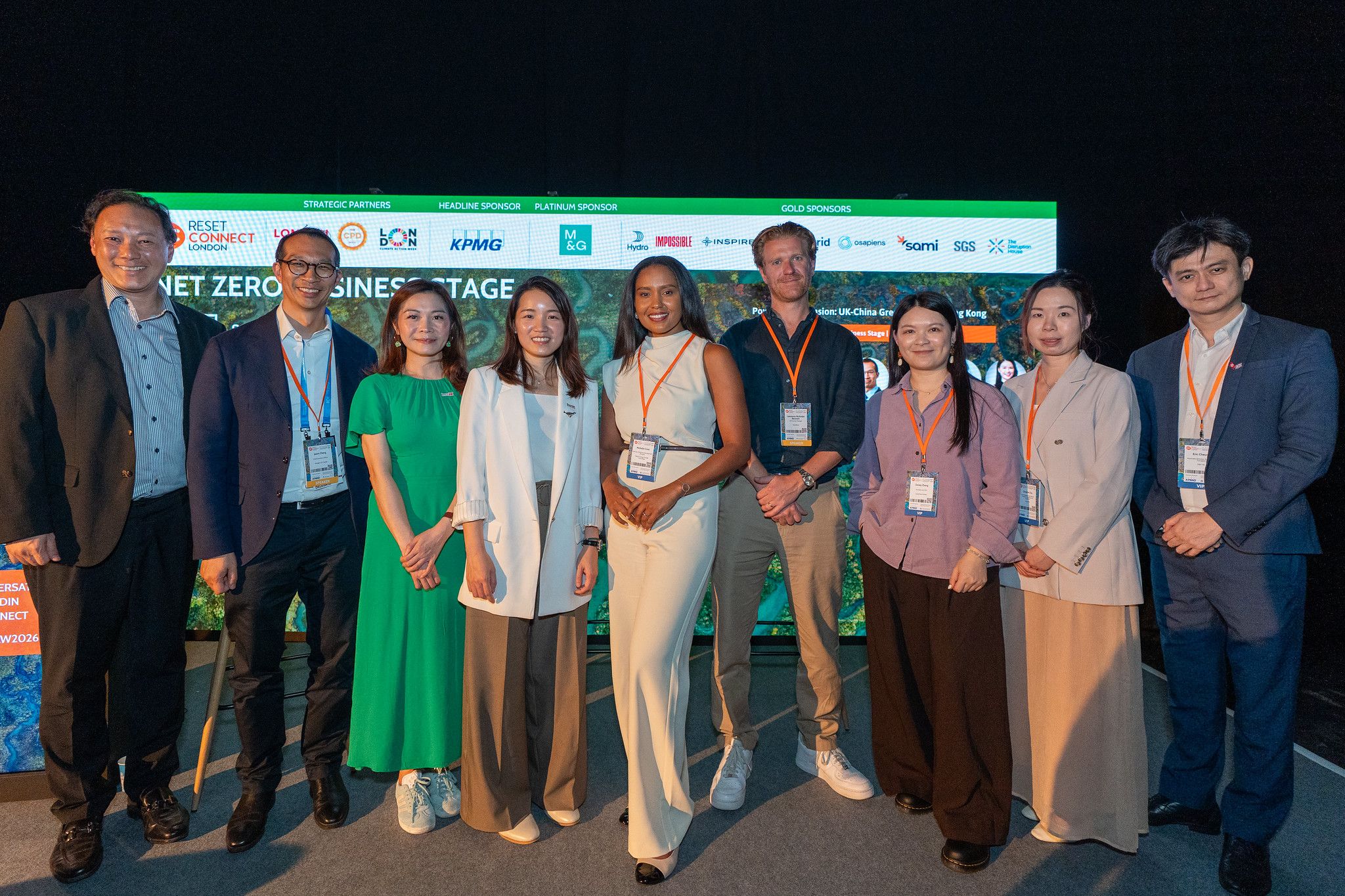
Speakers: Jason Cheng, Chief Executive Officer, Kerogen-CX Capital. Michelle Cross, Director of Business Development for Europe, RelyEZ Energy Storage Technology. Lawrence Nicholas Bennett, United Kingdom Country Manager, WorldFirst. Zooey Zhang, Founder and Chief Executive Officer, GreenSeed Power.
Also featured in the programme: Daisy Ip, Head of Investment Promotion and Talent Attraction, London, Invest Hong Kong
Estimated read time: 14 minutes
Quick Read Summary
A battery project can have equipment and a prospective customer while still facing delays over software, grid access or the money needed to pay a supplier. Those details shaped an Invest Hong Kong discussion at Reset Connect London about expanding green technology businesses between the United Kingdom, China and international markets.
King Leung opened the session with the case for Hong Kong as a source of capital and business connections. Olivia To then moderated a panel with Jason Cheng of Kerogen-CX Capital, Michelle Cross of RelyEZ Energy Storage Technology, Lawrence Nicholas Bennett of WorldFirst and Zooey Zhang of GreenSeed Power. The examples ranged from building demonstration plants to adapting energy management software and arranging payments to overseas factories.
The session offered a view of how finance and manufacturing relationships can support expansion, alongside the work needed to make a project deliverable in its destination market. Its practical lesson was to examine the whole route from a technology proposal to an operating asset, including the commercial arrangements that sit between them.
Capital Has to Match the Stage of the Project
King Leung introduced Hong Kong through several forms of finance, including equity markets, private capital and green lending. He described investors looking for energy transition opportunities and companies seeking partners in the United Kingdom. The delegation accompanying Invest Hong Kong included businesses and investors, reflecting the need to connect people developing projects with people able to fund them.
His account also distinguished between investment in companies and investment in infrastructure. A founder raising money to develop a technology is offering something different from an asset owner seeking finance for an established project with expected operating revenues. The amount of money available in a financial centre says relatively little about whether a particular investor will accept the risks of a particular proposal.
Jason Cheng developed that point from the perspective of an energy and energy transition investor. He described the value of having a presence in Hong Kong and London, with access to different kinds of experience. In his account, European markets had developed technologies, regulation and business models over many years. Manufacturing and project delivery capabilities in China could help businesses apply those ideas at scale. He also saw examples and methods moving in the other direction.
That exchange matters when a technology has to move beyond a prototype. Building an initial demonstration facility requires capital, engineering capacity and a place to resolve problems before repeating the design elsewhere. Jason Cheng described using Hong Kong and the surrounding manufacturing economy to bring those capabilities together. His argument was that engineers and suppliers with experience of building industrial facilities can help a company learn while it constructs and operates its first projects.
He used Kerogen-CX Capital’s investment in EcoCeres as an example, discussing sustainable aviation fuel production and a plant in Malaysia. The relevant point was the sequence of development, construction and expansion into further markets. His comparisons of time and cost were claims about particular projects and jurisdictions. They should prompt a developer to examine its own construction assumptions, permitting requirements and counterparties before applying the same model.
Later, Jason Cheng returned to the distinction between capital seeking a yield from infrastructure and capital willing to support earlier technology development. A business needs to understand which it is asking an investor to provide. A demonstration plant, a growth company and a portfolio of operating assets may require different evidence, contractual arrangements and funding partners even when they belong to the same sector.
A Battery Has to Work in the Market Where It Is Installed
Michelle Cross described RelyEZ as a business involved across the development of energy storage projects, including equipment, financing and operation. That breadth exposed several points where a solution developed in one market needed adaptation before it could be deployed in another.
The first was software. Michelle Cross explained that RelyEZ had developed an energy management system using artificial intelligence, but had encountered difficulties introducing it in Europe and the United Kingdom. She linked those difficulties to cybersecurity requirements and the expectations of customers in settings such as data centres. A battery’s physical availability did not settle whether its control systems would be acceptable for a particular project.
RelyEZ’s response, she said, included working with local energy management partners and sharing its technical knowledge with them. That creates a more specific partnership question than finding somebody to distribute equipment. The parties need to understand which organisation supplies the controls, how the hardware and software communicate, and who will maintain the operating system over the life of the asset.
Michelle Cross also connected software to the investment case. How a battery is managed influences its performance and operating life. The company’s software work included trading decisions, information flowing into and out of the asset, and predictive maintenance. Those functions affect the relationship between the equipment installed and the revenue an owner hopes to earn from it.
That dependence can complicate expansion. If a business has built its commercial proposition around a particular control system, changing that system for a new market can affect both operation and financial assumptions. In the discussion, Michelle Cross described transferring knowledge to local partners while working towards wider integration of the company’s software. She presented that as work in progress at the time of the session.
Grid connection was another constraint. Michelle Cross described projects and a pipeline that the company wanted to accelerate, alongside longer timelines for integration with the network. Local partnerships can help a developer understand what is required, but the connection date still affects when the asset can operate and begin generating revenue. Project planning needs to connect that timetable to commitments on equipment, construction and finance.
She also referred to plans for European manufacturing and preparations connected with battery product information requirements. These were company plans and interpretations discussed at the event. For a developer assessing a supplier, they raise practical questions about the origin of equipment, the documentation available and how future requirements will be met. Those questions need answers for the specific destination market and intended use of the battery.
The Payment Terms Can Decide Whether a Project Can Grow
Lawrence Nicholas Bennett brought the conversation to a less visible part of green technology deployment. A business importing equipment has to move money between customers, treasury accounts and suppliers, often in different currencies and on different schedules. Fees, currency movements and delays can change the economics of a transaction before the equipment is installed.
He described how an international payment can travel through several banks before reaching its destination. His account focused on the uncertainty that creates for businesses moving large sums, including the ability to establish when a payment will arrive and what it will cost. WorldFirst’s role in the discussion was as a provider seeking to simplify those transactions and connect businesses with suppliers in China.
The question becomes more complicated when a buyer chooses to source directly from a factory. Lawrence Nicholas Bennett discussed the 1688 sourcing platform and the attraction of reducing intermediaries. He also listed the responsibilities that come with a direct relationship. A buyer may have limited knowledge of the supplier, find communication difficult, need a currency it does not hold, and be asked to pay before production or delivery.
That is a decision about the whole purchase, including the work previously performed by an intermediary. Price needs to be considered alongside verification of the counterparty, payment arrangements and responsibility when something goes wrong. Lawrence Nicholas Bennett’s point was that an apparent saving can become expensive if a business has yet to understand those obligations.
Olivia To then asked about the period between paying a supplier and receiving money from customers. Lawrence Nicholas Bennett described the combination of advance payment, shipping, construction and a further wait to be paid. Each stage can extend the time for which a business needs to finance the project. A growing order book can therefore increase pressure on cash even when the underlying demand is promising.
He argued that this gap can lead founders to sell equity earlier than they would otherwise choose. He discussed financing linked to receivables or expected cash flows as an area WorldFirst wanted to develop further. The session did not establish that a particular financing arrangement would be available or suitable for every company. It identified the timing of cash as a problem a business should define before deciding how to fund expansion.
For a project team, that means mapping the dates on which money leaves and returns. Supplier deposits, delivery milestones, commissioning and customer payment terms all belong in that picture. The size and duration of the gap can then be discussed with prospective funders using the actual transaction, alongside the fees, conditions and responsibilities attached to any offer.
The Contracting Structure Has to Support the Business on Both Sides
Zooey Zhang described GreenSeed Power as a provider of customised electric vehicle charging solutions that began its journey in the United Kingdom. In her account, Hong Kong had become an international base for a business connecting manufacturing in China with customers and partners elsewhere.
She discussed access to legal services and advice as part of that development. For a company entering new markets, those relationships help it establish the arrangements through which it will contract, hold rights and work with partners. Her contribution supplied an operating example of the professional services and business environment that King Leung and Jason Cheng had discussed more broadly.
Zooey Zhang said GreenSeed Power used its Hong Kong entity to enter agreements with partners in markets including the United Kingdom, the United States and Italy. That gave the discussion a specific commercial structure to examine. A customer needs to know which entity signs the agreement, which organisation supplies or manufactures the product and how the responsibilities of each party connect.
Her description also showed how a company’s needs can change as it expands. Legal support, business introductions and an international contracting base can matter at an early stage, while manufacturing and access to finance become more prominent as orders increase. The usefulness of a location depends in part on whether the company can build the relationships it needs for the next stage of delivery.
Jason Cheng’s later contribution brought capital, market access and professional services into the same discussion. He described Hong Kong and London as established financial centres with supporting lawyers, bankers and institutions. In his view, those relationships helped make it possible to raise money and operate across markets. He also pointed to differences in the willingness of investors to take technology risk.
Michelle Cross illustrated a related shift in the supplier’s role. She described RelyEZ’s ambition to combine equipment with project finance, giving it a broader relationship with developers and asset owners. That can change how a project is proposed and evaluated. A customer comparing offers needs to distinguish the equipment specification from financing terms, software arrangements and the responsibilities retained after commissioning.
The discussion was hosted by an investment promotion organisation and made an explicit case for Hong Kong. Its examples are most useful as questions a business can test against its own plans. The work lies in matching a funding relationship, a manufacturing route and a contracting structure to the project being delivered. Each has to function in the destination market as well as in the place where the company raises money or sources equipment.
Practical Application How to Assess an International Green Technology Partnership
Choose a defined project or expansion decision and follow it from funding to operation. Involve the people responsible for engineering, procurement, treasury, contracts and local delivery. Use their evidence to identify the point most likely to delay the project or create an unexpected financing need.
Questions to ask
- Are we funding technology development, a demonstration facility, company growth or an operating asset, and does the proposed investor understand that stage?
- Which entity will sign the customer and supplier agreements, and which party is responsible for each delivery milestone?
- Can the proposed energy management system be used for this project, and what adaptations or local partners are required?
- Does the revenue model assume a connection date, software capability or market access that has yet to be secured?
- How much cash leaves the business before the customer pays, and for how long?
- When sourcing directly, who will verify the supplier and resolve problems with payment, quality or delivery?
Signals to watch
- Equipment commitments moving ahead while software integration or grid access remains unresolved.
- A growing pipeline increasing supplier deposits faster than customer receipts.
- Finance proposals that assume performance data from a different operating market.
- Partnerships that can supply hardware but have yet to specify who maintains controls and supporting systems.
- Manufacturing or listing plans being described as though they were already completed.
Traps to avoid
- Choosing a financing route before calculating the timing of the cash requirement.
- Comparing factory prices without accounting for the work an intermediary would otherwise perform.
- Assuming legal, product or cybersecurity requirements are identical in the United Kingdom and the European Union.
- Treating a supplier’s expansion announcement as evidence that a particular project is ready to operate.
A useful outcome is a delivery plan in which each major assumption has an owner. The equipment specification, software arrangements, grid timetable, contracts and cash needs can then be reviewed together. That gives prospective partners a clearer account of what is ready, what depends on another party and where additional work or finance is required.
Key Takeaways
The strongest material concerned the work between raising capital and operating a project. Jason Cheng discussed how manufacturing experience can support early deployment. Michelle Cross described adapting battery controls and managing grid timelines. Lawrence Nicholas Bennett examined payments and cash gaps. Zooey Zhang explained how a contracting base supported international partnerships.
- Match the type of capital to the project’s stage and the risks it still needs to resolve.
- Evaluate battery equipment alongside the software, integration and operating arrangements needed in its destination market.
- Include supplier verification, currency costs and payment timing when assessing direct sourcing.
- Map the interval between advance payment and customer receipts before choosing how to finance growth.
- Understand the contracting entity and the responsibilities linking manufacturers, technology providers and local partners.
Quote of the Session
“Hong Kong provides both access to capital and access to a market.”
Jason Cheng, Chief Executive Officer, Kerogen-CX Capital
Final Thoughts
The battery software example put a useful limit on the session’s broad language about international opportunity. A business can have manufacturing capability and prospective finance while still needing to adapt the system that controls its equipment. That work affects delivery and the financial case for the asset. The payment discussion made a similar point through the dates on which cash leaves and returns to a company.
Hong Kong was presented as a place to bring several capabilities together. The panel’s examples also showed why a business needs to examine them individually. A demonstration plant needs engineering support. A battery project needs a workable operating system and connection route. An importer needs a reliable supplier and a financing plan for the period before it is paid. The quality of the partnership becomes visible in how those details are handled.
Speakers moderator and opening contributor
King Leung, Global Head of Financial Services, Financial Technology and Sustainability, Invest Hong Kong. King Leung opened the session with an overview of Hong Kong’s role in financing and international business expansion. He described the delegation’s interest in connecting energy transition businesses and investors with partners in the United Kingdom. His contribution established the context for the panel that followed.
Olivia To, Senior Vice President for Sustainability within Technology, Innovation and Entrepreneurship, Invest Hong Kong. Olivia To moderated the panel, drawing together the perspectives of investment, battery storage, payments and electric vehicle charging. She introduced the delegation and asked speakers how their arrangements for finance, manufacturing and market access worked in practice.
Jason Cheng, Chief Executive Officer, Kerogen-CX Capital. Jason Cheng discussed investing across energy and the energy transition, with experience spanning markets in Europe and Asia. He explained the role of manufacturing and engineering capabilities in demonstrating new technologies and used the firm’s involvement with sustainable aviation fuel production as an example of expansion across markets.
Michelle Cross, Director of Business Development for Europe, RelyEZ Energy Storage Technology. Michelle Cross described the battery company’s involvement in development, equipment, software and financing. Her contribution addressed the practical difficulties of adapting energy management systems for new markets, arranging local partnerships and managing the relationship between grid access and project deployment.
Lawrence Nicholas Bennett, United Kingdom Country Manager, WorldFirst. Lawrence Nicholas Bennett discussed the financial arrangements surrounding international equipment purchases and supply chains. He examined supplier payments, currency costs, direct sourcing and the cash required between an advance payment and customer receipts. His contribution focused on the operating consequences of those arrangements for growing businesses.
Zooey Zhang, Founder and Chief Executive Officer, GreenSeed Power. Zooey Zhang described building an electric vehicle charging business with manufacturing connections in China and partners in international markets. She discussed the role of GreenSeed Power’s Hong Kong entity in contracting, access to professional services and the company’s expansion beyond its initial work in the United Kingdom.
Daisy Ip, Head of Investment Promotion and Talent Attraction, London, Invest Hong Kong. Daisy Ip is listed as a featured contributor in the session programme and identified in Invest Hong Kong’s event report. The supplied captions contain no clearly attributable speaking contribution from her, so the article makes no attribution of panel remarks to her.
Watch Full Session