


Keynote - The Resilience Imperative: Meeting the UK’s Energy Challenge
Home | Blog | Keynote - The Resilience Imperative: Meeting the UK’s Energy Challenge
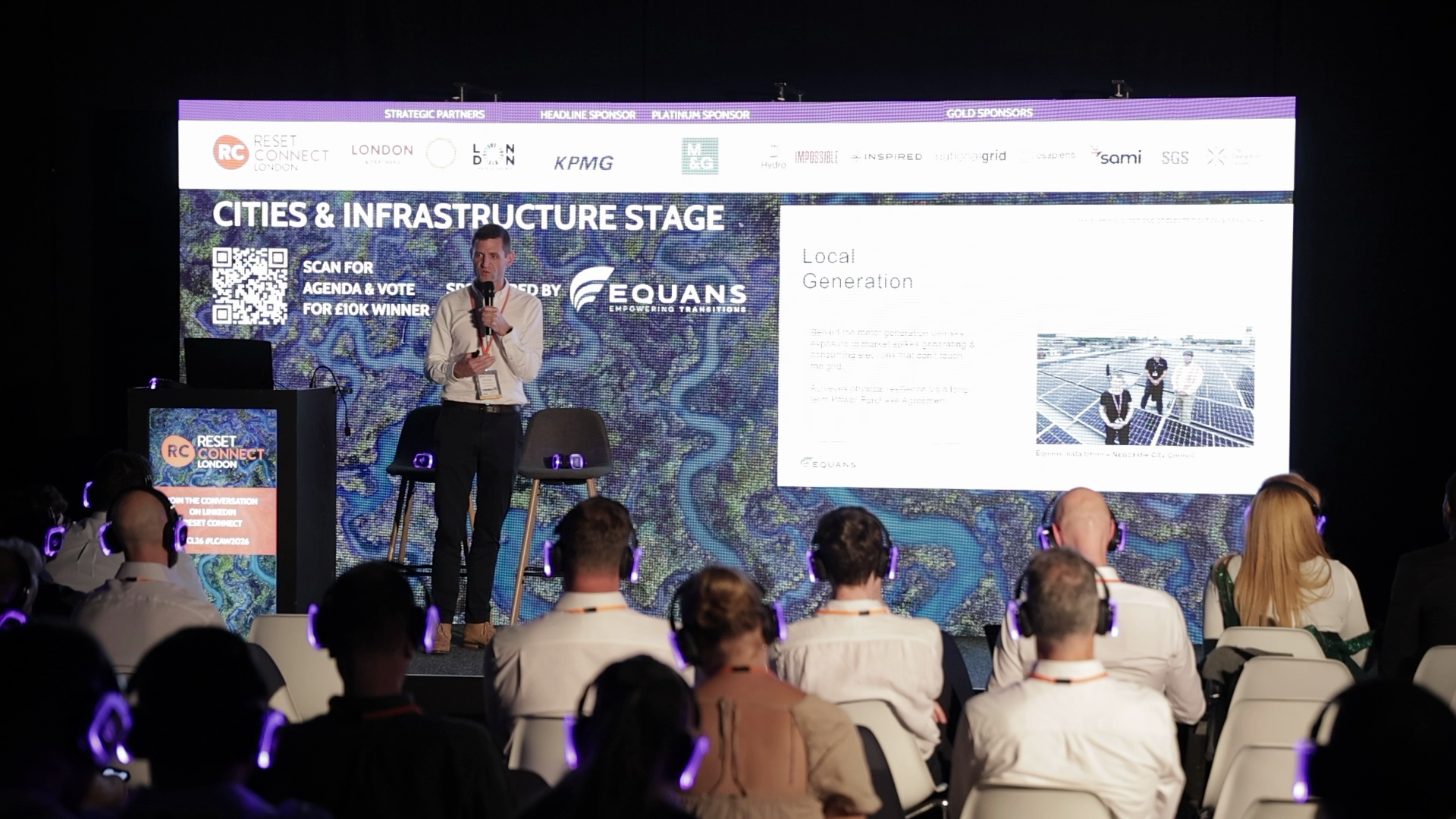
Event: Reset Connect London 2026
Date: Tuesday 23 June 2026 Speaker: James Graham, CEO Digital & Energy Services - Equans UK & Ireland
Estimated read time: 7 minutes
Quick Read Summary
There is a growing argument that electrification is not the answer and that the UK should be exploiting more North Sea oil instead. James Graham of Equans built this Reset Connect London 2026 keynote around testing that claim, and concluded that the capital markets have already settled it.
His more useful contribution was on why the transition is stuck anyway. Grid constraint is not an abstraction: the transmission capacity between Scotland and England is a specific number, and when it is exceeded the country pays generators to stop producing power it cannot move.
You will come away with the economic case against new North Sea development, a concrete picture of what grid constraint costs, and three established technologies businesses can combine now rather than waiting for the network to catch up.
The Capital Markets Have Already Answered the North Sea Question
Graham opened with the argument circulating in public debate, that the UK erred by not opening up more North Sea oil and that electrification is the wrong answer. His response was to look at where money is actually going.
Global investment in clean energy is running at roughly double the level going into fossil fuels. "The markets don’t agree," he said, arguing that industry worldwide has made its judgement regardless of shifting national policy. He supported it with two further datasets: sustained inflows into clean energy funds since 2021, and clean energy stocks outperforming oil following the outbreak of conflict involving Iran.
The reason he thinks capital has moved is security rather than sentiment. He walked through the price shock history, from the Gulf crisis through roughly two decades of stability, then the 2008 financial crisis, then Ukraine, then Iran. His conclusion was that the intervals are shortening: "the price shocks that we see are going to become more severe and closer together." For a business buying energy, that pattern matters more than any individual policy announcement.
Exposure to global commodity markets is exposure to events nobody can forecast.
New Oil Takes Longer and Ends in the Same Exposure
Graham took the counterargument seriously rather than dismissing it, which made the section considerably more persuasive.
Research from the University of Aberdeen identifies around 4.7 billion barrels of recoverable oil off the west coast of Scotland near Shetland. If the resource exists, why not use it? His answer was about time and about what you own at the end. Comparing how long different energy sources take to bring into production, nuclear and oil sit at the far end of the scale. The North Sea conditions are difficult, the rock is unfavourable, and the investment required to reach and refine it is substantial.
Then comes the part he considered decisive. Having spent the years and the capital, the output is a finite resource sold at whatever the global market will pay. "We are left exposed to the global market," he said. The same money and time spent on clean generation produces infrastructure that delivers stability rather than a commodity position.
Clean power can also be delivered considerably faster, which in an environment of shortening shock intervals is the whole argument.
Grid Constraint Has a Number, and the Country Pays for It
The most valuable part of the talk was making an abstraction concrete. Everyone says grid capacity is constrained; Graham showed what that means physically.
Transmission between Scotland and England runs across a boundary carrying a limit of around 6.7 gigawatts at any moment. Wind and solar generation north of that line substantially exceeds what can be consumed there, and the surplus cannot all move south. The consequence is curtailment payments: developers are paid to stop generating power the country has already built the capacity to produce.
The problem is not confined to that boundary. He cited solar connection delays of two to three years in parts of eastern England, and noted that while UK connection waits are not the worst in Europe, they are long enough to damage investor confidence and put jobs at risk. His example was a steelworks in South Wales, where publicly reported delays to network upgrades have pushed back the electrification of production that hundreds of jobs depend on.
Government investment in the network is underway. Graham’s question was simply whether it arrives in time for businesses making decisions now.
Three Established Technologies Build Resilience Without the Grid
Graham was clear that his solutions are not novel. What makes them powerful is combining them, and doing so without waiting for anyone else.
The first is local generation, which for most businesses means solar on their own buildings. The second is local storage, because generation rarely coincides with demand. He expects flexible tariffs to spread, with peak electricity costing perhaps two to four times off-peak rates, which turns storage into straightforward arbitrage as well as insurance. The third, and the one he sees most often skipped, is demand optimisation. Businesses tend to size generation against current consumption without first working out from the bottom up what they genuinely need, which inflates the capital cost of the whole system.
On financing, he reported energy as a service becoming the most common route, where a provider designs, builds and operates the assets and carries the operating risk, though outright purchase and leasing both remain in use. Asked for a cost per kilowatt hour, his team supplied a figure of roughly 12 to 18 pence depending on how the project is financed.
Asked whether falling battery prices change the calculation, his answer was that the counterfactual matters more: "the business case is there today", because grid electricity costs are heading the other way.
Practical Application, How to Assess On-Site Energy Resilience
This was a solutions talk from a supplier, and the underlying sequence holds regardless of who delivers it.
Questions to ask
- Have we established our true demand from the bottom up, or are we sizing generation against our current bill?
- What would peak pricing at two to four times off-peak rates do to our operating costs?
- Are we carrying the capital and operating risk ourselves, or would an energy as a service structure suit us better?
Signals to watch
- Flexible tariffs spreading into commercial and industrial supply contracts
- Curtailment payments, which indicate where generation exists that the network cannot move
- Connection queue times in the regions where you are planning new capacity
Traps to avoid
- Installing generation without storage, and finding you produce power when you do not need it
- Oversizing the system because demand was never properly assessed first
- Treating grid reinforcement as a plan, when the timescales are measured in years
What good looks like, on Graham’s account, is generation, storage and optimisation working as one system, sized against real demand rather than against a bill, and owned or contracted in whichever structure puts the operating risk in the right place.
Key Takeaways
A supplier making a supplier’s case, but built on public data and unusually specific about the constraint rather than the product. The strongest material was the arithmetic on why waiting is the expensive option.
- Global clean energy investment is running at roughly double the level flowing into fossil fuels
- New North Sea development would take years, cost heavily and still leave the UK exposed to global commodity pricing
- Transmission between Scotland and England is limited to around 6.7 gigawatts, which is why curtailment payments exist
- Solar connection delays of two to three years are reported in parts of eastern England
- Resilience comes from combining local generation, local storage and demand optimisation, not from any one of them
Quote of the Session
"We can’t wait for the UK grid to deliver clean power."
James Graham, CEO Digital & Energy Services, Equans UK & Ireland
Final Thoughts
What distinguished this keynote was that it argued against a position rather than for a product, at least for the first three quarters. Graham took the case for new North Sea development at its strongest, granted the resource exists, and defeated it on time, cost and the exposure it leaves behind. That is a more useful thing to watch than a presentation which assumes its audience already agrees.
The uncomfortable implication is that the solutions he offers are a workaround. A business installing generation, storage and optimisation is insulating itself from a national infrastructure problem rather than solving it. Graham did not pretend otherwise, saying plainly that not enough is being done at government level. His argument is simply that businesses cannot wait for that to change, which is both true and a slightly bleak reading of where the UK has got to.
Speakers
James Graham, CEO Digital & Energy Services - Equans UK & Ireland. James drives strategy and delivery for renewable energy and decarbonisation projects and the digital technologies that optimise building and infrastructure performance, and chairs the Hydrogen Delivery Council’s jobs, skills and supply chains working group.
Watch Full Session