


Keynote Panel - AI, Energy and the Future Grid
Home | Blog | Keynote Panel - AI, Energy and the Future Grid
Event: Reset Connect London 2026
Date: Tuesday 23 June 2026
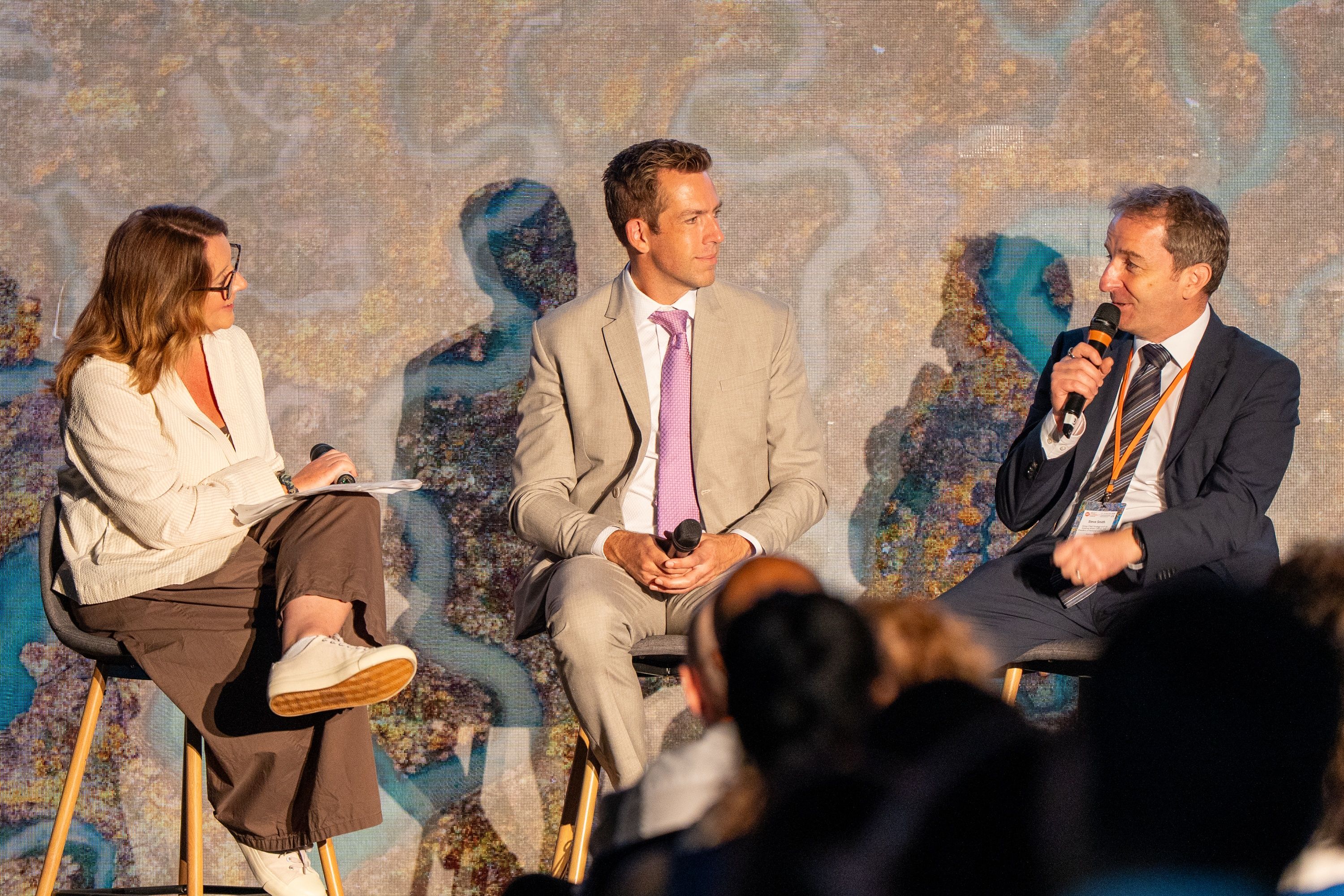
Speakers: Lucy Siegle, Journalist and Broadcaster (moderator). Steve Smith, Group Chief Strategy and UK External Affairs Officer, and President of National Grid Partners - National Grid. Josh Parker, Head of Sustainability - NVIDIA.
Estimated read time: 9 minutes
Quick Read Summary
The usual framing has AI as a threat to an already stressed grid. This Reset Connect London 2026 keynote put the network operator and the chip maker on stage together to argue the opposite, and brought a trial to back it up.
At an AI factory in London, National Grid ran a double-blind test asking the site to cut power on command. National Grid’s published trial results report demand reductions of more than a third in under a minute, without disrupting critical compute workloads. Smith said the site tracked the requested profile more accurately than some of the flexible industrial load already on the system.
You will come away with what that trial actually proved, the three ways a data centre can flex its demand, and the scale of existing grid capacity that flexibility could unlock. The session also drew visible scepticism from the chair, which is included rather than smoothed over.
National Grid Treats AI Load as an Affordability Opportunity
Lucy Siegle opened by framing AI demand as a problem for a stressed system. Steve Smith of National Grid declined the framing immediately, and his reasoning was commercial rather than rhetorical.
Network costs form part of the final price of energy and are recovered across users. A large new customer that can be connected without triggering major new investment therefore reduces what everyone else pays. Smith put National Grid’s current plans at around 10 gigawatts of data centre connections over five years, against a UK peak demand of roughly 45 gigawatts, alongside a further 9 gigawatts of other industrial demand from electrifying steel and battery manufacturing.
He had run the arithmetic on what that does to bills. Connecting 10 gigawatts of data centres, before counting any flexibility benefit, would take roughly 25 pounds off a domestic bill, somewhere between 50,000 and 100,000 pounds off a hospital’s, and up to half a million for a very large industrial user.
The technology is also revising the constraint itself. Working with a modelling company to stress test how much power the network can actually carry, National Grid found in its US business that "there’s more capacity on our system than we thought", and can connect more data centres than previously believed.
AI’s Footprint Is Smaller and Moving Faster Than the Debate Assumes
Josh Parker of NVIDIA spent much of his time correcting the picture the public holds, and was upfront that these are fair questions to ask of any new infrastructure.
On scale, his central claim was that "AI is actually not driving the largest load growth in the world right now". Electrification of buildings, heating and cooling is larger. He put AI at around 0.5 per cent of global electricity demand, growing and requiring management, but manageable. Modern data centres draw far more power per square metre than their predecessors while delivering disproportionately more compute for it, which he characterised as roughly a tenfold improvement in energy efficiency per year for the same workload.
On water, which Siegle raised directly, his answer was the most concrete of the session. NVIDIA has moved its platform entirely to closed loop direct-to-chip liquid cooling operating at a 45 degree intake temperature. Because the loop only needs cooling to that relatively high temperature, it consumes essentially no water and in most locations needs no chillers at all.
His honest caveat was that aggregate energy use is still climbing. Efficiency per unit of work is improving faster than total consumption is falling.
The London Trial Demonstrated Rapid Demand Response
The evidence at the centre of the session came from a live demonstration at a new AI factory in London, and the surprising part is how little is actually being asked of these sites.
Smith pointed out that the UK system is genuinely constrained only during a narrow window: "it only really is stressed for maybe 10 to 50 hours of the year". For the rest of the time there is abundant network capacity and generation. Nor does every site need to participate, or shed all its load. "We just need them to be able to do a bit," he said, provided the system operator can instruct a reduction and rely on it happening.
The trial tested the hardest version of that. The trial tested responses to sudden demand spikes, including those associated with major broadcast events. National Grid ran the test double blind, so nobody in the room knew what would be asked. The site tracked the requested profile precisely, and Smith reported that it performed better than some of the large flexible loads already on the system. National Grid’s published results record reductions of around 30% in under 40 seconds during simulated emergencies.
Parker explained why an AI facility is unusually suited to this. Unlike a manufacturing plant, its load is orchestrated in software.
Flexibility Unlocks Capacity the Grid Already Has
Both speakers agreed the prize is not new infrastructure but better use of what exists, and Parker had the number that makes the case.
Electrical infrastructure in the United States runs at roughly 40 to 50 per cent utilisation, with the UK around 50 per cent. He cited research from Duke University concluding that if AI data centres were flexible for just 1 per cent of the year, it could unlock around 100 gigawatts of existing capacity on the US grid. Siegle added the comparison from the same research, that this is roughly equivalent to avoiding 50 Hoover dams.
Parker set out the three mechanisms a site can use. On-site batteries charged when energy is abundant and discharged at peak. Time shifting, where workloads that are not time-critical are shelved for a period. And geographic shifting, moving a workload to another facility elsewhere in the country or the world where the local grid is not under stress.
Smith connected it to system costs, noting that balancing the UK system costs the operator in the region of three and a half billion pounds a year, and that services of this kind bring that figure down.
The Climate Case Rests on Displacement, and the Chair Pushed Back
Siegle was not a soft interviewer, telling both speakers directly that they would have to convince a lot of people on environmental grounds, and later that part of the argument "might be a hard sell".
Parker’s case has two parts. The first is displacement: he cited work from the International Energy Agency, the World Economic Forum and the Grantham Institute concluding that AI is positioned to drive net emissions reductions if deployed broadly, because efficiencies unlocked in manufacturing, buildings and transport dwarf AI’s own footprint. The second is that flexibility makes intermittent generation more valuable, since a large flexible load can absorb wind and solar when abundant and pull back when it is not.
Smith supported the second half from operational experience. Renewables have to be overbuilt to cope with intermittency, and there have been periods this year when wind farms were curtailed because demand was not there. Gas frequently provides the balancing that flexible demand could displace.
The part Siegle challenged was Smith’s bet that even if AI burns more gas globally in the short term, the innovation it unlocks in generation and storage will justify it within five years. That is a claim about the future rather than about the trial, and the article reports it as one.
Practical Application, What This Means for Anyone Connecting Large Load
This was a keynote rather than a workshop, but the operational content is unusually specific for a main stage session.
Questions to ask
- If we operate or procure data centre capacity, can any of our load actually be shifted in time or geography?
- Are we treating a grid connection as a fixed entitlement, or as something we could trade flexibility against?
- Do our sustainability claims about compute reflect current cooling and efficiency, or a picture from three years ago?
Signals to watch
- Connection agreements that include demand response obligations in exchange for faster access
- Utilisation figures for existing network capacity, which both speakers put at around half
- Liquid cooling becoming standard, which changes the water argument substantially
Traps to avoid
- Assuming a data centre must shed all its load to be useful, when a partial reduction is what the system needs
- Planning around continuous grid stress when the genuinely constrained window is tens of hours a year
- Accepting either the alarmed or the reassuring version of AI energy claims without checking whose data it is
What good looks like, on this panel’s account, is a large load that connects quickly, contributes to network costs, and can be instructed to step back for the handful of hours a year when it matters.
Key Takeaways
A network operator and a chip maker made a coordinated case that AI load is an asset rather than a threat, with a trial to support the technical half of it. The chair tested the wider climate claim and did not entirely accept it.
- The UK grid is genuinely stressed for only around 10 to 50 hours a year, so partial flexibility from a few sites goes a long way
- A London trial demonstrated demand reductions of more than a third in under a minute; Smith said it tracked instructions better than some existing flexible industrial loads
- Data centres can flex through on-site batteries, shifting non-time-critical work later, or moving workloads to another location
- US research suggests flexibility for 1 per cent of the year could unlock around 100 gigawatts of existing grid capacity
- Connecting 10 gigawatts of data centres could reduce a domestic bill by roughly 25 pounds by spreading network costs more widely
Quote of the Session
"It only really is stressed for maybe 10 to 50 hours of the year."
Steve Smith, Group Chief Strategy and UK External Affairs Officer, National Grid
Final Thoughts
What made this session worth watching was that the technical claim and the strategic claim are not equally strong, and the chair kept them apart. The trial result is concrete, was run double blind, and demonstrates something specific: an AI facility can reduce its demand quickly while critical workloads continue. National Grid’s published results substantiate that response; Smith’s comparison with other flexible loads remains his account of the demonstration. That is genuinely new evidence.
The broader argument, that AI will deliver net emissions reductions once deployed widely enough, rests on modelling and on a bet about future innovation. Both speakers believe it. Siegle said plainly that it would be a hard sell, and she was right to separate the two. The flexibility case does not need the displacement case to be true, which is precisely what makes it the more persuasive half.
Speakers
Lucy Siegle, Journalist and Broadcaster (moderator). Lucy is a writer, broadcaster and specialist in environmental communications, credited with mainstreaming action on plastic and on fashion supply chains, and a reporter and presenter on BBC One’s The One Show.
Steve Smith, Group Chief Strategy and UK External Affairs Officer, and President of National Grid Partners - National Grid. Steve is an executive leader with extensive experience across energy and retail financial services, spanning large corporates, strategy consulting, start-ups and regulators.
Josh Parker, Head of Sustainability - NVIDIA. Josh leads corporate sustainability at NVIDIA and is both an engineer and a lawyer, having previously built and led the sustainability programme at a computer storage company and practised patent law.
Watch Full Session