


Igniting a New Era of Proactive Climate Finance
🏠 | Blog | Igniting a New Era of Proactive Climate Finance
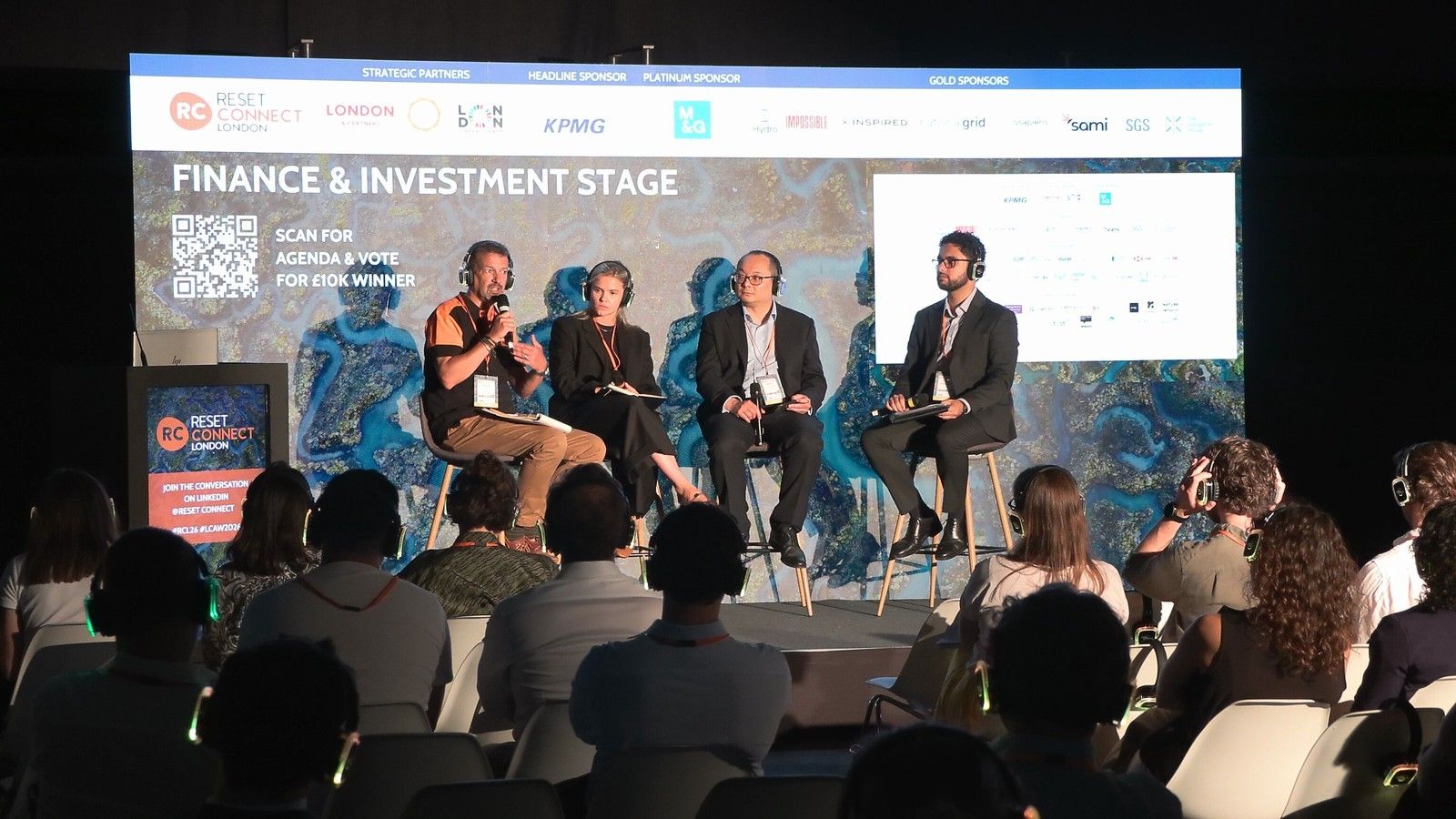
Event: Reset Connect London 2026
Date: Tuesday 23 June 2026
Speakers: Manveer Gill, Head of Sustainable Business & Sustainable Finance Lead - CDP (moderator). Holly Turner, Head of Sustainable Investments - Schroders. JinWee Tan, Head of ESG & Regulatory - M&G Plc. Ray Coyle, CEO - Energise Africa.
Estimated read time: 9 minutes
Quick Read Summary
Sustainable finance reached around 2 trillion dollars last year. The figure needed is closer to 8 trillion. This Reset Connect London 2026 panel spent an hour on the mechanics of that gap rather than the ambition behind it, with a disclosure platform, an asset manager, an asset owner and a direct investment platform each explaining where their capital can and cannot go.
The sharpest disagreement was definitional. Transition finance now covers so many things that it has stopped signalling much, and the taxonomies meant to fix that are pulling in different directions across jurisdictions.
You will come away with a working definition of transition finance, a worked example of a blended structure in northern Nigeria, and an honest account of why physical risk is harder to model than the volume of available data suggests.
Africa’s Energy Gap Is About Access to Capital, Not Affordability
The panel opened on the scale of the problem, and the numbers did most of the work.
Ray Coyle, CEO of Energise Africa, set out the arithmetic. Around 600 million of Africa’s 1.6 billion people have no access to electricity, and the population is forecast to reach 2.5 billion by 2050. That leaves roughly 1.5 billion people needing power within 25 years. There are already about 6 million diesel generators on the continent. If that demand is met the same way, he said, "everything that we are doing in Europe is a complete waste of time".
His firm issues bonds to UK retail investors, typically 500,000 to 3 million pounds over six months to five years, funding solar home systems, mini grids, electric vehicles and clean cook stoves. Coyle was clear that the constraint is not that customers cannot pay. Renewable solutions are frequently cheaper over the ownership period. The constraint is that the capital to build them is not there.
Total investment into energy access across Africa in 2025 came to just over 350 million dollars. Before anyone moves trillions, the sector has to reach billions.
Why Institutional Capital Struggles to Reach Developing Markets
Asked what is actually blocking the flow, the panel gave three structural answers rather than a shortage of goodwill.
JinWee Tan, Head of ESG and Regulatory at M&G, estimated that developing markets receive perhaps 10 to 20 per cent of the capital they need, leaving a gap running to hundreds of billions. The first reason is that the returns no longer stack up. The end of near-zero interest rates removed the search for yield that once pushed allocators towards emerging market transition finance, and for the first time in his career Japanese government bonds are paying a meaningful yield. Hurdle rates have risen accordingly.
The second is that credit risk is awkwardly priced. Ratings are backward-looking, and counterparties in developing markets rarely achieve the ratings needed to attract developed world asset owners.
The third is operational. Frontier markets are thin, currency conversion can cost a 25 per cent haircut, and an allocation large enough to be worth the effort may itself move the market.
None of those is solved by more ambition. Each is solved by restructuring the deal.
Blended Structures Are What Make These Deals Investable
Both investors landed on the same mechanism, approached from opposite ends of the market.
Coyle gave the worked example: 19 green mini grids under construction in northern Nigeria. Grant funding comes from a World Bank programme administered by Nigeria’s renewable energy agency on a results basis, paying out in dollars only once the grids are commissioned. Energise Africa funds the construction, which means it carries build risk on a two-year horizon rather than currency risk or long-term project risk. That structure returns 8 per cent on the debt. It also takes real work to assemble, with debt, equity and grant all having to land in sequence.
Holly Turner, Head of Sustainable Investments at Schroders, described the institutional version. BlueOrchard builds blended private debt strategies for emerging markets, and Schroders Capital’s multi-private asset solutions carry 70 to 80 per cent climate exposure with emerging market risk mixed into a wider portfolio, absorbing the complexity on behalf of clients who could not access those funds directly.
Tan’s closing wish went to the missing piece: government capital taking first loss rather than competing for senior tranches.
Adaptation Finance Works Only When the Solution Is Affordable Upfront
The conversation on adaptation stayed unusually concrete, and both investors ended up describing the same portfolio company.
Coyle described Altech, an energy access business in the Democratic Republic of Congo founded by two former refugees, now employing around 3,500 people and reaching two and a half million with clean energy. Its headquarters sat for eight years in a city later overrun by armed groups. The companies, he argued, are extraordinarily resilient. The communities they serve are not. His firm also funds suppliers of solar water pumps to smallholder farmers, who can afford the pumps through higher yields over time but cannot pay upfront, which is why BlueOrchard lends to Altech so it can sell on credit.
Turner framed the same territory as financial inclusion. Her emerging market private equity funds target the climate insurance protection gap, investing in lenders and platforms already serving those communities and adding insurance cover through technical assistance rather than building a market from nothing.
Access, as Turner put it, means something very different in developing countries.
Physical Risk Is Harder to Model Than the Data Volume Suggests
Every panellist had a version of the same warning: better data has not yet produced reliable models.
Tan made the point about people rather than assets. Working with colleagues in Mumbai, he learned that one of them was attempting a 14-hour train journey to reach the office because his home city was flooding. Nothing in the firm’s risk register captured that exposure. His conclusion was that physical risk sits in workforces and supply chains as much as in facilities, and that measurement and reporting have to catch up.
Turner described the modelling work at Schroders Capital, which now models by asset type rather than by location alone, using an external geospatial provider in real estate and a purpose-built model in infrastructure. The firm is also borrowing method from its insurance-linked securities business, which already prices weather risk competently over one to three years.
Manveer Gill, Head of Sustainable Business at CDP and the session’s moderator, supplied the aggregate. Companies able to quantify their exposure have disclosed over 700 billion dollars in anticipated financial effects, most of it expected within two to three years.
Transition Finance Needs a Tighter Definition and the Taxonomies Disagree
The final segment was the most contested, and it started with a gap in the data.
Gill reported CDP findings across roughly 12,000 disclosing companies: 72 per cent have some form of emissions reduction initiative, but only around a tenth have capital expenditure aligned to their transition plan. Intent is widespread. Financial planning behind it is not.
Tan argued the label has been stretched past usefulness. A capital expenditure plan aligned with the Paris agreement over 20 years, financed with debt or equity, is transition finance. A great deal of what carries the label is not, and buyers should check what they are actually purchasing.
Turner explained why taxonomies do not settle it. The EU’s technical screening criteria describe the end state of a transition, so they identify green activities rather than companies partway through changing. Singapore’s traffic light system adds an amber category for activities needing a step change, which is a different and arguably more useful signal.
Tan’s objection was commercial. Taxonomies encode national priorities, so a fund built for one jurisdiction cannot be sold into another, and clients lose the benefit of scale.
Practical Application, How to Test Whether Your Transition Finance Label Holds
This panel was more useful as a diagnostic than as a forecast. Most of its advice is about checking what you already have.
Questions to ask
- Does our transition-labelled financing sit against a dated, Paris-aligned capital expenditure plan, or against an intention?
- Which specific risk are we asking concessional or public capital to absorb, and is that the risk it is best placed to hold?
- Does our physical risk register cover workforces and supply chains, or only sites and facilities?
Signals to watch
- Companies publishing capital expenditure aligned to their transition plans, not just emissions targets
- Taxonomy equivalence work following the COP30 presidency’s announcement on comparability
- Results-based grant structures paying in hard currency, which is what removes currency risk from private lenders
Traps to avoid
- Applying a European definition of transition to markets at an entirely different starting point
- Treating better geospatial data as equivalent to a reliable physical risk model
- Designing an adaptation product that customers can afford in total but not upfront
What good looks like is a financing structure where each party holds the risk it understands best, and a label that survives someone asking what sits behind it.
Key Takeaways
A disclosure platform, an asset manager, an asset owner and a retail investment platform described the same blockage from four positions. The capital exists and the structures to move it are known. What is missing is precision about what each type of capital is for.
- Around 600 million people in Africa lack electricity access, while total energy access investment across the continent in 2025 was just over 350 million dollars
- Developing markets receive an estimated 10 to 20 per cent of the climate capital they need, held back by hurdle rates, backward-looking credit ratings and operational friction
- Blended structures work by allocating each risk to the party best able to carry it, with results-based grants paying in hard currency
- Only around a tenth of disclosing companies have capital expenditure aligned to their transition plan, despite 72 per cent running emissions reduction initiatives
- Taxonomies encode national priorities, which prevents managers pooling capital across jurisdictions
Quote of the Session
"Everything that we are doing in Europe is a complete waste of time."
Ray Coyle, CEO, Energise Africa, on what happens if 1.5 billion people gain power through diesel
Final Thoughts
The most valuable thing this panel did was refuse the comfortable framing. Nobody argued that developing markets are underfunded because investors do not care. They are underfunded because hurdle rates rose, ratings look backwards, currencies are expensive to cross and the label meant to guide capital has been stretched until it signals very little.
Two closing suggestions are worth carrying. Turner pointed to enablers as an underappreciated category: asset-light companies servicing the transition rather than delivering it, such as solar maintenance businesses addressing the roughly 10 per cent of generation lost annually to poorly serviced panels. Tan wanted public money moved into first-loss positions instead of competing with asset owners for senior tranches. Both are structural fixes rather than appeals, which is consistent with everything else the panel said.
Speakers
Manveer Gill, Head of Sustainable Business & Sustainable Finance Lead - CDP (moderator). Manveer leads CDP’s sustainable finance research on how the financial sector uses real economy environmental data, and has represented CDP at COP29 and COP30.
Holly Turner, Head of Sustainable Investments - Schroders. Holly leads platform-wide sustainability and impact strategy at Schroders Capital, working across infrastructure, real estate, private equity and private debt, with over seven years at the firm.
JinWee Tan, Head of ESG & Regulatory - M&G Plc. Jin Wee leads ESG investment strategy for the life company and its products, having worked at the intersection of life insurance and asset management for many years, including 11 at M&G.
Ray Coyle, CEO - Energise Africa. Ray is an award-winning social entrepreneur and qualified lawyer with extensive experience in emerging economies, spanning renewable energy, clean technology and impact investing.
Watch Full Session