)
)
)
Industry Keynote Panel - Financing the Transition
🏠︎ | Blog | Industry Keynote Panel - Financing the Transition
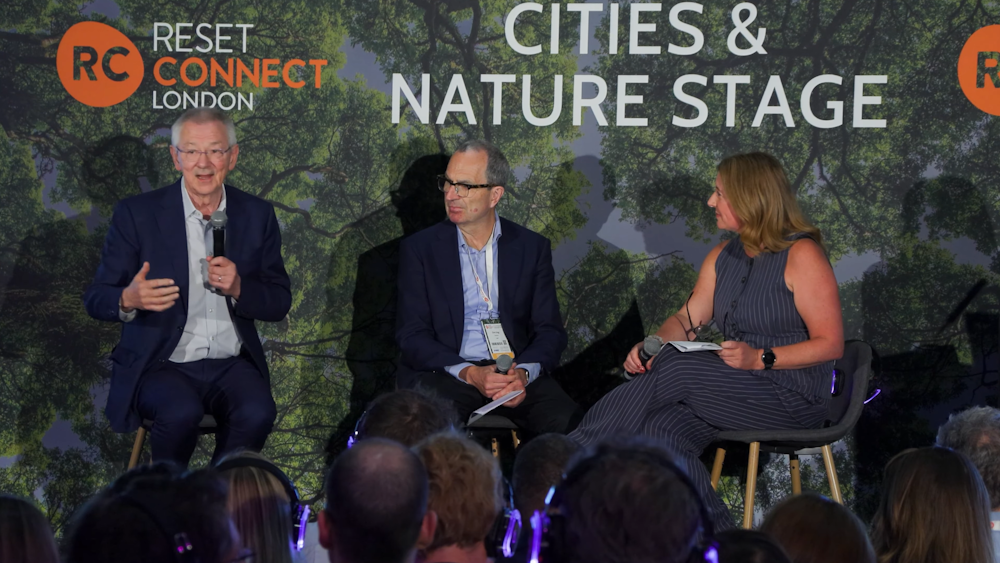
- Event: Reset Connect London 2025
- Date: 25 June 2025
- Speakers
- Sir Andrew Steer, Professor of Practice, Economics and Sustainability, London School of Economics, Distinguished Fellow, Georgetown University
- Chris Grigg, Chairman, National Wealth Fund
- Estimated read time: 6 minutes
Quick read summary
This session explored why financing the transition still feels harder than it should, even in a world with vast pools of capital and improving low carbon economics.
It matters now because the constraints are increasingly practical, allocation discipline, early stage risk and delivery capacity, rather than abstract intent or high level commitments.
Readers will gain a clearer lens for diagnosing where capital stalls, what credible risk sharing looks like and how public finance can accelerate real economy decarbonisation without crowding out private investment.
Financing the transition is an allocation problem, not a money problem
A persistent narrative frames net zero as a funding gap. The panel’s more useful diagnosis was misallocation, capital exists, but it is not moving into the right assets quickly enough, at the scale required, with risk priced realistically.
Sir Andrew Steer’s point was direct, there is no shortage of money in the world, the problem is that money is in the wrong place. He contrasted the sheer size of global financial assets with the lower, though still significant, annual investment implied by the transition. The implication for commercially minded leaders is sobering, the barrier is not whether capital exists, it is whether the system will reprice risk and change its defaults.
This reframing matters because it shifts the leadership task. If the challenge is allocation, the question becomes what needs to change in incentives, underwriting, policy signals and delivery confidence so that decarbonisation becomes a mainstream investment decision, rather than a specialist carve out.
Why investable economics still fails to unlock investable behaviour
Steer sketched how green finance has evolved from an era where low carbon options carried a clear incremental cost, towards a world where many technologies are economically competitive. He argued that despite these improvements, financial behaviour often remains anchored to the old fashioned way of doing things.
The reasons he gave were operational, not ideological. Inertia, institutions optimise around familiar models and known counterparties. Relationship driven decision making, banks and investors stick with long standing clients. Unfamiliar risk, new technologies and delivery models create uncertainty about failure modes. Political volatility, backlash and changing narratives increase perceived risk.
He also challenged the idea that finance is purely neutral, following risk adjusted return wherever it leads. In practice, neutrality can mask path dependence, a preference for what is comfortable because it is easier to price, easier to govern and easier to explain internally.
For event audiences focused on delivery, this is a reminder that good economics does not automatically translate into deployed capital. The bottleneck is often confidence, not intent, confidence in policy stability, confidence in execution capacity and confidence that risks are shared rather than silently pushed onto one party.
The first 5 percent problem, where projects stall
The most actionable thread in the discussion was the distinction between financing projects and financing project development.
Steer argued that the hardest part to fund is not the bulk construction spend, it is the early stage work that turns a concept into a bankable project, design, land procurement, government engagement, permitting and reaching financial close. He described this as the first 5 percent of the project, small in cost share, high in uncertainty and often where projects fail to progress.
Private capital’s rational response is to wait. Investors prefer to arrive after financial close, when the plan is set and the work becomes delivery rather than discovery. This is why the system can appear to suffer from a lack of bankable projects, the pipeline is thin because the riskiest development work is underfunded.
In practice, this is where many well meaning transition strategies break down. They talk about scaling capital, but do not solve the conversion step that produces investable assets in the first place.
What blended finance is for, targeted risk reduction
Blended finance often gets described in broad, partnership language. The panel’s framing was narrower and more operational, it works when it absorbs risk at the precise point that stops private capital from committing.
Steer shared an example of a structure designed to take first loss risk at the early stage bottleneck. The logic is simple, if early stage projects fail, the first loss capital takes the hit, if projects succeed and reach financial close, they can be sold on to mainstream investors and returns can be recycled into the next round of development.
The test for credibility is therefore not branding or ambition, it is where the structure is willing to take pain.
A practical way to assess any initiative positioned as transition finance is to ask:
- Does it fund early stage development or mainly post close deployment
- Who takes first loss risk and on what terms
- How is capital recycled and what triggers that recycling
- What is the path from concept to financial close, including permits and counterparties
If those answers are vague, it is unlikely the model will thicken the pipeline.
National financing institutions, investor discipline with public purpose
Chris Grigg positioned the National Wealth Fund as part of the ecosystem that sits after grant capital, stepping into situations where the private sector will not invest on its own, at least not yet. He stressed that the fund does not make grants, it makes loans and investments across the capital stack, with a requirement to generate a financial return.
Two points stand out for readers thinking about investment, partnerships and delivery.
First, time horizon. Grigg described the practical reality of building the pipework of a new financial institution, with an expectation of breaking even around 2029 to 2030 and a more meaningful return expectation beyond 2030.
Second, risk appetite measured in behaviour, not rhetoric. He described the fund as taking higher risk than typical commercial lenders in order to crowd in private sector capital, with a target of leveraging one pound of public money to bring in three pounds of private capital.
He also grounded this in a domestic example, retrofit and warm homes, where partial guarantees were used to involve private finance and support supply chain development. The significance is the model, public tools can shift risk perception, but impact depends on disciplined underwriting and real delivery capacity, not just the existence of a guarantee.
Practical application, how to move from intent to investable delivery
For leaders across attendance, sponsorship and exhibition communities, the most transferable lesson is that transition finance is a system design problem. It sits across investment committees, policy signals, delivery partners and the real world capacity to execute. The opportunity is to stop treating finance as something that arrives at the end and instead design the conditions that make an investor comfortable earlier in the journey.
In most organisations, the real friction shows up in predictable places. Early stage work goes unfunded because it feels speculative, risks are pushed to whoever has the least negotiating power and timelines stretch because permitting, counterparties or supply chains are not treated as part of the investment case. Addressing these issues is less about finding a new pot of money, more about building an investability pathway that turns ambition into assets.
The leadership questions that unlock movement
Leaders can use a small set of questions to pressure test whether a transition plan is genuinely investable or merely well intentioned:
- Where is our first 5 percent risk and who is paying for it today
- What would need to be true for an investor to commit before financial close
- Which risks are genuinely technical and which are policy or process driven
- Are we building investable pipelines or just funding individual projects
The signals that capital is stalling
When capital is present but not deploying, the symptoms are usually visible long before a project formally fails. Watch for these patterns:
- Persistent pipeline concerns without funded project development capability
- A bias towards post close capital, with limited early stage support
- Partnerships that promise leverage, but do not define first loss terms
- Delivery constraints, permitting delays, weak supply chains, unclear counterparties
The pitfalls that keep repeating
The panel’s logic points to a few common traps. They are rarely deliberate, but they are consistently expensive:
- Treating finance as the solution, while ignoring project development capacity
- Announcing commitments that do not survive political shifts or changing narratives
- Using blended finance to pay for outcomes, rather than reducing the specific risk that blocks investment
What good looks like when it works
Good transition finance tends to look boring, because it is engineered. It is clear on risk allocation, disciplined on governance, and realistic about delivery.
- Early stage development is funded, governed and measured as a conversion engine
- Public capital is deployed with clear risk sharing rules and clear recycling mechanisms
- Delivery capacity is treated as part of the investment case, not an afterthought
- Leverage is tracked as crowding in, alongside quality of outcomes
Key takeaways
The panel’s core argument is that capital will move faster when investability is designed into the system, not assumed. In practice, that means focusing on where projects stall and building credible pathways through that friction.
- The transition challenge is less about finding more capital, more about redirecting capital through better risk pricing and clearer investment defaults
- The hardest funding gap often sits in early stage development, the first 5 percent that gets projects to financial close
- Blended finance is most effective when it targets that bottleneck and takes first loss risk with explicit terms
- National financing institutions can unlock private investment when they act with investor discipline and public purpose
- Delivery capacity, permitting, supply chains and counterparties is inseparable from the finance conversation
Quote of the session: “There’s no shortage of money in the world.” Sir Andrew Steer
Final thoughts
The panel’s core message was pragmatic, financing the transition is a question of system mechanics. Capital will move when risk is priced honestly, early stage bottlenecks are funded and delivery confidence is real.
For organisations trying to decarbonise, invest or build partnerships, the priority is to treat investability as a designed outcome. That means building pipelines that survive political noise and focusing public and private collaboration where it changes decisions, not where it simply announces them.
Speakers
Sir Andrew Steer, Professor of Practice, Economics and Sustainability, London School of Economics, Distinguished Fellow, Georgetown University. Professor Sir Andrew Steer, KCMG, PhD is a globally recognised economist and leader in economic development, climate action and sustainability. As President and CEO of the Bezos Earth Fund, he directed the world’s largest philanthropy for climate and nature. He previously led the World Resources Institute and has held senior roles at the World Bank and the UK’s Department for International
Chris Grigg, Chairman, National Wealth Fund. Chris is Chair of the National Wealth Fund, Evelyn Partners and Melrose plc. In his executive career he was most recently CEO of British Land and previously CEO of Barclays’ Commercial Bank. Earlier in his career he was a Partner at Goldman Sachs and worked at Morgan Grenfell.
Watch full session