


Farmland that Delivers: How UK Farms Can Deliver Environmental Outcomes for the Rest of Business
Home | Blog | Farmland that Delivers: How UK Farms Can Deliver Environmental Outcomes for the Rest of Business
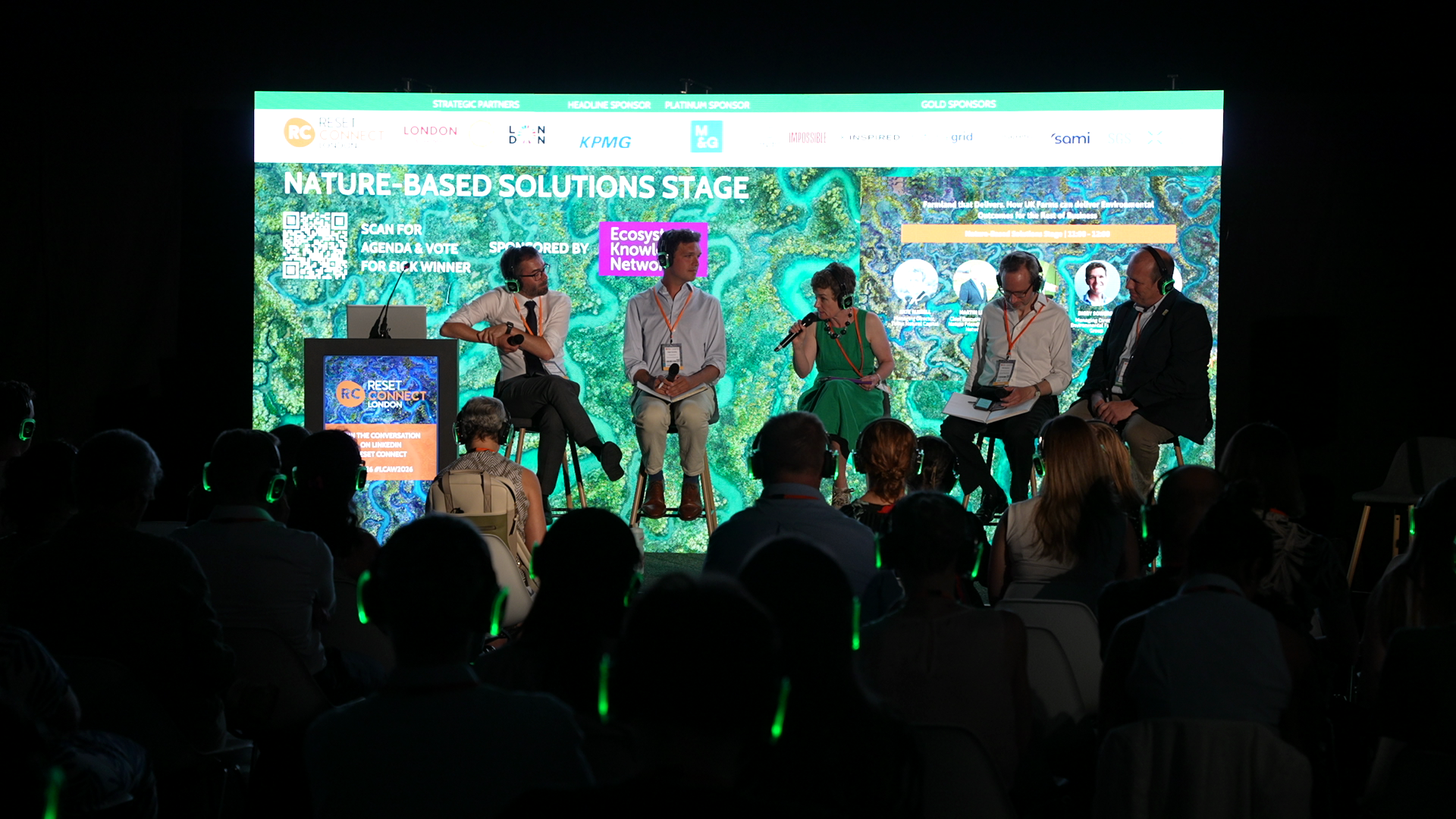
Event: Reset Connect London 2026
Date and stage: 23 June 2026, Nature-Based Solutions Stage
Moderator: Kate Russell, Managing Director, Tellus Natural Capital
Speakers: Martin Lines, Nature Friendly Farming Network. Will Stephens, Landscape Enterprise Networks. Digby Sowerby, Environmental Farmers Group. Will Lockhart, Defra.
Estimated read time: 7 minutes
Quick Read Summary
A food manufacturer needs a reliable supply of crops. A water company wants less pollution reaching a treatment works. A council wants to slow floodwater before it reaches homes. Each has a reason to fund work on farms, and several may depend on the same land. At Reset Connect London 2026, Kate Russell asked what those buyers should pay for and how farmers could make the work part of a viable business.
The panel agreed that farmers need clear commitments and workable data requirements. They disagreed on how much payment should depend on measured results. That decision determines who carries the risk when a project takes years to mature or a season fails to produce the expected result.
Start with the business problem
Martin Lines, an arable farmer and chief executive of the Nature Friendly Farming Network, said four supply chains were paying his farm for regenerative actions on top of the commodity price. Better habitats can support pollinators and beneficial insects, while changes to how land is managed can make production more resilient as weather becomes less predictable. Lines also described the administrative cost of working with buyers that ask for data through different platforms. A farm with several crops and buyers still has one rotation to manage.
Will Stephens described how Landscape Enterprise Networks, known as LENs, starts by asking organisations what they need from the area. A food buyer might prioritise emissions within its supply chain. A water company might want to reduce treatment costs linked to runoff. A council might need farms upstream to help slow the flow of water towards a housing development. LENs works with buyers and farmers to identify practices that could address those needs. Farmers select from the options or propose alternatives, and the scheme reports back to both sides so they can decide what to fund the following year.
Give farmers a route to larger buyers
Digby Sowerby described a different starting point for Environmental Farmers Group, a farmer-owned cooperative. Its members identify projects they want to undertake, then the group brings those projects together for potential buyers. Its work includes biodiversity net gain, nutrient neutrality and soil carbon. For farmers, working together can improve access to buyers and give them a stronger hand in negotiations. For buyers, it can bring projects across several holdings into one conversation.
Scale matters for what the work can achieve as well. A farm can alter how water moves across its own fields, but flood mitigation often depends on what happens elsewhere in the catchment. Stephens made a similar point in the audience discussion. Water companies, retailers and landowners share landscapes, and each depends on decisions the others make. Funding isolated projects may leave too much of the area untouched to deliver the wider change a buyer is seeking.
Decide who carries the risk
Sowerby argued that contracts should reward measurable outcomes. If a buyer wants a reduction in phosphate, for instance, the unit of payment should reflect what it is buying. He also described work to find investment for the early costs of projects, when farmers need to commit money before they can earn income from a completed scheme.
Lines pointed to the risk of making payment depend entirely on what can be observed. A farmer may create good habitat and find few insects on the day of a survey. A flood measure may be ready to work throughout a quiet season. Russell drew a related distinction between a grant that pays to install a leaky dam and a contract that pays for providing a flood mitigation service over time.
Stephens said LENs pays for agreed practices so money can reach farms in time for the work. An audience member raised the other side of that choice: paying for an action can reward the cheapest way to complete it unless the contract specifies the standard it must meet. A buyer and farmer could agree when money is needed, what quality is expected and which results can reasonably be measured. That makes it possible to separate the costs of delivery from the risks neither side controls.
Be clear about what each payment buys
A change in soil management can affect carbon, water retention and biodiversity. Sowerby described how a supply chain buyer might pay for the carbon benefit and a water company for a separate water benefit. Lines wanted enough transparency to show what each customer had funded and what remained available. Stephens said LENs asks farmers what public support they receive or expect to receive and funds work that goes beyond it or differs from it.
Will Lockhart described Defra’s work with the British Standards Institution on nature investment standards and plans to make land data more accessible through England’s Land Use Framework. He also discussed public investment taking some early risk to help attract private funding. In the Q&A, the distinction between standards and governance mattered. Common definitions can help buyers compare projects, while contracts and oversight determine what happens if commitments are missed or two buyers claim the same benefit.
Practical Application
- Start with a specific dependency. Identify which crops, water sources or sites are exposed and which farms could make a difference.
- Ask what farmers can deliver within their rotations, what needs paying for upfront and how long the work needs to be maintained.
- Agree the baseline, evidence, data access and payment conditions before work starts. Record what other buyers or public schemes already fund.
- Test whether the project makes sense across the catchment or supply area. Ask who else benefits and whether they could share the cost.
Key Takeaways
- Buyers can fund farm work to protect supply, improve water quality or reduce flood risk.
- Farmer groups can bring together projects across holdings and make them easier for buyers to fund.
- Payment for practices helps cover delivery costs. Payment for outcomes links spending to evidence but can expose farmers to risks beyond their control.
- Multiple buyers need a clear record of the distinct benefits each pays for.
Quote of the Session
“We repurpose production.”
Martin Lines, Chief Executive Officer, Nature Friendly Farming Network
Final Thoughts
For businesses, the place to start is the land their operations depend on. A shared interest in a catchment gives a food buyer, a council and a water company a reason to work together. Farmers then need contracts that give them room to choose what works on their land and enough certainty to commit to it.
Speakers
Kate Russell is a natural capital consultant and Managing Director of Tellus Natural Capital. She advises landowners and organisations on ecosystem services and emerging nature markets.
Martin Lines is a Cambridgeshire arable farmer and Chief Executive Officer of the Nature Friendly Farming Network.
Will Stephens is Development Director at Landscape Enterprise Networks, which connects buyers with farmers delivering work in shared landscapes.
Digby Sowerby is Managing Director of Environmental Farmers Group, a farmer-owned cooperative that helps members access natural capital markets.
Will Lockhart spoke for Defra, where he leads work on nature markets and investment.
Watch Full Session