


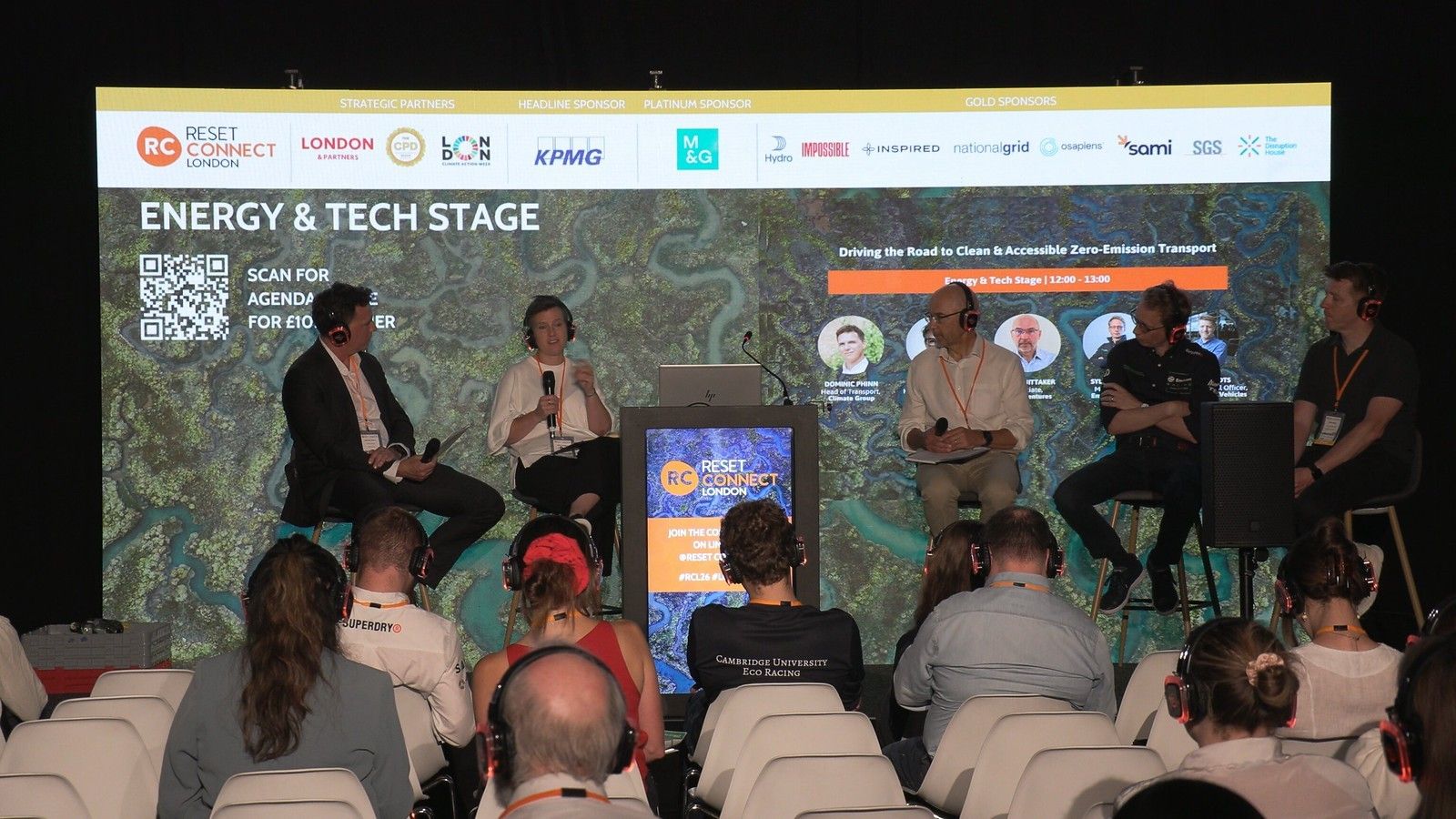
Driving the Road to Clean & Accessible Zero-Emission Transport
🏠 | Blog | Driving the Road to Clean & Accessible Zero-Emission Transport
Event: Reset Connect London 2026
Date: Wednesday 24 June 2026
Speakers: Dominic Phinn, Head of Transport - Climate Group (moderator). Abby Chicken, Head of Sustainability - Openreach. Neil Whittaker, Associate - Eigen Ventures. Sylvain Filippi, MD and CTO - Envision Racing. Oliver Boots, Chief Commercial Officer - Octopus Electric Vehicles.
Estimated read time: 9 minutes
Quick Read Summary
The argument for electric vehicles has stopped being an environmental one. This Reset Connect London 2026 panel brought together a fleet operator, a leasing and energy business, a motorsport team and an investor, and every one of them described a market now moving on cost and product quality rather than on carbon.
Passenger cars are mainstream. Vans are behind and heavy goods vehicles are barely started, with a few hundred electric HGVs on UK roads against an annual market of around 20,000.
You will come away with a clear picture of where vehicle to grid actually is today, why charging infrastructure rather than vehicle technology is now the binding constraint, and the evidence the panel put against two persistent myths about batteries.
The Case for Electric Has Stopped Being About Carbon
Every panellist arrived at the same observation from a different market, and none of them led with emissions.
Abby Chicken, Head of Sustainability at Openreach, runs one of the largest commercial fleets in the country and now has 7,000 electric vehicles on the road. The shift she described was cultural rather than technical. "We don’t talk about climate, we don’t talk about net zero, we let the engineers talk for themselves," she said. What sells the vehicles internally is the driving experience, the in-cab technology and being able to warm the cab from a phone app on a cold morning. "It’s almost never about carbon."
Oliver Boots, Chief Commercial Officer at Octopus Electric Vehicles, gave the consumer version in the same order. Cost comes first, since an electric car is cheaper to lease and considerably cheaper to run when charged at home. Experience comes second. Reducing emissions comes third, and only for a minority. He cited internal research finding that 93 per cent of drivers say they would not go back.
Neil Whittaker, Associate at Eigen Ventures, reported the same from heavy goods drivers, who find the vehicles easier and more comfortable to drive.
Cars Are Mainstream, Vans Are Behind, HGVs Have Barely Started
The panel was careful not to let passenger car progress stand in for the whole transition.
Boots put cars firmly in the mainstream, with roughly one in four new cars sold in the UK now fully electric rather than hybrid. Vans, he argued, follow the same pattern as every other automotive technology, arriving a few years after cars, with heavy goods vehicles a further step behind again.
Whittaker supplied the numbers for the heavy end. Just over 500 electric HGVs were registered in the UK last year according to industry figures, with around 1,100 pre-sold for this year, against a total market of roughly 20,000 a year. That is early adopter territory, and the constraint is load capacity and route suitability rather than whether the technology functions.
Chicken and Boots both described working round van limitations operationally rather than waiting for better vehicles. Octopus schedules charging windows into engineer routes using its own charge point data, and where an engineer is working in a customer’s home for several hours the van charges there, with the household reimbursed.
Motorsport Technology Is Reaching Road Cars Faster Than Expected
Sylvain Filippi, Managing Director and CTO at Envision Racing, has watched the technology develop from inside Formula E since its founding season.
The progression is stark. In 2014 the energy density was so low that each driver needed two cars to complete a 45-minute race, physically swapping vehicles mid-race. Four years later the same race distance was covered faster in a single car. The fourth-generation car being tested the week after the panel reaches 60 mph in 1.7 seconds, tops out at 210 mph and delivers 700 kW of regenerative braking against about 150 kW in a road car.
The figure Filippi was proudest of was efficiency. From battery to wheel, the car runs at 97 per cent, against roughly 25 per cent for a combustion engine and 80 to 85 per cent for a good road-going EV, achieved partly by running at 950 volts.
That voltage is the point. The 800 volt architecture now appearing in new road cars was pioneered in Formula E seven years ago, when no supplier made inverters or motors at that specification and the teams had to build them.
Vehicle to Grid Turns a Fleet Into Grid Infrastructure
Vehicle to grid, where a parked car exports power back to the network, was the technology the panel returned to most often.
Boots was candid that it remains at an early stage. Octopus ran its first trial in 2020 with 140 Nissan Leafs, has live vehicles on the road today and around a dozen manufacturers in the pipeline, with grid operator compliance the slow part. What is already at scale is the simpler version, which schedules charging to happen when the grid is cheapest and cleanest, aggregating those batteries into a virtual power plant. The commercial logic is grid investment: peak demand sits between five and seven in the evening, and smoothing that peak means building less network to meet it.
Chicken explained why this matters well beyond transport. The Climate Change Committee’s adaptation report published in May included telecoms for the first time, with a recommendation that there should be no climate-driven telecoms outages by 2050. Openreach depends entirely on power, and a large fleet that can move stored energy around the country turns an aspiration into something achievable.
Charging Is Now the Constraint, and It Is a Planning Problem
Asked what is actually blocking further progress, Chicken was blunt: "low hanging fruit is definitely plucked".
Her list was practical. A large proportion of UK households have no off-street parking. Charging in cities is reasonable and confidence drops sharply in rural areas. Public charging in daytime is expensive and carbon-intensive, which she described as a business case deal breaker for a fleet, so Openreach is building private provision and has struck a business-rate charging deal with a supermarket chain that has its own power purchase agreement behind it. Much of the relevant budget sits with local authorities, without good data on where charge points are most needed.
Whittaker argued the answer is national coordination rather than more subsidy. The Netherlands plans charging infrastructure as a national structure involving grid operators, councils and equipment operators together, and the UK has no equivalent forum. He also pointed to two cost levers: connecting depots directly at 11 kV can remove around half the capital cost of an installation, and second-life vehicle batteries can balance local networks instead of reinforcing them.
Policy Certainty Was the One Thing Everyone Asked For
Asked what they would want from the next government, all four gave versions of the same answer.
Boots wanted clarity on the zero emission vehicle mandate, which has been reopened for consultation. Businesses and consumers making capital investments need to know what they are investing against, and he noted a widespread confusion in public debate between the sale of cars and their production, which are different questions with different employment implications.
Chicken made the same point from a fleet perspective, describing a pattern of commitments being reaffirmed and then reopened within months. Her wider argument was about language: the wins are measurable in health and air quality, and London is no longer the UK’s most polluted city.
Filippi took the opposite tack and reached the same place. "The best technology must win," he said, arguing that constant adjustment of tax treatment does more harm than the incentives do good. Whittaker’s ask was structural: a national plan for depot charging over five years, so supply chains and investors have something to price against.
Practical Application, How to Build a Fleet Electrification Case That Holds
This panel was unusually operational, and most of its advice applies to fleets already partway through the transition rather than to those considering it.
Questions to ask
- What proportion of our charging happens on public networks during the day, and what is that doing to both cost and emissions?
- Could our depot connect directly at higher voltage, and have we costed that against a standard connection?
- Are we selling this internally on carbon, or on the things drivers and finance directors actually respond to?
Signals to watch
- Vehicle to grid moving out of trials as manufacturer and grid operator approvals come through
- Electric HGV registrations against the roughly 20,000 vehicle annual market
- Business-to-business charging partnerships with retailers and other large site owners
Traps to avoid
- Building the business case on daytime public charging, which breaks it on both price and carbon
- Waiting for a vehicle that suits every route rather than electrifying the routes that already work
- Leading internal communications with net zero when cost and driver experience do the persuading
What good looks like here is a fleet that treats charging as an energy strategy rather than a procurement line, and that can schedule vehicles around cheap, clean power.
Key Takeaways
A fleet operator, an energy retailer, a racing team and an investor described a transition that has passed its technology argument and moved into infrastructure and policy. The disagreements were about pace and mechanism, not direction.
- Cost and driving experience now drive adoption, with emissions reduction a third-order reason for most buyers
- Around one in four new UK cars is fully electric, while electric HGVs remain in the hundreds against a market of roughly 20,000 a year
- Vehicle to grid is still in trials, but managed charging is already at scale and reduces the peak the grid has to be built for
- Daytime public charging can break a commercial fleet business case on both price and carbon
- Battery degradation in full electric vehicles is minimal in practice, including under vehicle to grid cycling
Quote of the Session
"These are just cars. These are just vans."
Oliver Boots, Chief Commercial Officer, Octopus Electric Vehicles
Final Thoughts
The most useful part of the session was the last ten minutes, when an audience question sent the panel into myth-busting. On battery degradation, Boots reported thousands of three-year-old vehicles returning off lease with minimal loss, and noted nobody asks the same question about a three-year-old diesel. Filippi pointed out that vehicle to grid cycles at around 7 kW in either direction, which is trivially slow, while his race batteries are charged at 600 kW during pit stops with minimal degradation. His summary was that suspension will fail before the battery does.
Chicken addressed the other persistent claim, that heavier electric vans wear tyres and brakes faster. Across the Openreach fleet, wear is roughly on a par with the diesel equivalents, because the vans are loaded to the same payload, and servicing costs are considerably lower. Both answers point the same way. The remaining obstacles in this transition are infrastructure and policy, not the vehicles.
Speakers
Dominic Phinn, Head of Transport - Climate Group (moderator). Dominic leads Climate Group’s global transport programme including EV100, a network of major companies committed to electrifying their fleets, with active projects across 12 markets.
Abby Chicken, Head of Sustainability - Openreach. Abby leads sustainability at Openreach, where workstreams include transitioning one of the UK’s largest commercial fleets to zero emissions, and has more than 12 years of experience across multiple sectors.
Neil Whittaker, Associate - Eigen Ventures. Neil is a professional electrical engineer with a record of scaling electrification and energy infrastructure businesses, having previously led development of the UK’s first megawatt charging system for electric HGVs.
Sylvain Filippi, MD and CTO - Envision Racing. Sylvain leads the Envision Racing Formula E team across sporting and commercial operations, having joined Formula E as a founding member in 2013 after co-founding the first circuit race series for zero emission vehicles.
Oliver Boots, Chief Commercial Officer - Octopus Electric Vehicles. Ollie leads the commercial side of an all-in-one car, charger and energy proposition, with nearly two decades of automotive experience including senior roles at LeasePlan and CarNext.
Watch Full Session