


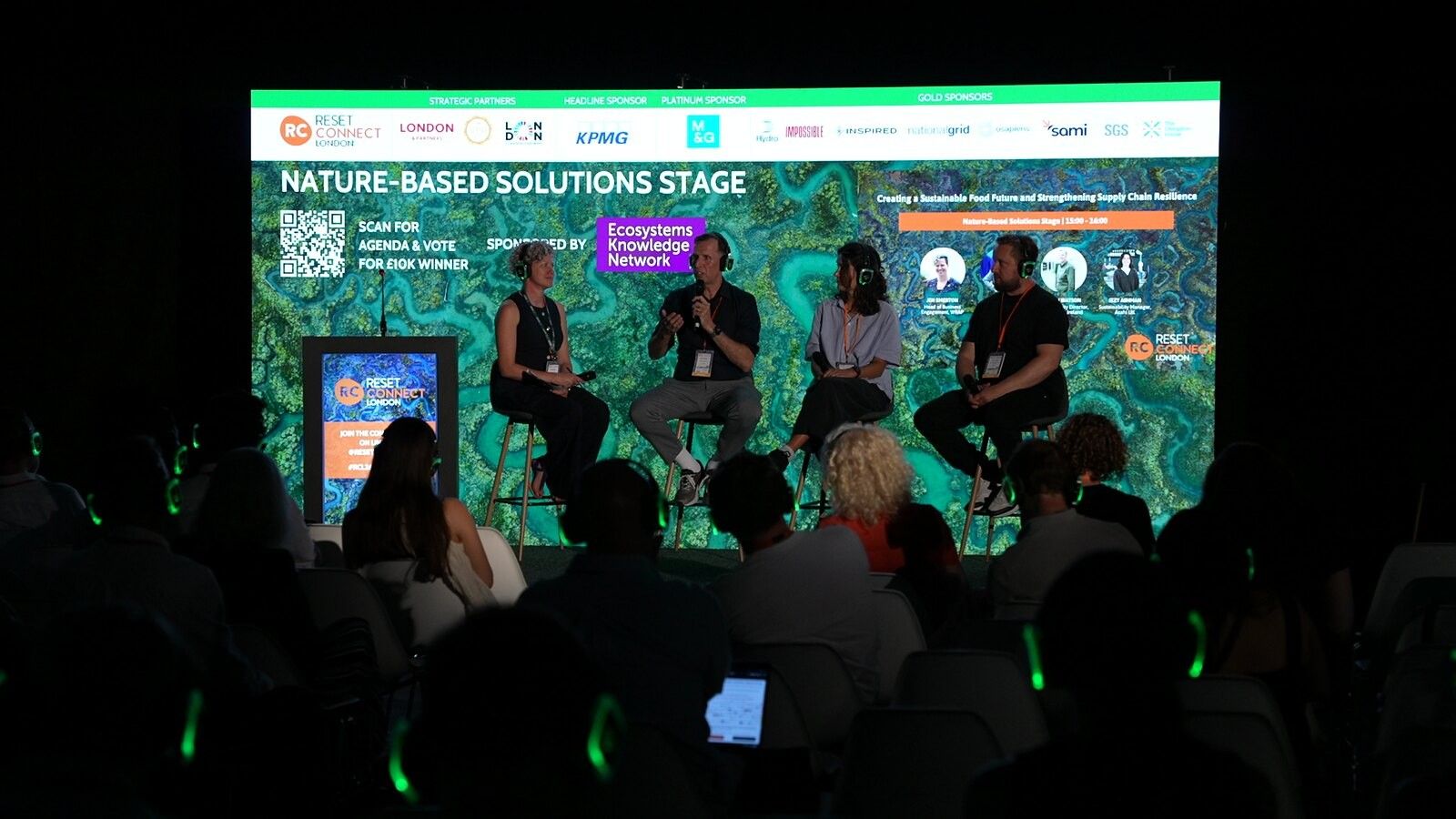
Creating a Sustainable Food Future and Strengthening Supply Chain Resilience
🏠︎ | Blog | Creating a Sustainable Food Future and Strengthening Supply Chain Resilience
- Event: Reset Connect London 2026
- Date: Tuesday 23 June 2026
- Speakers: Jen Emerton, Head of Business Engagement, WRAP (moderator); Tim Lambert, Regional Lead UK, Ireland & Nordics, osapiens; Kevin Watson, Sustainability Director, Levy UK & Ireland; Izzy Ashman, Sustainability Manager, Asahi UK.
- Estimated read time: 8 minutes
“We haven't always had the perfect measurement framework from the beginning, but that's something that we've developed along the way.”
-Izzy Ashman, Sustainability Manager, Asahi UK
Quick Read Summary
Hops make up a small part of a brewer’s emissions footprint. Losing access to the right varieties could still put a beer’s future at risk. That gap between carbon impact and business vulnerability ran through this Reset Connect London 2026 panel, moderated by WRAP’s Jen Emerton.
Asahi UK explained why it is funding hops research and supporting regenerative barley farming. Levy described changes to menus, ingredients and packaging, alongside a £500,000 investment in nature recovery. osapiens explored how supply chain data can help businesses identify risks and win support for action.
The discussion showed why food supply chain resilience requires a closer understanding of the land, water and ecosystems behind a product, and how businesses can begin acting without waiting for perfect information.
A Small Carbon Footprint Can Hide a Critical Supply Risk
Izzy Ashman, Sustainability Manager at Asahi UK, gave the clearest example of what a carbon-only assessment can miss. Hops are used in small quantities compared with malted barley. Measured through emissions, they are a relatively minor ingredient. Measured through their vulnerability and importance to flavour, they become a business priority.
Hop varieties have distinct regional characteristics. Replacing a British variety with one grown elsewhere may change the product, while the crop itself is sensitive to rainfall, soil conditions and disease. Ashman described the combined effects of changing weather, reduced natural pest control and vulnerability to verticillium wilt.
This changed the question Asahi was asking. Cutting emissions remained important, but the business also needed to understand whether it could keep sourcing the ingredients that make its beers recognisable.
Ashman described two PhD projects examining biochar as a soil treatment and wildflowers planted between hop rows. The work brings together industry partners and researchers from the Royal Agricultural University and the University of Warwick to investigate ways of making British hop production more resilient.
These are research projects, with results still to establish. Their commercial relevance is already clear: an ingredient does not need to dominate the carbon inventory to deserve investment. A sourcing team needs to know which ingredients are exposed to disruption as well as which produce the most emissions.
Regenerative Barley Requires Collaboration and Careful Claims
For barley, Asahi’s approach is closer to changing existing farm practices at scale. Ashman described its collaboration with malt supplier Boortmalt, supporting measures including cover cropping, reduced tillage and changes to fertiliser use.
The programme covers barley production equivalent to all the pale malt used for Asahi’s local British beers, delivered on a mass-balance basis. Pale malt represents around 90 per cent of annual malt use at the Griffin Brewery in Chiswick. Partners Cefetra Ecosystem Services and Soil Capital support delivery and measurement.
Ashman emphasised the work behind that arrangement: identifying farmers willing and able to make changes, establishing a baseline and tracking practices over time. Measurement helps connect activity on farms with the business’s emissions reporting and its understanding of progress.
The mass-balance qualification matters. The programme supports equivalent production within the wider supply system; it does not establish that every grain in a particular beer came from a participating farm. Ashman explicitly recognised the limits this places on product claims.
It also affects how quickly the business can demonstrate improved resilience. Where crops are bought through an aggregated system, progress depends on wider participation. Ashman contrasted that with long-term, direct apple-supplier relationships, where working with an individual grower gives a clearer connection between farm improvements and future supply.
The purchasing relationship therefore shapes both the intervention and the evidence a business can reasonably expect to collect.
Procurement Decisions Can Support Nature, Health and Emissions Goals Together
Kevin Watson, Sustainability Director at Levy UK & Ireland, approached the discussion through the food served at venues. His examples showed how buying decisions can connect environmental objectives with the practical work of running a hospitality business.
Levy’s increased use of wild venison in place of beef was one such decision. Watson described visiting farmers and working with specialists to understand how deer populations affect vegetation and habitat recovery. Those conversations helped him explain the sourcing choice internally and respond to questions about availability and suitability.
He was specific about the product: wild venison, rather than treating all venison as environmentally equivalent. The distinction illustrates why a category label alone is insufficient evidence for a sourcing decision. Production methods and local conditions matter.
Watson also described replacing farmed salmon with trout and introducing Notpla’s seaweed-based packaging. Each change required looking at suppliers and operational requirements, as well as the environmental objective it was intended to address.
Seasonality provided another route. Watson said Levy had introduced an air-freight ban in 2021 and described changing menus as produce moves out of season. A strawberry dessert can become an apple dessert, giving chefs a way to work within seasonal availability.
For foodservice businesses, that is a practical form of adaptation: change the offer rather than assume the same ingredients must always be available. It gives procurement and kitchen teams a shared role in reducing exposure to resource pressures.
Better Data Helps Fund Action, but Nature Does Not Always Offer a Simple Payback
Tim Lambert, Regional Lead UK, Ireland & Nordics at osapiens, argued that businesses need a better view of what happens beyond their immediate suppliers. Traceability can reveal where ingredients originate, where risks sit and which parts of a supply chain need attention.
He described sustainability information as a resource that should receive the same seriousness as financial data. Once collected for reporting or compliance, it can also help teams explain a risk to the board, identify an opportunity and secure investment.
His examples included deforestation due diligence and the visibility it can create within business workflows. The value comes when information changes decisions, rather than remaining a reporting exercise.
Watson added a different perspective on investment. Levy committed £500,000 in 2026 to the Living System Fund, developed with RegenFutureCo. Its projects include habitat connections in the North York Moors, seagrass work in Wales and river restoration in the Scottish Highlands. The fund builds on the Biohub regenerative demonstration project in North Yorkshire.
Asked about the return, Watson said these projects were not expected to produce a direct financial payback. He described a commitment to restoring nature, alongside the value of a business whose clients and employees understand its purpose.
The distinction is useful for boards. Some interventions have a direct relationship with ingredient security or operating costs. Others restore ecosystems without a readily attributable financial return. Both require evidence and a clear purpose; presenting every nature project as a short-term cost saving obscures what the investment is actually intended to do.
Employees and Customers Need a Way to Participate
A sourcing policy becomes effective through the people who order ingredients, design menus and serve customers. Watson described Levy’s sustainability workshops and annual venue reviews as ways to turn its objectives into responsibilities that colleagues can act on.
The training concentrates on the changes teams need to make and why they matter. Reviews identify local challenges and create an action plan. Watson also described linking contracted bonuses to sustainability performance, reinforcing the message that delivery belongs within the business’s normal assessment of success.
Ashman described tailoring engagement at Asahi to different audiences. Board members need information that supports decisions. Colleagues responsible for implementation need to understand their tasks and how those contribute to the overall objectives. The wider workforce needs clear priorities and updates.
Customers can be involved through something more tangible than a target. Through Fuller’s London Pride’s partnership with Brentford FC, fans were invited to grow hops at home for a shared harvest and a special beer. Ashman explained how the activity connected supporters with the pressures facing British hop growers and the future of a product they enjoy.
That example brought the discussion back to collaboration. Suppliers, researchers, employees and consumers each have a different role. Giving them a specific way to contribute makes a large, abstract challenge easier to act on.
Practical Application: Find the Ingredient Your Carbon Assessment Overlooks
Start by comparing emissions priorities with supply vulnerabilities. The two lists may differ substantially.
Questions to ask
- Which ingredients are essential to our products but receive little attention because their emissions contribution is small?
- Where do those ingredients depend on vulnerable water sources, soils, habitats or regional growing conditions?
- Do our supplier relationships let us work directly with growers, or do we need a collective approach across an aggregated supply system?
Signals to watch
- Repeated disruption to the availability or quality of particular crops.
- Suppliers willing to collaborate on trials, share farm data or offer longer-term relationships.
- Opportunities to adapt menus or specifications as seasonal availability changes.
Traps to avoid
- Assuming a lower-carbon ingredient automatically resolves every environmental concern.
- Describing mass-balance sourcing as physical traceability to an individual product.
- Reporting a funded project or an adopted practice as though a measurable ecological outcome has already been demonstrated.
Emerton encouraged food and drink businesses to map water risk and pointed to WRAP’s Water Roadmap. That offers a concrete starting point for organisations deciding where to focus their next supplier conversation.
Key Takeaways
- Hops illustrated why an ingredient with a small emissions contribution can still create a major supply risk.
- Asahi’s hops research and regenerative barley programme respond to different pressures through different forms of collaboration.
- Mass-balance sourcing supports change across a supply system, with limits on what can be claimed about an individual product.
- Levy’s sourcing and menu changes showed how procurement can connect nature, emissions and operational decisions.
- Supply chain data can strengthen investment cases, while some restoration projects require a rationale beyond direct financial payback.
- Training, clear responsibilities and accountability help make sustainability part of everyday delivery.
Final Thoughts
The most useful distinction in this discussion was between reducing a business’s impact and protecting the conditions it needs to keep operating. A carbon inventory can identify emissions hotspots. It cannot, by itself, tell a brewer whether a particular hop variety will remain available or a food business which water catchment needs attention.
The panel’s examples showed how to begin answering those questions: understand the ingredient, speak to the people producing it and choose an intervention that fits the supply relationship. Build measurement into the work, be clear about what it demonstrates and improve it as the project develops.
That gave substance to the closing advice shared by all three panellists: get started.
Speakers
Jen Emerton, Head of Business Engagement, WRAP. Jen leads a team working across WRAP’s textiles, food and drink, and packaging programmes. Her work supports businesses in making informed decisions and embedding circular living, connecting organisations and stakeholders working towards circularity. Jen moderated the session.
Tim Lambert, Regional Lead UK, Ireland & Nordics, osapiens. Tim leads osapiens’ work across the UK, Ireland and Nordics. He and his team help organisations connect sustainability data with operational decisions, moving beyond fragmented reporting to improve efficiency, resilience and growth across supply chains.
Kevin Watson, Sustainability Director, Levy UK & Ireland. Kevin is an experienced food and drink operator who has led Levy’s operational and cultural sustainability programme. Following his work on the food and drink strategy for COP26’s Blue Zone, he became Sustainability Director in 2022. His work spans environment, nature and health, combining employee education with initiatives in food sourcing, menus and packaging.
Izzy Ashman, Sustainability Manager, Asahi UK. Izzy develops Asahi UK’s sustainability roadmap and supports implementation across its brewing supply chain. Previously, she worked on Nature Positive Transitions at the World Economic Forum and advised clients on climate and sustainability at Boston Consulting Group. Her experience also includes independent research into regenerative farming in the UK.
Watch Full Session