


How Can AI Unlock the Economic Opportunity of the 21st Century?
Home | Blog | How Can AI Unlock the Economic Opportunity of the 21st Century?
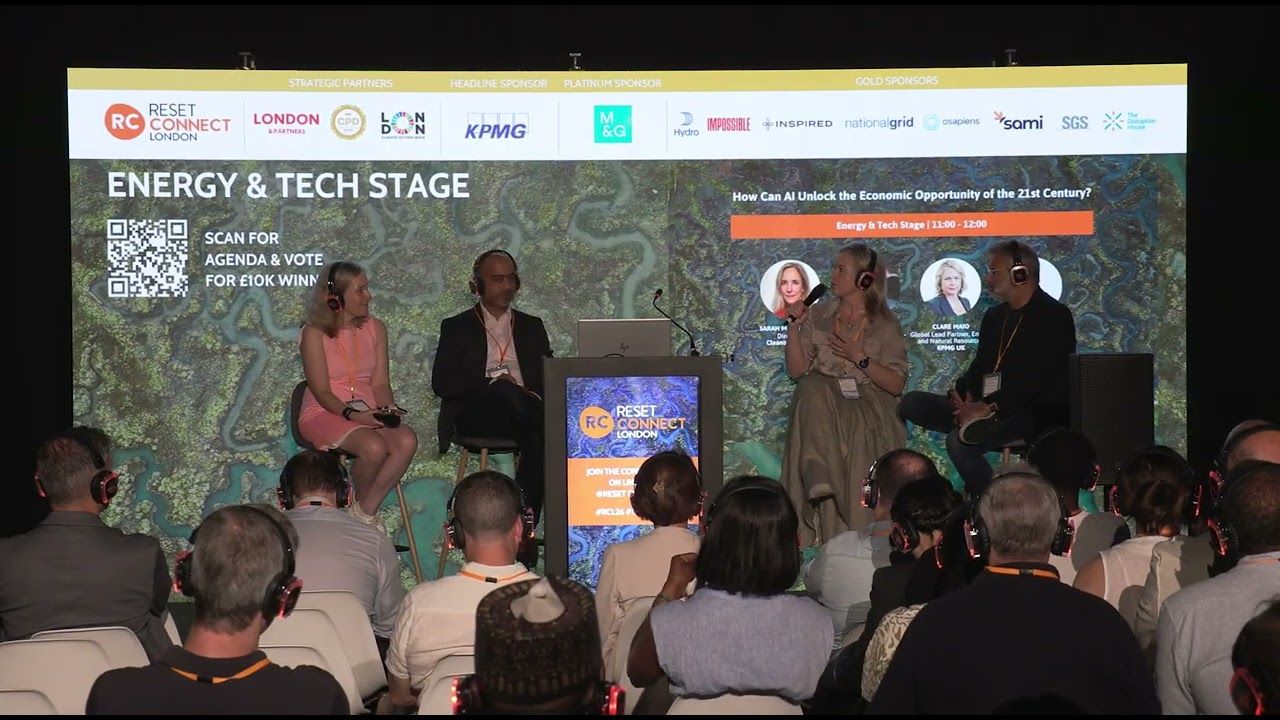
Event Reset Connect London 2026
Date Wednesday 24 June 2026
Stage Energy & Tech Stage
Moderator Sarah Mackintosh, Cleantech for UK
Speakers Sam Mathew, Microsoft. Clare Maio, KPMG UK. Alex Pinho, SAP.
Estimated read time 5 minutes
Quick Read Summary
AI can help energy businesses make sense of more information than their teams could process manually. The harder question is whether that information can improve a real decision, from operating a congested grid to tracing an emissions figure or drafting an infrastructure permit.
At Reset Connect London 2026, the panel looked at both sides of the equation. Energy companies can use AI to improve how they work, while data centres themselves add demand to the power system.
Start with the decision the business needs to make
An AI investment can touch operations, finance and reporting at the same time. That makes it easy to describe its potential and harder to measure its value. The panel discussed what happens when a company begins with a business problem and works back to the information and processes needed to solve it.
For an energy business, that could mean helping operators compare responses to a constraint or helping a reporting team trace a figure to its source. Each task has a different test of success. Defining it early gives the team a way to decide whether the tool is worth using.
Make legacy data usable
Energy companies often have decades of records spread across systems built for different purposes. Alex Pinho discussed connecting structured business data with unstructured material and giving the tool enough context to interpret it. A system needs to know what a field means, where it came from and how it relates to the work at hand.
That is a practical constraint for organisations looking to move beyond a pilot. A tool tested on a tidy sample may behave differently when it meets inconsistent records from several sites or teams. The data work helps reveal where the output can be trusted and where a person needs to intervene.
Use AI to help operate a more complex grid
The panel discussed how a grid with more variables creates decisions that are difficult to make by hand. An operator has to weigh changing conditions across the network, sometimes with congestion already limiting what can move through it. AI can help evaluate more combinations and surface options for operators to examine.
The value depends on how the tool fits into operations. The people responsible for the grid still need to know what it is recommending, which inputs drove the recommendation and how to respond when the system is wrong.
Keep emissions reporting auditable
Scope 3 reporting can involve records from suppliers and other sources that use different formats and assumptions. The panel discussed AI as a way to gather and organise that material. It also drew attention to a familiar risk. A report can look polished while the evidence behind its conclusions remains difficult to trace.
A useful reporting tool should let the team get back to the underlying record and explain how a figure was produced. That makes review part of the workflow, especially where source data is incomplete or a calculation uses an estimate.
Count the power AI itself needs
Data centres add a second question to the discussion. AI can help the power system work more efficiently, while the infrastructure running those tools needs electricity and a connection. Where that demand lands matters to a network already dealing with competing requests for capacity.
The panel discussed AI demand in the context of UK grid decarbonisation. For energy planners, the practical task is to consider where and when new loads arrive alongside what the system can supply. A benefit in one part of the economy does not resolve a connection constraint elsewhere.
Use AI on the paperwork that slows projects down
One example concerned nuclear permitting in the US. The panel described using a language model grounded in decades of material to help people drafting permit submissions work through the relevant information. The example showed where a tool can assist with a document-heavy task that requires searching and comparing a large body of records.
The distinction matters for anyone assessing the result. Drafting a submission and obtaining approval are separate milestones. Measure the time saved on preparation separately from the time taken by the wider permitting process.
Practical Application
Pick one decision with a named owner. Record how long it takes today, which evidence the team uses and what a material error would look like. Test an AI tool on real cases alongside the existing process, and have the team compare the results before relying on it. For reporting, check traceability. For operations, test unusual conditions as well as routine ones.
Key Takeaways
- Define the decision and success measure before choosing the tool.
- Give the model usable data and keep a record of where outputs came from.
- Assess electricity and connection needs alongside the benefits of AI.
- Measure time saved on one task separately from the duration of the whole project.
Quote of the Session
“Who are going to be the winners and how do we remain competitive?”
Sarah Mackintosh, moderator, Cleantech for UK
Final Thoughts
The strongest examples in the discussion began with a job someone already had to do. Operators have to make decisions on a more complex grid. Reporting teams have to show where their figures came from. Project teams have to work through years of technical and regulatory material. Each gives businesses a concrete way to test whether AI is earning its place.
Speakers
Sarah Mackintosh, Director, Cleantech for UK, moderated the discussion from the perspective of a policy advocacy organisation working with cleantech start-ups, scale-ups and investors.
Sam Mathew, Director, Industry Lead, UK Energy & Resources, Microsoft, brought a technology provider’s perspective on AI in energy and infrastructure.
Clare Maio, Global Lead Partner, Energy and Natural Resources, KPMG UK, brought an advisory perspective on how energy businesses use AI and assess its outputs.
Alex Pinho, Global Chief Revenue Officer, SAP Sustainability, discussed connecting business data with the context needed to use it.
Watch Full Session