)
)
)
How Can the UK Tackle the Plastic Crisis?
🏠 | Blog | How Can the UK Tackle the Plastic Crisis?
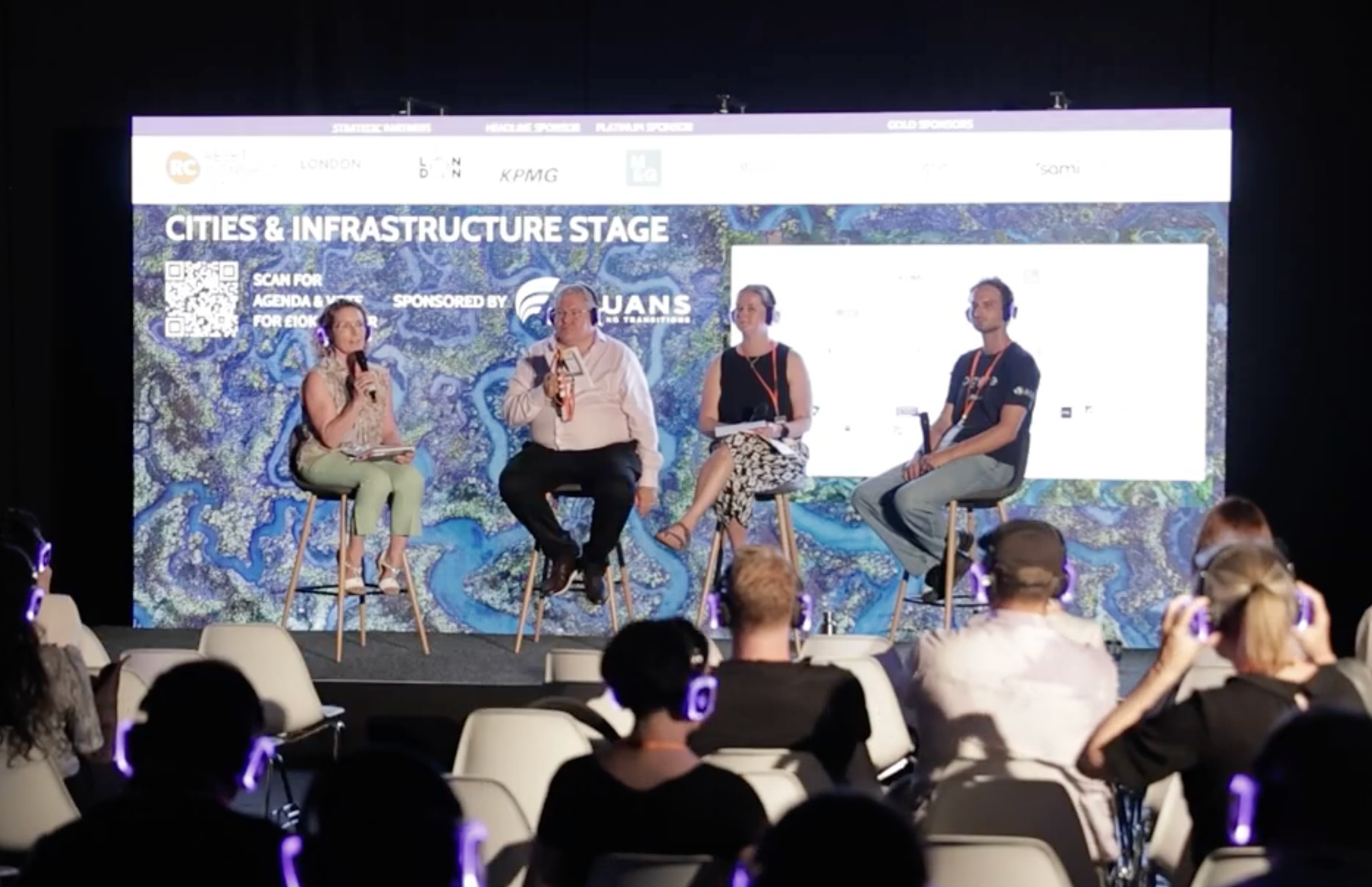
Event: Reset Connect London 2026
Date: Wednesday 24 June 2026
Speakers: Sue Armstrong Brown, Global Director of Environmental Impact - CDP . Sebastian Munden, Chair - WRAP. Tegan Evans, Research Fellow - University of Portsmouth. Francesco Notari, Chief Sustainability Officer - Ogyre.
Estimated read time: 9 minutes
The most alarming number in this Reset Connect London 2026 panel was not about pollution. It was that the UK has lost more than a fifth of its plastic recycling capacity since 2023, at the same moment as governments worldwide are mandating recycled content in packaging.
That gap framed the hour. Collection and sorting are largely funded and reasonably well understood. Reprocessing, the stage that turns collected material back into something usable, does not currently pay, and no amount of household participation fixes that.
You will come away with a clear-eyed account of where UK policy stands, a practical model for scaling reuse that does not depend on consumer heroics, and three different readings of what the stalled global plastics treaty actually means.
The Scale Is Larger Than the Public Conversation Suggests
Sue Armstrong Brown of CDP opened by resizing the problem for a room that thought it already understood it.
If the plastics system were a country, she said, it would be the third largest greenhouse gas emitter in the world, behind China and the United States and ahead of everyone else, and it is on track to grow by 60 per cent over the next 15 years. The UK produces plastic packaging equivalent in mass to a thousand London Eyes annually. Globally, around 130 million tonnes of plastic enters the environment each year, a figure expected to more than double by 2040.
Francesco Notari, Chief Sustainability Officer at Ogyre, supplied the view from the receiving end, having visited one of the world’s largest landfill sites days before the event. He described waste mountains measured in kilometres and tens of metres in height, a landslide that killed almost 10 people the previous month, and earlier explosions caused by methane fermentation that killed hundreds.
His point was that the consequences are already being paid, just not by the people generating the waste. Everyone in the room, he noted, now tests positive for microplastics in blood and lung tissue, with no reliable evidence yet on what that means long term.
UK Policy Is Piecemeal Rather Than Strategic
Tegan Evans, Research Fellow at the University of Portsmouth’s Revolution Plastics Institute, gave the policy assessment, and it was more nuanced than either cheerleading or dismissal.
The instruments exist. A plastic packaging tax incentivises recycled content over virgin material. Extended producer responsibility makes producers pay for collection and recycling, with modulated fees rewarding packaging that is easier to recycle. There are single-use bans and microbead restrictions, and a broader circular economy strategy is expected.
Her objection is architectural. "The UK approach is still piecemeal rather than strategic," she said, with no overarching framework covering the full life cycle, production through to disposal, which makes progress almost impossible to measure. Policies occasionally contradict one another, and the domains that ought to reinforce each other, climate, investment, biodiversity, energy and trade, are not joined up. She pointed to Ecuador and Ghana as countries further along in building exactly that kind of national framework.
Notari added the enforcement problem from European experience. A single-use plastics directive took five or six years to negotiate, and producers responded by relabelling single-use items as washable or reusable.
The Reprocessing Economics Are the Real Crisis
This was the section that should worry anyone with recycled content targets, and all four panellists converged on it.
Sebastian Munden, Chair of WRAP, explained that producer responsibility schemes generally fund collection and sorting, while the economics of reprocessing do not work well enough to attract companies into the business. "What’s the point of collecting it all if you can’t process it?" he asked. Evans supplied the measurement: the UK has lost 22 per cent of its recycling capacity since 2023, while national policies across Europe increasingly mandate recycled content. The mechanism intended to subsidise reprocessing suffers from price volatility and, in her assessment, provides too little support rather than too much.
Armstrong Brown named the underlying cause, which is that virgin plastic remains cheaper. Companies that want to do the right thing face a real cost penalty, which is why so much packaging carries 30 or 50 per cent recycled content rather than 90 or 100.
Notari confirmed it from the supply side. His organisation produces recycled plastic and has storage full of unsold material, priced comparably to virgin, because nobody is buying it.
Reduce First, Then Reuse, and Recycling Last
Munden made the case that the sector has become fixated on the wrong tier of the waste hierarchy.
WRAP was created 25 years ago to move material out of landfill, and recycling was the right answer to that question. The right answer now sits further up. Reducing the amount of packaging in the first place comes first, genuine reuse second, and recycling after that. He quoted a colleague approvingly: "we don’t have a plastic problem, we have a plastic management problem", the point being that plastic is an excellent material being handled appallingly.
The coordinated approach has a track record. The first UK Plastics Pact launched in 2018 and was retired in 2025 having achieved around two thirds of its stretch targets, with similar pacts now running in 19 countries. Across them, 33 billion items of unnecessary plastic have been removed and around 900,000 tonnes recycled. The successor UK Packaging Pact concentrates on delivery rather than target-setting, since the targets already exist.
His illustration of what does not count was a plastic drinking straw he saw in Greece, printed with the claim that it could be used 20 times.
Scaling Reuse Means Making It Easy for Brands
Munden was unusually candid about why reuse has failed before, starting with his own attempt at it.
As a brand manager in the late 1990s he trialled in-store dispensing of a fabric conditioner and, by his account, created the first skating rink in a British supermarket. In-store filling is messy, unfair on staff and carries safety and hygiene problems. The model that does work is prefilled containers bought, returned, cleaned and refilled, with interoperability as the critical feature: buy anywhere, return anywhere.
The insight that makes it scalable is commercial rather than environmental. "There is absolutely no commercial incentive for them to do this," he said of brands, since nobody sells more product for being in a reusable bottle. The answer is to ask brands to make their existing packaging as reusable as possible so it still runs down today’s production lines, because bespoke reuse packaging is a ten million pound factory decision no one will take early enough.
Evans pointed to France, where the AGEC law ring-fences 5 per cent of producer responsibility fees for reuse and has established a national reuse observatory, and to Germany, where reuse mandates in takeaway food have spawned a commercial hygienic washing sector.
The Panel Disagreed About What the Stalled Treaty Means
The most honest exchange came on the global plastics treaty, where three people who all want the same outcome read the same events completely differently.
Munden described a crossroads. Roughly 80 countries want to move forward and around 30 are resisting, which leaves a choice between a coalition treaty that lacks universal legal force but allows progress, and waiting for a universal agreement that gets diluted in the process. His view was that waiting is pointless.
Evans found genuine value in the negotiations regardless of outcome. They have catalysed research across every dimension of the problem and produced what she called an explosion of plastics policy, misdirected in places but undeniably progress.
Notari, who took part in the negotiations, was blunt about how it felt from inside. Years of work, agreement among the overwhelming majority, and nothing delivered because of opposition from the countries benefiting most from the current system. He described returning to the same position as six years earlier as deeply frustrating.
Munden’s resolution was to refuse the choice: "don’t bet on any one thing." Treaties, voluntary systemic action and well-placed legislation all matter, and legislation raises the floor rather than the ceiling.
Key Takeaways
An NGO chair, a policy researcher, a moderator from a disclosure platform and an operator working in the world’s most polluted waters agreed on the diagnosis and disagreed usefully about the remedy. The technical answers are largely known. The economics underneath them are not working.
- The UK has lost 22 per cent of its plastic recycling capacity since 2023, while recycled content mandates increase internationally
- Producer responsibility schemes fund collection and sorting, but reprocessing economics remain unattractive, which is where the system breaks
- Virgin plastic is cheap enough that most packaging carries 30 to 50 per cent recycled content rather than 90 to 100
- Reuse scales when brands can use existing production lines, since no brand sells more product for being in a reusable container
- France ring-fences 5 per cent of producer responsibility fees for reuse and runs a national reuse observatory, which the UK does not
Quote of the Session
"What’s the point of collecting it all if you can’t process it?"
Sebastian Munden, Chair, WRAP
Final Thoughts
Asked what they would do with a day as circular economy minister, the three panellists gave answers that map neatly onto the problem. Notari would mandate progressively higher recycled content, on the grounds that demand pulls the whole system. Evans would mandate reuse in closed loop settings, to prove to consumers and businesses that it works. Munden would ask the packaging pact signatories what government could do to scale reuse, and then legally ring-fence producer responsibility fees so they can only be spent on packaging rather than, as he put it, potholes.
The observation that stayed with me was Notari’s. Plastic is an outstanding material with an economic value far below its actual worth, which is precisely why it gets treated as disposable. The costs are real; they are simply borne by people in places that receive our waste rather than by the people producing it. Correct that price and most of the other problems become tractable.
Speakers
Sue Armstrong Brown, Global Director of Environmental Impact - CDP (moderator). Sue ensures CDP’s disclosure drives the transparency and action needed for a net zero, nature-positive economy, and was previously CEO of Adoption UK, Policy Director at Green Alliance and Head of Conservation at the RSPB.
Sebastian Munden, Chair - WRAP. Seb chairs the circular economy NGO working on food, consumer products and textiles worldwide, and is also Global Chair of Ad Net Zero, having been Chief Executive of Unilever UK and Ireland until 2022 after 32 years in consumer goods.
Tegan Evans, Research Fellow - University of Portsmouth. Tegan researches plastics policy and environmental governance at the Revolution Plastics Institute, evaluating the effectiveness of policies designed to reduce plastic pollution, and has engaged directly with the UN Global Plastics Treaty negotiations.
Francesco Notari, Chief Sustainability Officer - Ogyre. Francesco oversees sustainability strategy and partnerships at Ogyre, which works with a global network of fishermen who collect marine waste during their daily operations, and is a lawyer and historian by training.
Watch Full Session