


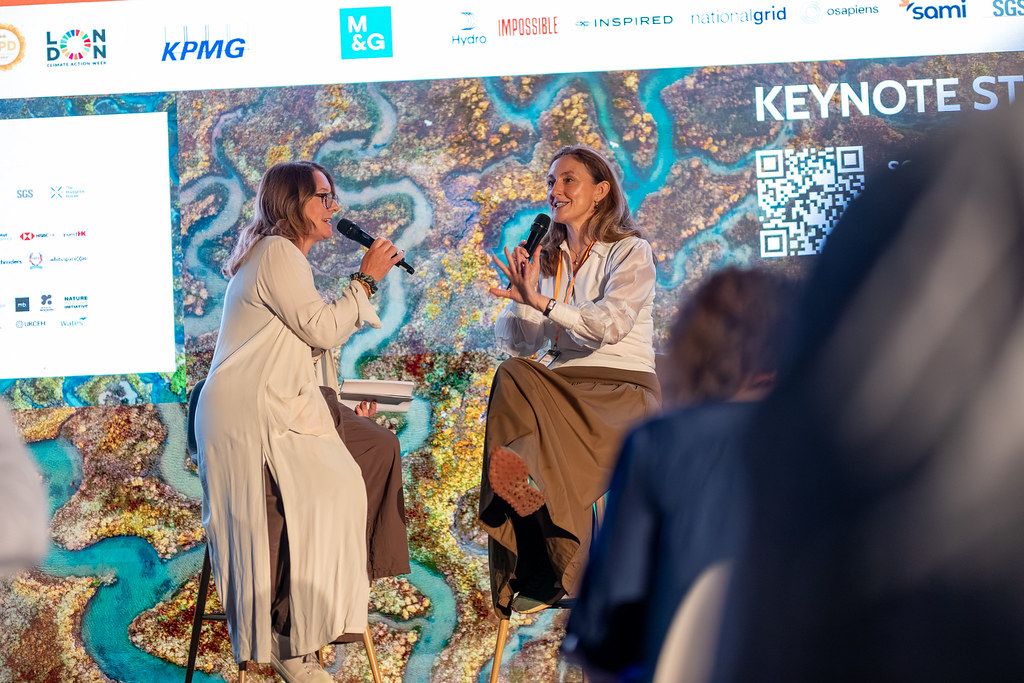
Keynote - UK security in Uncertain Times – the Case for Ambition on Climate and Nature
🏠 | Blog | Keynote - UK security in Uncertain Times – the Case for Ambition on Climate and Nature
Event: Reset Connect London 2026
Date: Wednesday 24 June 2026
Speaker: Tanya Steele CBE, CEO - WWF-UK
Estimated read time: 8 minutes
Quick Read Summary
Security is the word the UK uses for defence, borders and energy supply. Tanya Steele, Chief Executive of WWF-UK, used this Reset Connect London 2026 keynote to argue it belongs to ecosystems too, and that the UK government has already commissioned the evidence to prove it. Her case to the room was not primarily moral. She set out a risk argument aimed at boards, built on supply chain exposure, and a hierarchy for companies with climate and nature targets that puts reduction first and offsetting last. You will come away with the security framing and the report behind it, an explanation of why the City of London is the highest-leverage point in the UK economy, and a clear sequence for businesses that want to act without waiting for policy.
Ecosystems Belong in the National Security Conversation
Steele opened the security argument by conceding the obvious point first. Nothing she was about to say dismisses conventional defence, and she was careful to make that explicit.
Her framing was of a green shield: part of the national infrastructure that determines whether the country can withstand the threats it faces. "A stable climate and secure ecosystems are fundamental to national security," she said, adding that it is reassuring to see defence experts beginning to make the same case. The evidence is closer to hand than most of the audience realised. Steele described the UK government commissioning its first national security assessment of ecosystems, briefed into cabinet by intelligence chiefs and summarised publicly at the start of this year, with results she characterised as very significant. She also pointed to the growing science on tipping points, which she described as one-way doors the country could walk through without noticing. The exposure figure she gave sharpens it considerably. The UK is roughly 50 per cent reliant on global ecosystems for its own security, which turns nature loss elsewhere into a domestic resilience problem here.
The City of London Is the Highest Leverage Point in the UK Economy
Asked how WWF works beyond conservation, Steele went straight to finance, and to a commitment the UK made five years ago. At COP26 in 2021 the government announced that the City of London would become one of the greenest financial centres in the world, moving towards a system where businesses and financial institutions publish transition plans setting out their pathway to a 1.5 degree world. WWF has worked on the task force behind that, publishing guidance and sectoral pathways. Her assessment of progress was blunt: the UK is some way off. To explain why it matters, she offered a comparison that lands harder than any percentage. If the City of London were counted as a nation, the emissions associated with the finance flowing through it would place it around the seventh or eighth largest emitter in the world. She described that scale as both terrifying and, more usefully, the single largest opportunity available. What determines where that money goes is how funds are incentivised and how government regulates, which is why she argued that the policy signal on mandatory transition plans now needs to be laid down.
Business Should Start With Supply Chains Rather Than Wait for Policy
The most direct passage of the keynote was aimed squarely at the room, and it started with a number. Somewhere between 75 and 80 per cent of global GDP is driven by decisions made in the private sector. Government matters for setting policy and catalysing capital, but Steele’s instruction was not to wait for it: businesses already hold the planning cycles and in many cases the investment needed to make these shifts themselves.
Her recommended starting point was supply chains, and her evidence was recent experience. She watched chief executives crack open their supply chains during the pandemic, and watched boards discover how little of that exposure had been tracked or understood. "Crack open your supply chains and understand the nature of those risks," she said. The line that should travel furthest was about governance rather than analysis. "If a risk committee in your board sees an issue, it cannot unsee it." Steele was open that she will always make the moral case, and equally clear that anyone doing this work will end up with a risk, resilience, security and financial case as well.
A Clear Hierarchy for Companies With Climate and Nature Targets
For organisations that have already set targets, Steele gave a sequence rather than a menu, and the ordering matters. First, decarbonise and reduce your own impacts on nature. Second, insetting: enabling others in your supply chain to do the same, which serves scope three ambitions while helping medium and smaller businesses participate. Third, what she called a contribution model, which she deliberately distinguished from straight offsetting. The invitation there is to invest in the recovery of ecosystems that may benefit your business and will certainly benefit everyone else. She also pointed to finance already moving in this direction, describing loans structured so that a company reducing its water impact by 40 or 50 per cent sees that reflected in its cost of capital. That is the mechanism that turns an environmental target into a treasury conversation. Alongside the structural changes she made a smaller and more personal case, asking how organisations move their people beyond being white collar workers towards being green collar ones, through the everyday decisions taken in product development and operations.
The Optimism Comes From Countries That Industrialised Later
Asked to make the audience confident, Steele did not reach for targets. She reached for places where transition is visibly happening at speed. China was her primary example, having travelled there repeatedly over many years. She described the scale of the economic and natural transition as mind-blowing, citing the proportion of the world’s electric vehicles now on Chinese roads, solar output in a single recent year exceeding what the United States has installed in total, and a national park system on track to be the world’s largest by 2030. Indonesia is running restoration and reforestation programmes on land previously damaged by timber and palm oil. Her explanation was that governments are increasingly connecting the dots between ecosystems and their duty to provide water, food and energy security. A country that cannot deliver those has failed regardless of anything else it achieves.
She also highlighted debt for nature swaps, where a heavily indebted nation refinances on better terms in exchange for meeting energy or nature goals. Unpayable interest helps nobody, and restructuring that also restores an environment is, in her words, a complete win-win. The phrase she kept returning to was simpler: give nature half a chance and it will always recover.
Practical Application, How to Act on This Without Waiting for Regulation
This keynote converted unusually cleanly into actions, largely because Steele structured her answers as sequences rather than as principles.
Questions to ask
- Has our risk committee been shown our supply chain exposure to climate and nature, in terms it will recognise as risk?
- Are we reducing first, enabling our suppliers second and contributing third, or have we jumped to the third?
- Where in our operations could water, land or ecosystem dependency interrupt what we sell?
Signals to watch
- Any move towards mandatory transition plans for businesses and financial institutions
- Lending and investment terms linked to measurable reductions in water or nature impact
- Debt for nature swaps expanding as a sovereign financing mechanism
Traps to avoid
- Treating nature as a reputational topic when the exposure sits in procurement and operations
- Moving to contribution or offsetting before reduction and supply chain work is genuinely underway
- Waiting for policy certainty when the planning cycles and capital are already in the business What good looks like, on Steele’s account, is a board that has seen its own exposure clearly enough that it cannot be unseen, and a supply chain programme that starts before anyone is required to have one.
Key Takeaways
A conservation chief executive spent most of a keynote talking about finance, supply chains and board governance, which is itself the point. The nature argument has moved into the language of risk.
- The UK government has commissioned a national security assessment of ecosystems, briefed to cabinet and summarised publicly this year
- The UK is roughly 50 per cent reliant on global ecosystems for its own security, particularly through food systems
- If the City of London were a nation, the emissions associated with finance flowing through it would rank it around seventh or eighth globally
- Between 75 and 80 per cent of global GDP is driven by private sector decisions, which is why waiting for policy wastes the available leverage
- The hierarchy is reduce, then inset through your supply chain, then contribute to ecosystem recovery, in that order
Quote of the Session
"If a risk committee in your board sees an issue, it cannot unsee it."
Tanya Steele CBE, Chief Executive, WWF-UK
Final Thoughts
The most striking thing about this keynote was how little of it was about wildlife. Steele reassured the room early that WWF still works on species, noting the panda is no longer critically endangered and that tiger and mountain gorilla numbers are recovering, and then spent the rest of the session on financial regulation, procurement and board risk. Her explanation was that when you see problems downstream you have to walk up to the source, and the source is the food system, land use decisions and where capital flows. What she asked of the audience was correspondingly modest and quite demanding. Not new commitments, but use of the influence people already hold inside their businesses and communities. Delivered during a red heat warning, with the room comfortable and air conditioned, her closing point was that the means to transition already exist and the argument for delay does not.
Speakers
Tanya Steele CBE, CEO - WWF-UK. Tanya leads the UK office of the world’s largest independent conservation organisation, having joined as its first female Chief Executive in 2017 following senior roles in the private sector and at Save the Children, and received a CBE in 2022 for services to wildlife and the environment.
Watch Full Session