)
)
)
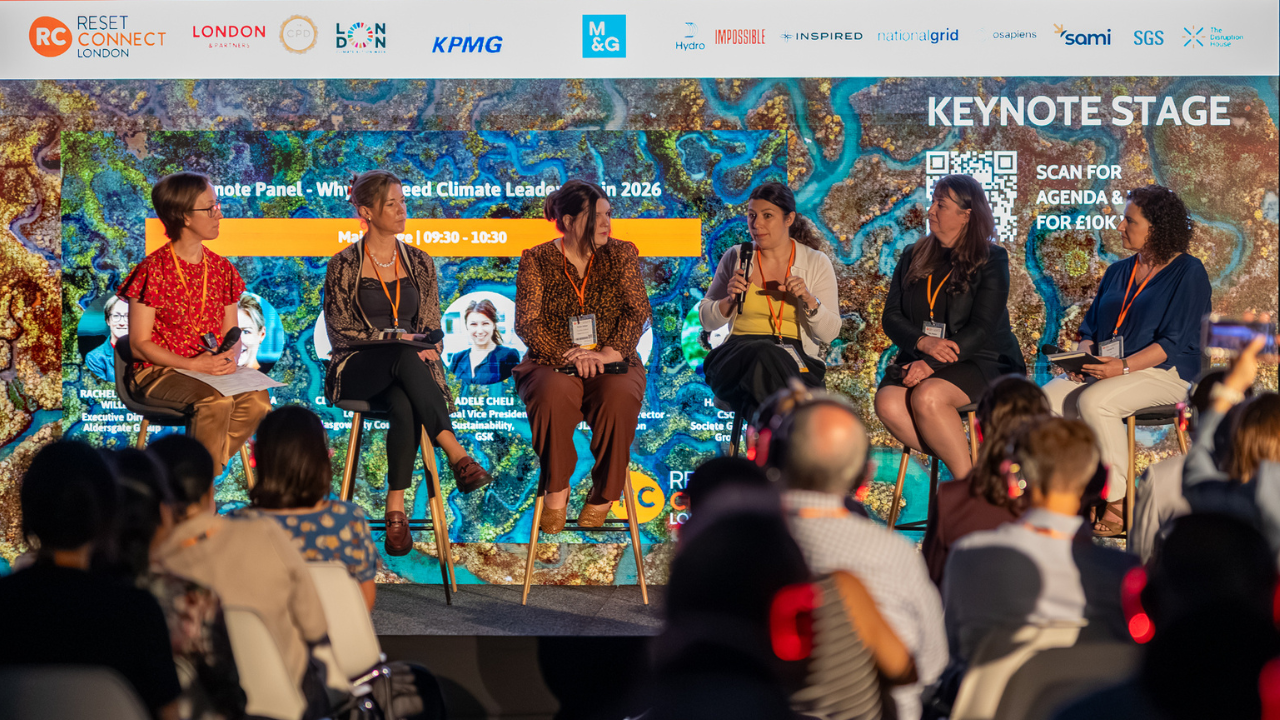
Keynote Panel - Why We Need Climate Leadership in 2026
🏠 | Blog | Keynote Panel - Why We Need Climate Leadership in 2026
Event: Reset Connect London 2026
Date: Wednesday 24 June 2026
Speakers: Rachel Solomon Williams, Executive Director - Aldersgate Group. Marian D’Auria, Chief Sustainability Officer - M&G Plc. Susan Aitken, Leader - Glasgow City Council. Climate leadership in 2026 is no longer an ambition problem. This Reset Connect London 2026 keynote panel reframed it as a delivery problem. Targets are set, the technologies work and capital is available, but too few organisations have named anyone to own the messy implementation work in between.
The timing gives that argument its edge. The session opened on the morning the Climate Change Committee published its latest progress report on the UK carbon budgets, with performance beginning to look difficult beyond the fifth budget period. Delivery capacity, not target-setting, is what closes that gap.
You will come away with a sharper test for your own climate plan, a view of how public authorities are learning to structure investable propositions, and the four conditions institutional investors say must be met before capital moves into nature at scale. Adele Cheli, Global Vice President, Sustainability - GSK. Erin Meezan, Chief Sustainability Officer - JLL and Executive Director - JLL Foundation. Hacina Py, Chief Sustainability Officer - Societe Generale Group.
Estimated read time: 10 minutes
Climate Leadership in 2026 Needs Ownership, Not More Ambition
Marian D’Auria, Chief Sustainability Officer at M&G Plc, opened with a distinction that shaped the rest of the hour. The era of setting ambition has done its job. What organisations need now is ownership, which means a named person, an operating model and a budget attached to each problem. "But more than leadership, I think we need ownership," she said.
Her evidence came from two places. The first was the list of blockers everyone in the room could already recite: grid connections, electricity pricing, planning. Years have gone into examining those problems and comparatively little into assigning them. The second was the recruitment market. A specialist recruiter had told her that FTSE 100 sustainability mandates have changed, and that boards now hire practitioners who can get inside business processes rather than speakers who can hold a stage.
For a commercial reader, this changes what a credible climate plan looks like in a board pack. A target with no named owner and no route through procurement reads as a gap rather than a commitment. The question is no longer whether the ambition is stretching enough. It is whether anyone is accountable for delivering it.
The Barriers to Decarbonising Buildings Are Human, Not Technical
Erin Meezan, Chief Sustainability Officer at JLL and Executive Director of the JLL Foundation, made the sharpest version of that argument. In the built environment the technologies exist, the business case is clear and in many cases the capital is available. "What’s missing is the complexity of actually working through these projects," she said.
What JLL hears from clients is not an engineering objection. Retrofit is a tenant challenge, a project management challenge and a stakeholder challenge. Meezan pointed to two responses. LaSalle announced a $400 million fund earlier this year focused on retrofitting and decarbonising buildings, a direct answer to frustration at the pace of change. The JLL Foundation will pass a $20 million milestone this year backing climate start-ups, and lends rather than grants, offering three-year cyclical support designed to carry an early idea through to stability.
For a commercial reader, this matters because it relocates the bottleneck. If neither capital nor technology is the constraint, then project management capacity, tenant negotiation and stakeholder time are where the next decarbonisation budget should go.
Holding the Line Now Counts for More Than Announcing New Targets
Councillor Susan Aitken, Leader of Glasgow City Council, gave the panel its most repeatable instruction: "hold your nerve but also trust your people". "Absolutely hold your nerve," she said, arguing that deniers and delayers take up a disproportionate share of the public conversation and do not represent what most people in the UK want.
Trusting people means crediting them with the ability to hold two things at once. A household worried about this month’s bills can still be worried about flooding. The answer is to make climate action visible through warmer homes, cleaner transport and better green space. "We need to go faster," Aitken said, because delay costs the consensus rather than protecting it.
Adele Cheli, Global Vice President, Sustainability at GSK, arrived at the same place by another route. Leadership now means action plus transparency, because the easy interventions are done and "some of this action is complex, some of this action is messy". D’Auria added a third element: stop staying quiet about misinformation on the cost of the transition.
For a commercial reader, this matters because going quiet has itself become a strategy. Where a business has stopped talking about sustainability to avoid political heat, the space gets filled by someone with a weaker grasp of the numbers.
The Case for the Transition Has to Be Made in Value, Not Sacrifice
Hacina Py, Chief Sustainability Officer at Societe Generale Group, argued that the transition has a narrative problem of its own making. Telling people to avoid an increase of more than two degrees by the end of the century never connected, she said, because the figure means little to anyone who has watched the temperature move 10 degrees in a single day.
The current story is worse. "It’s really a kind of punitive one," Py said, describing a transition that reaches households as a list of things they can no longer eat, buy or do. Her alternative is value. "This is about value creation," she said, with adaptation as value preservation. Boards that hear a climate proposal as cost keep deferring it, and Py was blunt about the excuse: "We don’t have other priorities." Around 70 per cent of the bank’s lending portfolio now sits under decarbonisation targets, and she was clear that most of it is ordinary, profitable business.
For a commercial reader, this matters because the framing decides the meeting. A proposal presented as risk avoidance competes with every other cost line in the budget. The same proposal presented as value preservation competes on strategy instead.
Public Authorities Are Learning to Structure Risk the Way Investors Do
Glasgow’s costed net-zero route map puts the investment needed to cut city emissions by 80 per cent by 2030 at around £35 billion. Aitken’s answer is a pair of vehicles, one for delivery and one for investment, both due by the end of this year, built so the council can bring institutional finance into work on the ground.
The first target is heat in the city’s hardest housing stock, including its pre-1919 sandstone tenements. Glasgow’s net-zero neighbourhoods model pairs clean heat networks with retrofit, so residents are not handed lower emissions and higher fuel bills together. Getting there meant changing the council’s own risk appetite. Aitken hosted an insurance professional inside the council for three months through a Resilient Cities Network fellowship, learning to make propositions insurable as well as investable.
D’Auria set out the constraint from the other side, and this is where the panel pulled against itself most usefully. M&G cannot invest in what does not make financial sense, however desirable the outcome. What is negotiable is the time horizon, and her thesis is that the transition is underinvested because the market has not recognised the pricing disconnect.
For a commercial reader, this matters because the vocabulary gap between public and private finance is closing faster than the capital gap. A council that can speak to insurability and returns is a different counterparty to one asking for support.
Nature Will Not Attract Institutional Capital Until Four Things Are Fixed
The most original thinking came on nature finance. D’Auria named four conditions to be met before institutional capital moves at scale into nature-based solutions, which are interventions using natural systems, such as tree planting or wetland restoration, to deliver measurable environmental and economic benefits.
Pipeline is the first. The appetite exists but a well-structured set of investable opportunities does not, partly because assembling one means getting farmers, supermarkets, cities and banks into rooms they have never shared. Standards are the second, without which nature risks repeating the credibility problem that damaged carbon credits. Insurance is the third: premiums should fall when a business has genuinely cut its physical climate risk, and they do not yet. Incentives are the fourth, such as a rebate on the capital an asset owner holds against climate risk when it invests in a solution that lowers that risk. "The appetite absolutely is there," D’Auria said. The plumbing is not.
Py added the pricing problem underneath all of it. Water costs about €3 per cubic metre in France, so multi-million capital projects to secure supply never clear a return-on-investment test on the material cost alone. Price in the shutdown that follows when a municipality allocates water to people instead of production, and the return arrives naturally.
For a commercial reader, this matters because the standards, insurance and incentive frameworks for nature are still being written. Firms that engage while they are drafted will shape terms everyone else inherits.
Practical Application, How to Turn Climate Ambition Into Delivery Decisions
The panel’s logic converts into a short internal audit. It is less about whether your targets are right and more about whether anything in the organisation is built to hit them.
Key Takeaways
Six leaders from finance, pharmaceuticals, real estate, banking and local government converged on one conclusion, which does not happen often on a keynote panel. Ambition is settled. Delivery is the open question, and it is a question about people, process and pricing rather than technology.
- Climate leadership in 2026 is defined by ownership and delivery capacity, not by the level of ambition in a target
- In the built environment the technologies, business case and capital already exist, and project complexity is the binding constraint
- Public support for climate action holds when the benefits are visible in bills, homes and transport rather than argued in the abstract
- Framing the transition as value creation and adaptation as value preservation is what gets it past a board with fiduciary duties
- Nature finance needs pipeline, standards, insurance pricing and capital incentives before institutional money moves at scale
Quote of the Session
"We can all recite what these problems look like, but who’s actually tasked with solving them?"
Marian D’Auria, Chief Sustainability Officer, M&G Plc
Final Thoughts
The underlying message of this session was that the climate conversation has run out of road on target-setting. Every panellist had targets. What separated them was whether they could describe the operating model, the financing structure and the named accountability that turns a target into a project. That is a less quotable form of leadership and a more useful one.
What is at stake is the consensus itself. Aitken’s warning was that the longer the gap runs between talking and delivering, the more people drift away from climate action, and that support is harder to rebuild than it is to keep. On that reading, delivery is not just an operational discipline. It is what keeps the political and commercial permission to act.
Speakers
Rachel Solomon Williams, Executive Director - Aldersgate Group. Rachel has worked in environment and energy policy for 24 years, with leadership roles across the public, private and non-profit sectors, including on the Climate Change Act.
Marian D’Auria, Chief Sustainability Officer - M&G Plc. Marian has over 20 years of experience across financial services, industrials and institutional governance, and previously served as Global Head of Risk and Sustainability for GFG Alliance.
Susan Aitken, Leader - Glasgow City Council. Susan has led the council since 2017 and oversaw Glasgow’s hosting of COP26. She chairs the Resilient Cities Network and the United Nations’ Forum of Mayors.
Adele Cheli, Global Vice President, Sustainability - GSK. Adele leads delivery of GSK’s environmental sustainability programme. She joined the company in 2013 and has held roles across procurement, product innovation, the CEO office and global health.
Erin Meezan, Chief Sustainability Officer - JLL and Executive Director - JLL Foundation. Erin brings more than 20 years in corporate sustainability and leads delivery of JLL’s Net Zero 2040 target, having previously held the same role at Interface.
Hacina Py, Chief Sustainability Officer - Societe Generale Group. Hacina joined the bank in 1995 and held senior structured finance roles including Global Head of Export Finance, before leading its work to embed sustainability across business lines.
Watch Full Session