


Issues and opportunities in the retail sustainable investing chain
Breadcrumb
Home | Blog | Issues and opportunities in the retail sustainable investing chain
Event, date, speakers and read time
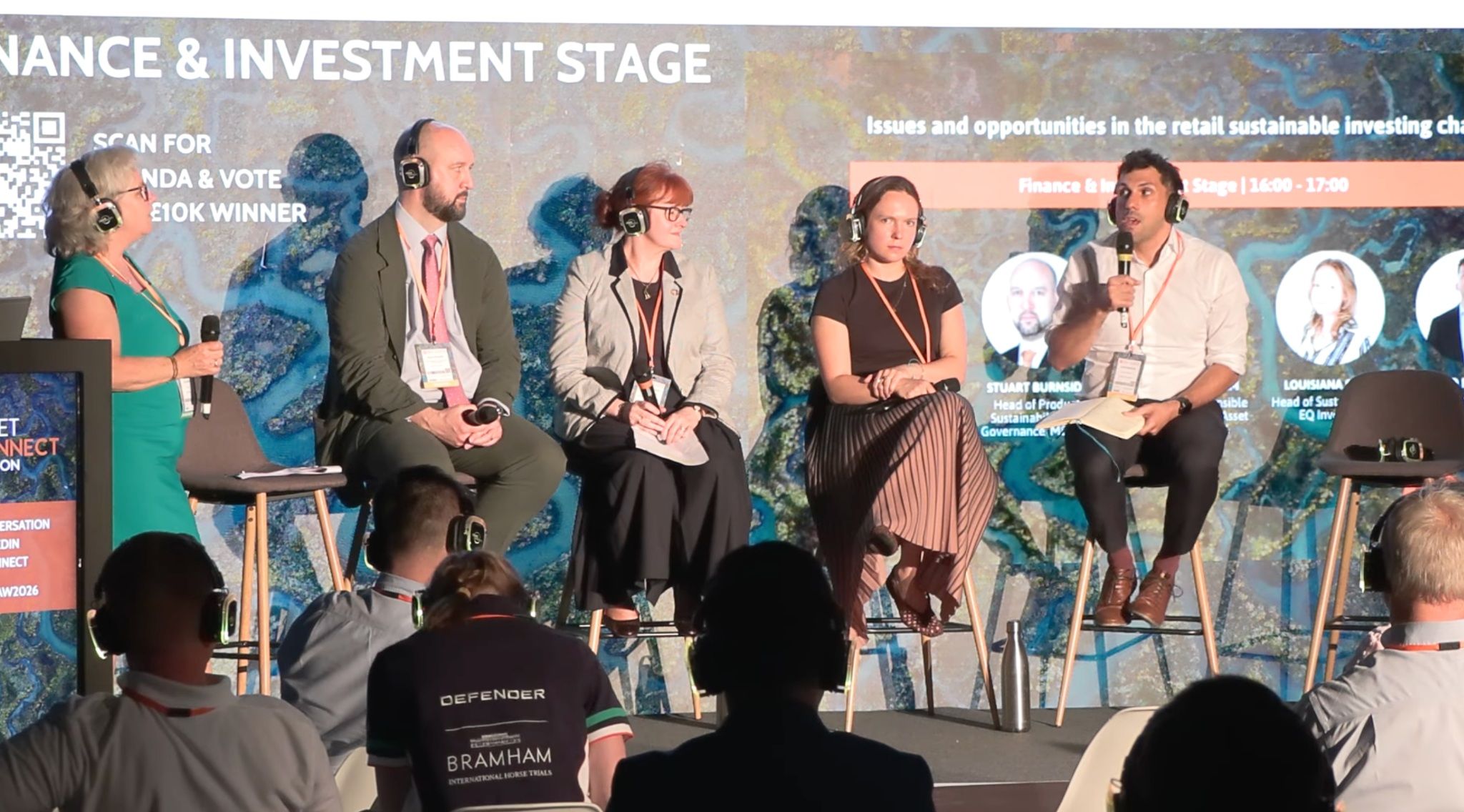
Reset Connect London 2026 | Tuesday 23 June 2026 | Finance & Investment Stage | 16:00 programme slot
Julia Dreblow, SRI Services (moderator). Stuart Burnside, M&G Investments. Miranda Beacham, Aegon Asset Management UK. Louisiana Salge, EQ Investors. David Nicholsby, Rathbones Greenbank Investments.
Estimated read time: 8 minutes
Quick Read Summary
A retail investor can ask for a sustainable fund and mean any number of things. They may want to avoid particular industries, support companies whose products address environmental or social problems, or invest with a manager that uses its ownership rights to push for change. Each aim calls for different evidence.
At Reset Connect London, Julia Dreblow brought together fund managers and wealth managers to ask how those preferences make it through to an actual portfolio. The panel considered what product disclosures can tell an investor, how to judge stewardship, and why the performance of a fund with exclusions can diverge from a broad market benchmark.
Quote of the Session
“They will perform differently from a wide benchmark.”
Miranda Beacham, Head of Responsible Investment, Aegon Asset Management UK
Start with what the investor wants to achieve
Dreblow opened by describing Fund EcoMarket, the free UK-focused database run by SRI Services. It collects information directly from fund and portfolio managers so that people can see what is available. Her reason for making it free was practical. People can be interested in sustainable investment without ever receiving advice about it, and the first hurdle is often finding out what the products actually do.
Even with that information in hand, the word sustainable can leave a great deal unresolved. An investor concerned about a company’s activities may want an exclusion. Another may want a portfolio that backs companies addressing a particular problem. Someone else may be comfortable holding a company with a poor record if the manager can explain what it is asking the company to change and how it will respond if progress stalls.
Louisiana Salge described EQ Investors as managing different kinds of portfolios for different kinds of sustainability preferences. That is a reminder that the adviser’s first conversation is about the client. It matters whether a preference is a hard boundary or one factor among several. It also matters whether the client wants to judge the result by what the portfolio owns, by what its managers do as shareholders, or by the changes they can evidence over time.
Make the fund’s rules clear enough to check
Stuart Burnside described a role that spans regulated point-of-sale documents, product design and evaluation at M&G Investments. Those responsibilities sit together for a reason. The description given to investors has to match the rules the investment team follows and the evidence the firm can produce when it reviews the product.
In the audience discussion, Burnside distinguished the manufacturer’s job from the adviser’s. The manager has to explain what the product does and where its approach stops. The adviser and investor can then decide whether those choices fit the client. A fund document is more useful when it gives enough detail to make that judgement before money is invested.
Take an exclusion policy. A client might say they want to avoid oil, or that they are concerned about particular types of exploration. Those preferences can lead to different portfolios. The same issue arises when a client draws a distinction between defence and certain weapons. To establish whether the product fits, an adviser needs to know where the manager draws the line, how it defines the activity and whether the rule applies throughout the portfolio. A broad label can make a fund easier to find. The underlying policy is where the adviser can check the fit.
Ask what happens after the fund buys a holding
Miranda Beacham described a remit that includes supporting responsible investment products, overseeing ESG integration and taking part in engagement and voting. Salge described responsibility for reporting and stewardship alongside scrutiny of EQ Investors’ sustainability claims. Their roles show how much of the work takes place after the investor has chosen a product.
Stewardship raises a different set of questions from an exclusion. The presence of a company in a portfolio can be checked against a holdings list. Understanding what a manager is doing with that position requires more information. What has it asked the company to do? Is there a point at which it will vote against management, join other investors or reconsider the holding? What can the investor read later to see how the manager followed through?
The panel also discussed stewardship across the investment chain. A retail client may appoint an adviser, use a wealth manager and ultimately hold several funds run by different firms. The more intermediaries there are, the easier it is for responsibility to become difficult to trace. A report that explains who made a decision and what happened next helps the client understand where their expectations can have an effect. A record of meetings or votes can show activity. A clear account of the objective and subsequent action helps the investor assess what that activity amounted to.
Explain how the portfolio can behave in different markets
An audience member asked whether a portfolio that made only modest sustainability changes could justify a perceived trade-off in returns. Burnside challenged the assumption that there is always a trade-off. Exclusions and thematic choices can give a fund a particular investment style or sector exposure. How that affects results depends on what the market is rewarding over the period being measured.
Beacham made the same point from the perspective of a manager running funds with explicit exclusions. She said those funds can behave differently from a wide benchmark and pointed to periods when exposure to healthcare and technology had helped. The same design can look very different when other parts of the market lead. A performance chart tells you what happened over the dates shown. To understand how much of that experience the investor should expect to recur, the next question is what holdings and exposures produced it.
This matters when a client compares two sustainable portfolios. One might differ from the broad market mainly through a handful of exclusions. Another might be concentrated in companies that provide particular environmental or social solutions. A client who sees both described as sustainable may expect them to behave alike. An adviser can explain where they differ, what might make each lag its benchmark and whether the client is willing to live with those periods.
Use the advice conversation to connect the pieces
David Nicholsby introduced Rathbones Greenbank Investments as a wealth manager specialising in building portfolios. That perspective matters because an investor experiences the combined result of the holdings they own. A single fund may have a clear policy, but a client’s investments can include several funds with different approaches to the same issue.
The discussion returned to the distinction between what a manufacturer can specify and what advice must resolve. A manager can describe its mandate, explain the investment process and report on how it applies its rules. The adviser has to understand which of those features matters to the client and how they fit alongside the client’s financial aims. A wealth manager then has to make the combination work as a portfolio.
That gives each part of the chain a concrete job. A client should be able to explain their priority in plain language. An adviser should be able to point to the product evidence that informed the recommendation. A manager should be able to explain how it applied the relevant policy and what it did when a holding or company raised a concern. The conversation is easier to revisit when each of those decisions is recorded.
Practical application
Suppose a client wants to avoid a particular activity, cares about managers’ voting records and is concerned about underperforming the broader market. Start by recording how the client defines the activity and whether any exceptions are acceptable. Compare that definition with the fund’s policy and look at the holdings for a concrete example of how the policy works. Ask for a stewardship example that includes an objective and a follow-up. Finally, show the client which portfolio exposures could make performance differ from a broad benchmark. Keep those answers with the recommendation so they can be revisited when the client’s preferences or the fund’s approach changes.
Key takeaways
- Translate broad preferences into questions a fund’s policy and holdings can answer.
- Check who is responsible for engagement and what happens when progress stalls.
- Explain performance differences through portfolio exposures and the period being compared.
- Keep the client’s priorities visible when combining products with different approaches.
Final thoughts
A client should be able to trace a recommendation back to the question they asked. If the issue was an exclusion, they should be able to find the rule. If it was stewardship, they should be able to see what the manager did. If it was performance, they should know which exposures may explain a difference from the benchmark. That is where the separate jobs in the retail investment chain come together.
Speaker bios
Julia Dreblow | Founder, SRI Services (moderator)
Julia has worked in retail sustainable and ethical investment for around three decades. Through SRI Services she publishes Fund EcoMarket, a free database that helps advisers and investors compare the sustainability approaches of UK retail funds. She opened the session by explaining why she wanted to remove barriers to finding that information.
Stuart Burnside | Head of Product, Sustainability and Governance, M&G Investments
Stuart oversees regulated point-of-sale documents, shareholder communications and the design and evaluation of sustainability features across M&G Investments’ products. He brought the fund manufacturer’s perspective to the discussion, explaining what managers can disclose about their approach and where advisers come in to assess whether a fund suits a client.
Miranda Beacham | Head of Responsible Investment, Aegon Asset Management UK
Miranda oversees ESG research for ethical and sustainable funds, supports ESG integration and leads stewardship work including engagement and voting. On the panel, she explained how explicit exclusions make a fund’s boundaries easier to understand and why those choices can lead to different performance from a broad benchmark.
Louisiana Salge | Head of Sustainability, EQ Investors
Louisiana oversees ESG and impact integration at EQ Investors and manages its sustainability reporting and stewardship programme. She discussed how a wealth manager can build portfolios around different client preferences and check that the claims it makes are supported by its investment process.
David Nicholsby | Investment Director, Rathbones Greenbank Investments
David works in specialist wealth management at Rathbones Greenbank Investments, where the team builds portfolios for clients with ethical and sustainability preferences. He brought the portfolio-level perspective to the panel, where the task is to combine investments in a way that reflects what the client wants to achieve.
Watch Full Session