)
)
)
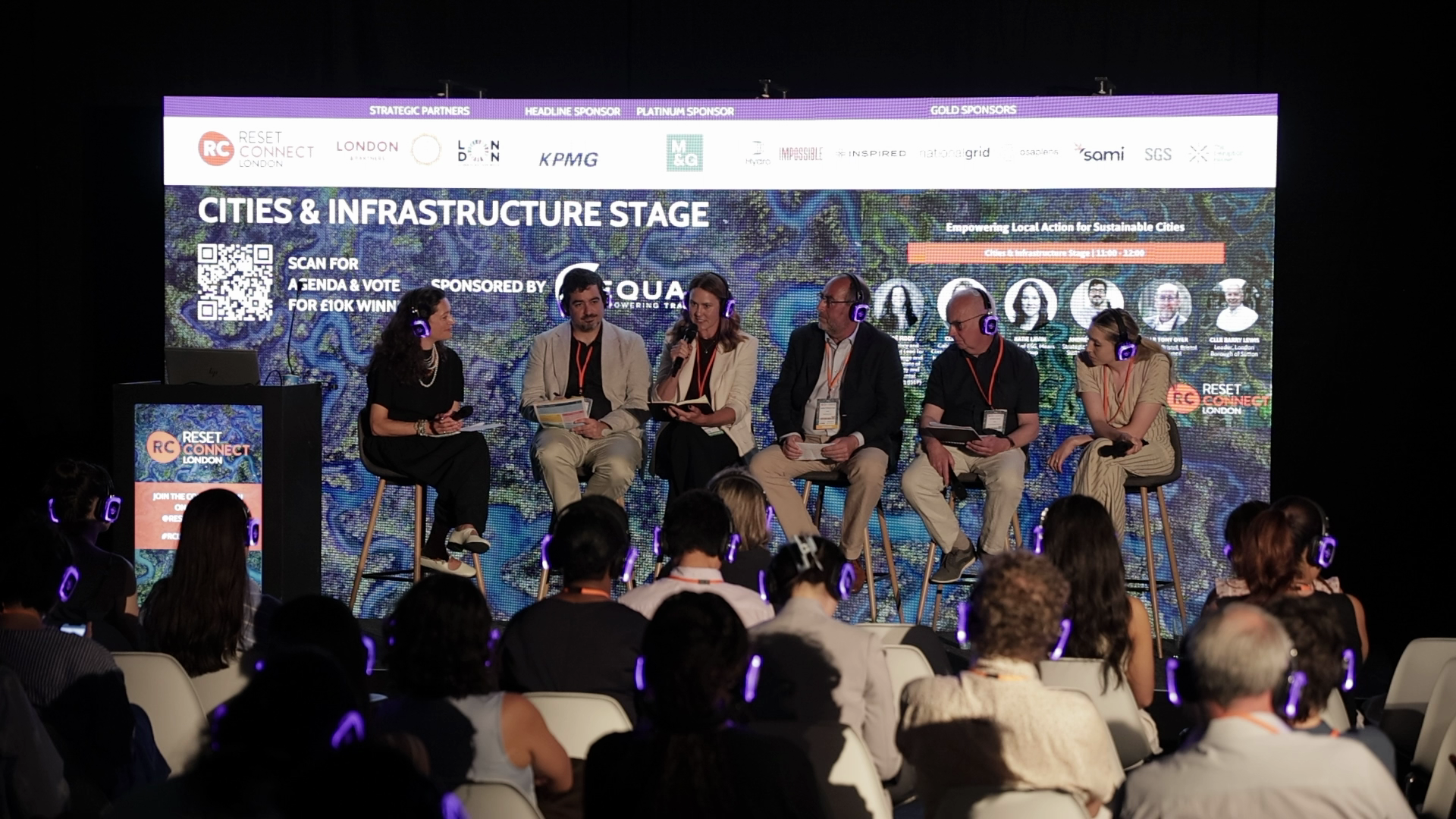
Empowering Local Action for Sustainable Cities
🏠 | Blog | Empowering Local Action for Sustainable Cities
Event: Reset Connect London 2026
Date: Tuesday 23 June 2026
Speakers: Chloë Fiddy, Senior Policy and Engagement Lead for Climate Change and Energy - ISEP . Cllr Sam Lux, Cabinet Member for Climate, Nature & Energy - Nottingham City Council. Katie Lavin, Head of ESG - Mears Group. Andrés Pica-Téllez, Strategic Ventures Advisor - Sustainability Solutions Group. Cllr Tony Dyer, Leader of Bristol - Bristol City Council. Cllr Barry Lewis, Leader - London Borough of Sutton.
Estimated read time: 10 minutes
Local authorities have powers or influence over roughly a third of emissions in their areas, and more than half of the cuts the UK needs are local. This Reset Connect London 2026 panel brought together three council leaders and cabinet members, a delivery partner and an international adviser to explain how any of it gets paid for.
The answer was not more grant funding. It was a set of specific, copyable mechanisms: a business rates scheme that turns relief into sustainability investment, a workplace parking levy generating 8 million pounds a year for public transport, and a 20-year concession that has brought 374 million pounds of private investment into one city.
You will come away with the detail of each of those models, an argument about why the payback often lands in someone else’s budget, and evidence from Santiago that the co-benefits routinely exceed the carbon case.
Climate Action Is Not a Zero Sum Game Between Cities
Chloë Fiddy of ISEP opened by asking whether one city being sustainable means another cannot be. Nobody accepted the premise.
Andrés Pica-Téllez of Sustainability Solutions Group, whose firm has worked with more than 200 municipalities internationally, argued the opposite on two grounds. Municipalities are the tier of government the public trusts most, which makes collective advocacy effective at attracting private and national funding. They are also unusually flexible, so what one tries, others can copy. He pointed to a Chilean region where 12 municipalities aligned their climate action plans, and to Canadian municipalities that adopted a shared building code so developers faced the same rules across boundaries.
Cllr Tony Dyer, Leader of Bristol City Council, made the cost argument. Not tackling climate change embeds future costs into a city and undermines its competitiveness, while acting opens up investment and supply chains. Bristol is part of a partnership of 112 cities that still provides access to European funding.
Katie Lavin, Head of ESG at Mears Group, identified the flaw in the framing itself. "We’re measuring the cost so much better than we’re measuring the value it creates," she said, which makes any calculation look worse than it is.
The Economics Have Moved, but the Payback Lands in Another Budget
Cllr Sam Lux, Cabinet Member for Climate, Nature and Energy at Nottingham City Council, put the affordability question to bed with numbers.
The cost of transitioning a city is around 73 per cent lower than the figure being used five years ago, because solar and battery costs have fallen dramatically at scale. Investment returns through energy savings and grid income, and delay simply increases the bill. She also cited recent figures suggesting that every pound spent on retrofit saves the NHS six pounds through fewer respiratory illnesses caused by cold and damp homes.
Cllr Barry Lewis, Leader of the London Borough of Sutton, put his finger on why that does not automatically unlock spending. "Whose pound is it that is invested in the first place?" he asked. A council that does not have the pound cannot spend it to generate a saving that accrues to the health service.
Lavin offered the practical route around it, describing a thermal imaging survey of over 450 properties in Rotherham to identify which homes to retrofit first, which saved residents an average of 597 pounds a year. As she put it, that is a cost of living intervention rather than a carbon reduction, which is also how she finds people want to talk about it.
Councils Are Constrained by Centralisation Rather Than Ambition
The strongest consensus on the panel concerned where the real limit sits, and it was not enthusiasm.
Lux described the effect of prolonged financial pressure on decision-making. Nottingham knew that decarbonising its estate at scale would pay back quickly, and that cutting waste advisers would increase recycling contamination costs, which it duly did. The council did both anyway because it was legally obliged to balance a budget. Her conclusion is that the UK is an unusually centralised democracy and that councils need devolution alongside a properly funded statutory duty, so that climate is not competing against services they are legally required to provide.
Dyer supported the statutory duty with a caveat drawn from experience, pointing to previous duties introduced without matching funds. He also cited a study for the Core Cities group estimating that acquiring some of the powers held by comparable European cities could add 100 billion pounds a year to the economy.
Lewis was more sceptical, noting that councils already struggle to deliver existing statutory services and that designating something statutory changes little unless funding follows.
Sutton and Nottingham Have Built Policies Other Councils Can Copy
Two mechanisms came up that require no new central funding, which is what made them the most useful part of the session.
Sutton’s Green Enterprise Partnership works through business rates. Small businesses with a rateable value between 10,000 and 50,000 pounds receive a substantial discount, hand 30 per cent of the benefit back to the council to administer the scheme, and are obliged to invest the remaining 70 per cent in sustainability measures such as lighting or appliance efficiency. Lewis’s reasoning is that large companies have sustainability staff and small ones do not, and small businesses make up around 60 per cent of Sutton’s business base.
Nottingham operates a workplace parking levy, taxing employers with more than 10 staff on each parking space they provide. Employers either reduce spaces or pass the cost on, and both outcomes push people towards public transport. It generates around 8 million pounds a year, reinvested in the transport network. Lux was candid that it required bold leadership and attracted significant opposition before it worked.
Both councils have also trialled the Dutch Energiesprong retrofit model, which Lux said cut tenants’ energy bills by half, and which Lewis described in terms of residents answering the door in t-shirts mid-winter.
Bristol Shows What Private Partnership Looks Like at Scale
Dyer described the largest single vehicle discussed, and was equally clear about where the ideas came from.
Bristol City Leap is a 20-year concession with an American energy services company covering heat networks, electric vehicle infrastructure, renewable generation and retrofit. It has delivered 374 million pounds of investment over five years alongside 40 million pounds of social value, and around 13,000 homes have been retrofitted at a pace of 5,000 a year, against a target requiring 10,000. His advice to other councils was to be clear about priorities and red lines before entering that kind of arrangement, and he offered to tell anyone who asked what Bristol got wrong.
The council also runs a city climate strategy partnership, and 17 neighbourhoods have developed their own community climate action plans.
His credit went outward. Bristol has what he described as the largest ecosystem of environmental groups in Europe, and much of the work has come from those groups rather than the council. That community base is also why the city’s commitment has survived repeated changes of political control, which he offered as an answer to politicians who say the electoral cycle prevents long-term action.
Santiago Shows the Co-Benefits Outrun the Carbon Case
Pica-Téllez supplied the example that made the strongest case for acting quickly, and it started small.
Santiago began with a pilot of three electric buses about a decade ago. The financial innovation was ownership: rather than the operator or the city buying the vehicles, the utility bought them and leased them out, which brought running costs below those of a conventional fleet. The city now runs around 4,400 electric buses, which he said is the largest fleet outside China.
The results reached well beyond emissions. Greenhouse gases from the fleet fell by a third and nitrogen oxide emissions by 75 per cent, saving lives through improved air quality, while noise on the city’s largest avenue dropped by 60 per cent. The engagement process attached to the programme also addressed gender, taking the number of women bus drivers from around five to roughly 2,000.
His wider point was about prioritisation. Assessing climate options for one American city produced 61 possible actions, of which around five delivered more than half the total benefit. Good data is what lets a resource-constrained council find those five, and visible early wins are what sustain support for everything after them.
Key Takeaways
Three councils, a delivery partner and an international adviser described the same constraint and worked around it in different ways. None of them argued that the case for action was unproven. All of them argued that the funding architecture is wrong.
- The estimated cost of a city transition has fallen by around 73 per cent in five years as solar and battery costs have dropped
- Retrofit savings frequently accrue to the health service rather than the council spending the money, which blocks otherwise sound investments
- Sutton’s business rates scheme obliges small firms to reinvest relief in sustainability measures, requiring no new central funding
- Nottingham’s workplace parking levy raises around 8 million pounds a year, reinvested in public transport
- Bristol City Leap has brought 374 million pounds of private investment across five years through a 20-year concession
Quote of the Session
"We’re measuring the cost so much better than we’re measuring the value it creates."
Katie Lavin, Head of ESG, Mears Group
Final Thoughts
The most transferable insight was not a policy but a habit. Councils share what works in a way businesses rarely do, and every mechanism described here was offered to the room with an open invitation to copy it. Dyer went further and offered to explain what Bristol got wrong, which is the more valuable half of a case study and almost never the half that gets published.
The unresolved question was durability. Several panellists worried about designing schemes that survive a change of administration, and the answer that emerged was to build them on returns rather than on values. A scheme that pays back to the taxpayer is harder to reverse than one that depends on a stated commitment, which is an argument for the business rates model and the parking levy over anything requiring a standing grant.
Speakers
Chloë Fiddy, Senior Policy and Engagement Lead for Climate Change and Energy - ISEP (moderator). Chloë shapes policy and practice on climate change and sustainability, working at the interface of regulation, strategy and delivery, with cross-sector experience spanning manufacturing, retail and the public sector.
Cllr Sam Lux, Cabinet Member for Climate, Nature & Energy - Nottingham City Council. Sam has a background in climate policy and engagement, moved to Nottingham to support the city’s carbon neutrality efforts, and works in green finance at a development bank.
Katie Lavin, Head of ESG - Mears Group. Katie leads ESG strategy across one of the UK’s leading providers of housing and accommodation services to central and local government, combining military leadership, sustainable finance and ESG advisory experience.
Andrés Pica-Téllez, Strategic Ventures Advisor - Sustainability Solutions Group. Andrés was previously Climate Change Director at the Ministry of Environment of Chile, leading implementation of the country’s Climate Change Law, and has supported governments across the Americas on emissions reduction and resilience.
Cllr Tony Dyer, Leader of Bristol - Bristol City Council. Tony has been a Bristol councillor since 2021 and leader since 2024, and is Core Cities lead for net zero, bringing a background in ICT, consultancy and large-scale project delivery in deprived communities.
Cllr Barry Lewis, Leader - London Borough of Sutton. Barry was elected in 2019 and became Leader in 2024, having chaired the council’s Environment and Sustainable Transport Committee.
Watch Full Session