)
)
)
How Can Advertising Accelerate the Race to a Sustainable Future for Businesses and Consumers?
🏠 | Blog | How Can Advertising Accelerate the Race to a Sustainable Future for Businesses and Consumers?
Date: Wednesday 24 June 2026
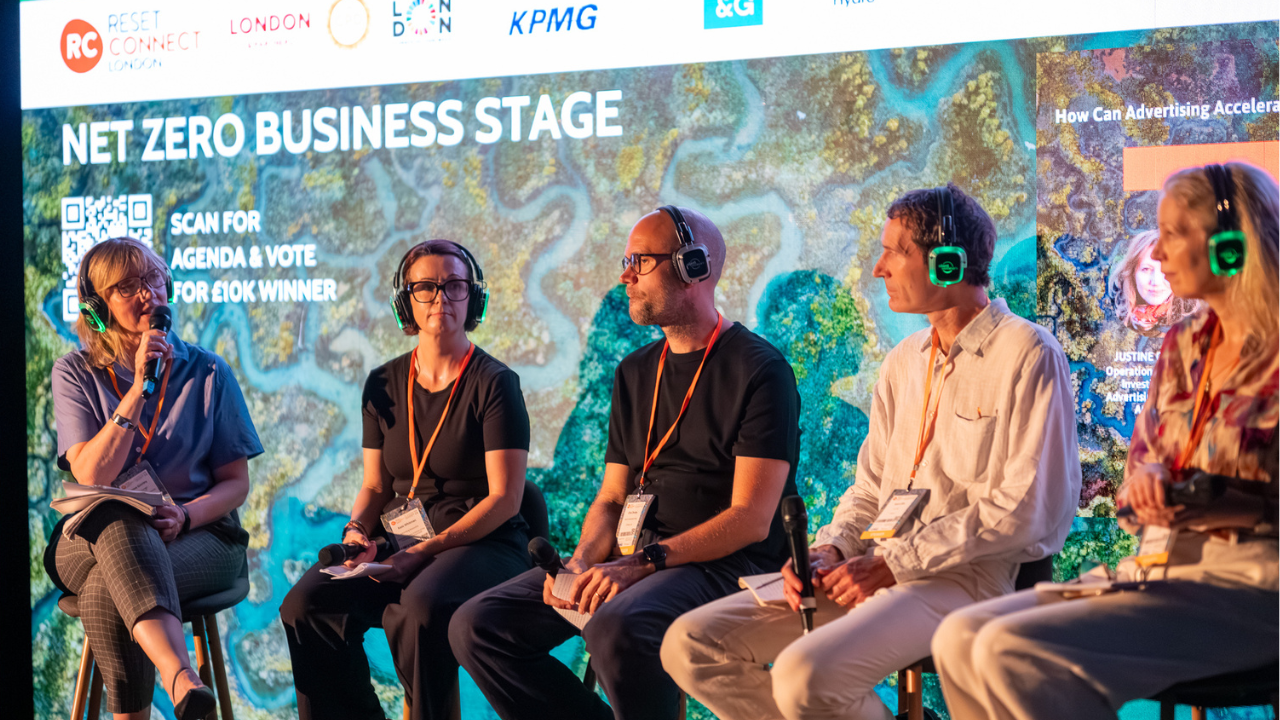
Speakers: Justine Grimley, Operations Manager - Investigations - Advertising Standards Authority. Kate Whitman, Advertising Researcher - Revolution Plastics Institute, University of Portsmouth. Chris Dooley, Head of Sustainable Media - JCDecaux UK. Gavin Ellis, Co-CEO - Hubbub. Fiona Couper, Group Head of Sustainability & Risk - VCCP.
Estimated read time: 10 minutes
Advertising is one of the few industries with the reach to shift consumer habits at scale, and it is currently using very little of it. Research cited on this Reset Connect London 2026 panel put the share of UK advertising portraying sustainable behaviour at 4.5 per cent, down from 6 per cent the year before.
The panel spent an hour on why that gap exists and what closes it. The answers were less about better claims and more about better craft: leading with what audiences already care about, dropping the recycling shorthand the industry leans on, and making low-carbon choices look ordinary rather than virtuous.
You will come away with the case for why green hushing is about to become untenable, evidence on what actually changes behaviour, and a clear-eyed view of where AI helps and where it does not.
The Real Constraint on Sustainability Messaging Is a Trust Deficit
Fiona Couper, Group Head of Sustainability and Risk at VCCP, started with the macro picture. Public trust in institutions in the UK sits at an all-time low, on figures she cited at 39 per cent, which places the UK alongside Japan and Argentina among developed economies. Her argument is that this raises the stakes on every individual piece of communication, because each one either adds to or draws down a shared reserve.
She traced the arc that got the industry here. Ambitious target-setting around COP26, followed by a wave of brands being caught out, followed by politicisation and a cost of living squeeze that has become permanent. What remains is an audience that expects businesses to act and assumes they will be found out if they do not. "It’s a war for trust," as Couper put it.
Chris Dooley, Head of Sustainable Media at JCDecaux UK, added the channel dimension. A large proportion of the advertising people see online is never checked by a human being, whereas out of home advertising is displayed publicly and consumed alongside other members of a community, which carries a credibility most audiences never consciously register.
For a commercial reader, this matters because it explains why sustainability messaging is judged more harshly than other marketing. It is being received by an audience already primed to expect to be misled.
Only 4.5 Per Cent of UK Advertising Portrays Sustainable Behaviour
Dooley brought the number that framed the session. Research first conducted in 2024 found 6 per cent of UK advertising portrayed sustainable behaviour. Repeated in April this year, the figure had fallen to 4.5 per cent.
Set against government expectations that a substantial share of the UK’s carbon reduction over the next 25 years must come from changes in how people travel, eat and heat their homes, the mismatch is stark. Advertising is asking for a fraction of the behaviour change the transition depends on.
His explanation was unglamorous. Quarterly targets and product launches push sustainability down the agenda. Beyond that sits green hushing and what he called the ostrich effect: a brand worries the claim is too difficult to get right, or fears being called out or referred to the regulator, so the work gets parked. The frustrating part is that the same research finds sustainability messaging resonates, because audiences respond well to brands credibly attempting something positive.
For a commercial reader, this matters because the risk calculation most brands are running is incomplete. It counts the risk of making a claim and ignores the cost of the silence.
The Industry’s Reliance on Recycling Labels Is Doing Active Harm
Kate Whitman, Advertising Researcher at the Revolution Plastics Institute at the University of Portsmouth, made the sharpest critique of the hour. Advertising leans heavily on the recycling symbol, and against the very worst behaviour that counts as progress. Measured against the waste hierarchy of reduce, reuse and recycle, it does not.
Her objection is that the label actively props up the linear economy. A recycling mark on a disposable product tells the consumer that continuing to buy it is fine, and consumers substantially overestimate how much recycling achieves compared with eating less meat or flying less. Whitman was the academic partner on a national household plastic counting project, which found that around 60 per cent of household plastic is incinerated despite almost all of it carrying recycling labelling, with only a small proportion mechanically recycled.
Her ask of the industry is honesty rather than abstinence. "Recycling is not the be all and end all of sustainability," she said, and advertising is well placed to move audiences up the hierarchy towards reuse.
For a commercial reader, this matters because the safest-looking sustainability signal in the toolkit may be the one most likely to age badly.
Lead With What Audiences Already Care About, Not With the Environment
Gavin Ellis, Co-CEO of Hubbub, was direct that the premise of most green campaigns is wrong. People do care about the environment, and the claim that they have stopped is not supported by the data. It is simply rarely their first concern, sitting behind cost, health and whether something improves their own neighbourhood.
Hubbub’s Ballot Bin illustrates the alternative. Faced with heavy cigarette litter on a street near Charing Cross, largely from young men leaving pubs after football, the charity built a voting ashtray asking who was the better player, Ronaldo or Messi. Litter fell and the idea travelled worldwide. "We weren’t leading with litter," Ellis said, because the audience had no interest in litter.
The second lesson is friction. Reuse is a textbook value-action gap: people endorse it and then do not do it, because single-use is extraordinarily convenient. "Most people won’t do it just because it’s the right thing to do," he said. Ellis also argued the environmental movement has been unnecessarily solemn, and that playfulness earns attention that lecturing does not.
For a commercial reader, this matters because it moves the brief. The question is not how to make people care, but which existing motivation the sustainable option can be attached to.
The Goal Is Making Sustainable Behaviour Look Unremarkable
Dooley’s ambition is advertising that portrays low-carbon behaviour without commenting on it: the character cycles rather than drives, the barbecue is plant-based, and nobody mentions why. He has worked on the Ad Net Zero Every Brief Counts initiative, which launched a toolkit during the event and sets out a science-based hierarchy of behaviours worth prioritising, with travel, diet and heating ranking above recycling. It is available to the initiative’s membership.
JCDecaux has put media behind the theory, offering brands an incentive to run genuinely new campaigns portraying a priority behaviour, overtly or otherwise, with research attached to test whether they worked. Seven ran in the first half of the year with brands including IKEA, giffgaff, Britvic and a government department, and Dooley reported the results as largely effective.
Whitman supplied the historical precedent. Advertising has always manufactured norms, a point she credited to the sociologist Elizabeth Shove, who documented how daily clothes washing became standard. Her suggestion is that the industry can normalise circular consumption the same way, and in doing so show policymakers a public appetite that policymakers currently doubt.
Couper and Ellis both pointed to the same example of it working: a reality television format where contestants wore pre-loved clothing through a long-running retail partnership, normalising second-hand fashion for a mainstream audience without ever using the word sustainability.
For a commercial reader, this matters because normalisation is a longer game than a campaign. It depends on repetition and partnership rather than on a single hero execution.
Reporting Will End Green Hushing, and AI Is the Next Credibility Test
Couper’s prediction was firm. "The train has now left the station," she said, because businesses are increasingly required to report emissions across their supply chains, and procurement processes now interrogate suppliers on accreditations, energy sourcing and cloud emissions. Once disclosure is mandatory and comparable, staying quiet stops being a safe option, and competitors’ disclosures create their own pressure. Her advice is to behave well when nobody is watching, because employees are the most reliable barometer of whether a brand’s claims match its conduct.
Dooley sees a parallel opportunity in what he called green shouting: established brands that have quietly done good work for years starting to talk about it again, with evidence and long-term storytelling rather than slogans.
On AI the panel was measured. Couper described it as roughly a 75 per cent tool at VCCP, useful for speed, for testing concepts against the advertising codes and for spotting problematic imagery, while requiring attention to its own resource footprint. Dooley raised the sharper question of whether advertising on AI platforms will repeat the unverified free-for-all of social media or arrive with guardrails. Justine Grimley of the Advertising Standards Authority, moderating, noted that the regulator uses AI extensively to detect problems at scale, but that "you can’t beat human eyes at the end of the day".
For a commercial reader, this matters because the window for voluntary transparency is closing. Disclosure is arriving either way, and the brands that speak first control the framing.
Key Takeaways
Five people from a regulator, an agency, a media owner, a charity and a university converged on a conclusion that should worry the industry. Advertising has the tools to shift behaviour at scale and is barely using them, largely out of fear.
- The share of UK advertising portraying sustainable behaviour fell to 4.5 per cent this year, down from 6 per cent the year before
- Recycling labels overstate impact and quietly support single-use consumption, making them a weak default for brands
- Campaigns work better when they lead with cost, convenience or local pride and let the environmental benefit follow
- Mandatory emissions reporting is expected to make green hushing untenable, since silence becomes conspicuous once peers disclose
- Sustainability terminology is a barrier in itself, with audiences unclear on the difference between recycled and recyclable
Quote of the Session
"It’s a war for trust."
Fiona Couper, Group Head of Sustainability & Risk, VCCP
Final Thoughts
The most useful reframing here was Dooley’s: the job of advertising is not to make people care, because they already do, but to make the low-carbon option feel like the ordinary one. That is a craft problem rather than a conviction problem, and craft problems are the sort this industry is equipped to solve.
What holds it back is caution. Brands are weighing the risk of a claim going wrong against nothing at all, when the alternative cost is a transition that depends on behaviour change being advertised at a fraction of the rate it needs. On the panel’s reading, mandatory reporting is about to remove the option of saying nothing, which may turn out to be the most useful thing regulation has done for this conversation.
Speakers
Justine Grimley, Operations Manager - Investigations - Advertising Standards Authority (moderator). Justine works in the ASA’s complaints and investigations team and has spent five years on its environmental work, covering claims in energy, transport, disposal, food and fashion.
Kate Whitman, Advertising Researcher - Revolution Plastics Institute, University of Portsmouth. Kate is a behavioural economist studying the psychological and cultural drivers of decision-making, having spent 15 years in the music industry before moving into academia.
Chris Dooley, Head of Sustainable Media - JCDecaux UK. Chris leads external engagement on sustainability for the world’s largest outdoor media owner, partnering with brands to embed sustainable practice in media and marketing, after 20 years in commercial roles across media businesses.
Gavin Ellis, Co-CEO - Hubbub. Gavin co-founded the environmental charity Hubbub and leads its behaviour change and public engagement campaigns, with more than 20 years of experience communicating environmental issues.
Fiona Couper, Group Head of Sustainability & Risk - VCCP. Fiona leads group-wide ESG strategy, governance and innovation at the agency, drawing on previous roles as a CMO and managing director within strategic consultancies.
Watch Full Session